
As Meta Platforms Launches New VR Glasses, This Is How You Should Play META Stock
Meta Platforms (META) has once again shaken up Wall Street. At its annual Connect event on Wednesday and Thursday, the Facebook creator put its expanding hardware ambitions front and center, unveiling several new products, including its latest virtual reality offering, the Meta VR Glasses.
The Meta VR Glasses weigh 100 grams but pack an extensive list of features. The device comes with a 5K Infinite Display built on micro-OLED panels, as well as Dolby Vision and Dolby Atmos for sharper visuals and richer sound. Meta is also building its artificial intelligence (AI) assistant directly into the glasses, while hand gestures and eye movements will allow users to navigate without traditional controllers.
Entertainment is a major part of the pitch. The glasses will be the first VR device certified as IMAX Enhanced and will support 3D movies through services including Disney+. The Facebook creator is also taking aim at live sports, saying users will have access to more than 100 immersive sporting events annually through partners including MLB, NBC Sports, TNT Sports, and UFC.
For work, the glasses can create multiple virtual screens and turn a flat surface into a keyboard and touchpad. Perhaps the more futuristic feature is hologram calling, which creates a digital version of the user that responds to their expressions in real time.
Arriving in Spring 2027, the glasses look like oversized sunglasses and will be paired with an external power and computing pod, similar to Apple’s (AAPL) Vision Pro. At around $1,300, the glasses are hardly inexpensive, but they remain well below the Vision Pro’s original $3,500 price and its current $3,700 price, making it quite an attractive deal.
About Meta Stock
Based in Menlo Park, California, Meta Platforms connects people through social media, messaging, AI, virtual and augmented reality, and wearable devices. Its Family of Apps includes Facebook, Instagram, Messenger, WhatsApp, Threads, and Meta AI, while Reality Labs develops Quest headsets, AI glasses, and related technologies.
That diversification has made Meta one of the technology sector’s largest companies, with a market cap of about $1.9 trillion. Investors have rewarded the company handsomely this year, as META stock has gained 13% in 2026 and is up 38% in just the last three months.
The recent momentum is especially pronounced. Over the past five trading sessions, Meta’s shares have skyrocketed 12%, with the Meta Connect event serving as a major catalyst.
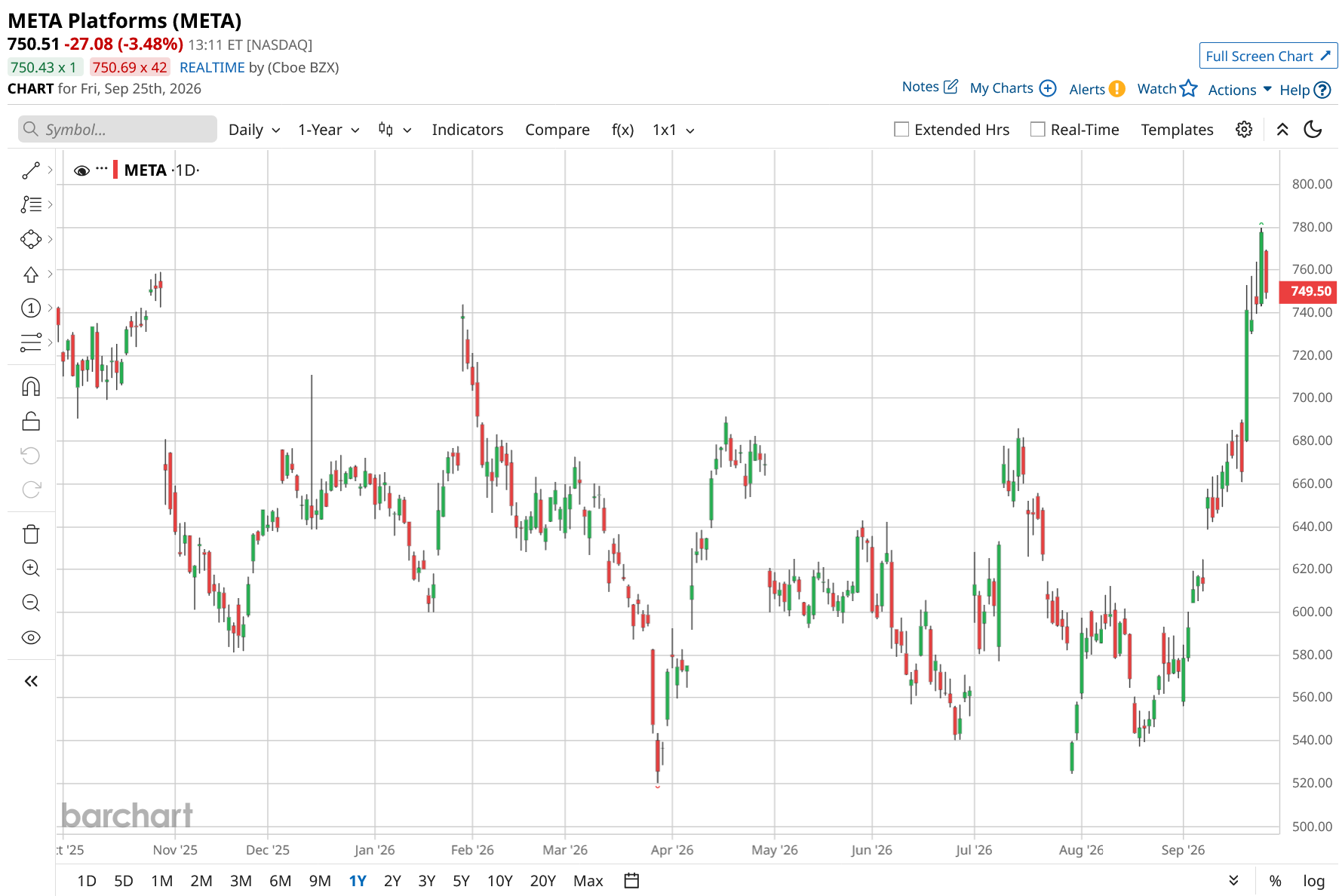
That enthusiasm, however, has also come with a richer valuation. META stock currently trades at 23.95 times forward-adjusted earnings and 7.46 times sales, with both multiples above their respective industry averages.
The company also returns capital to shareholders through its dividend, distributing $2.10 per share annually, resulting in a yield of 0.28%. Its next payment of $0.53 per share is scheduled for Monday, Sept. 28, for shareholders on record as of Monday, Sept. 21.
A Closer Look at Q2 Earnings
Meta reported its Q2 FY2026 results on July 29, showing a widening gap between strong top-line growth and the rising cost of its AI ambitions. Revenue reached $60.8 billion, up 28% year-over-year (YoY) and above analysts’ $60.2 billion expectation.
Advertising continued to drive growth, with Family of Apps advertising revenue increasing 27% YoY to $59.4 billion. The improvement was supported by a 14% increase in ad impressions and a 12% rise in the average price per ad, showing that the social media giant continued benefiting from stronger advertising volume as well as pricing.
The revenue momentum, however, did not carry through to the bottom line. EPS declined 13.4% to $6.18, falling short of the roughly $7.22 analysts had expected. The tech giant also reported $2.40 billion in legal-proceeding charges and $1.18 billion in severance expenses linked to its May 2026 headcount reduction.
The cost pressures extended beyond those charges. Total costs and expenses jumped 55.2% YoY to $42 billion. Meanwhile, CapEx climbed to $31.1 billion as the business accelerated spending on AI infrastructure. However, this spending surge sits at the heart of Meta’s growth.
The company is delivering strong revenue growth while committing increasingly large sums to AI infrastructure, with the expectation that those investments will generate stronger returns over time, and the near-term outlook reflects that balancing act.
For Q3 FY2026, Meta expects revenue between $61 billion and $64 billion. At the same time, the company has raised its 2026 capital-spending outlook to $130-145 billion, compared with its previous guidance range of $125-145 billion.
The social media giant has also increased the lower end of its full-year expense outlook to $165-169 billion to account for the legal charge. Despite the higher cost base, management continues to expect 2026 operating income to exceed 2025’s.
On the other hand, analysts project Q3 FY2026 EPS to decrease 11.9% YoY to $6.39, while FY2026 EPS is expected to decline 5.9% from the previous year to $27.93. By FY2027, however, EPS is projected to rebound 23% YoY to $34.36, offering a potentially brighter earnings trajectory as the company’s investments mature.
What Do Analysts Expect for META Stock?
Analyst sentiment toward META stock remains notably positive. Ivan Feinseth of Tigress Financial reiterated his “Buy” rating and raised his price target from $945 to $995. The revised target reflects his view of the company’s earnings momentum, competitive positioning, and improving growth outlook as potential drivers of further stock appreciation.
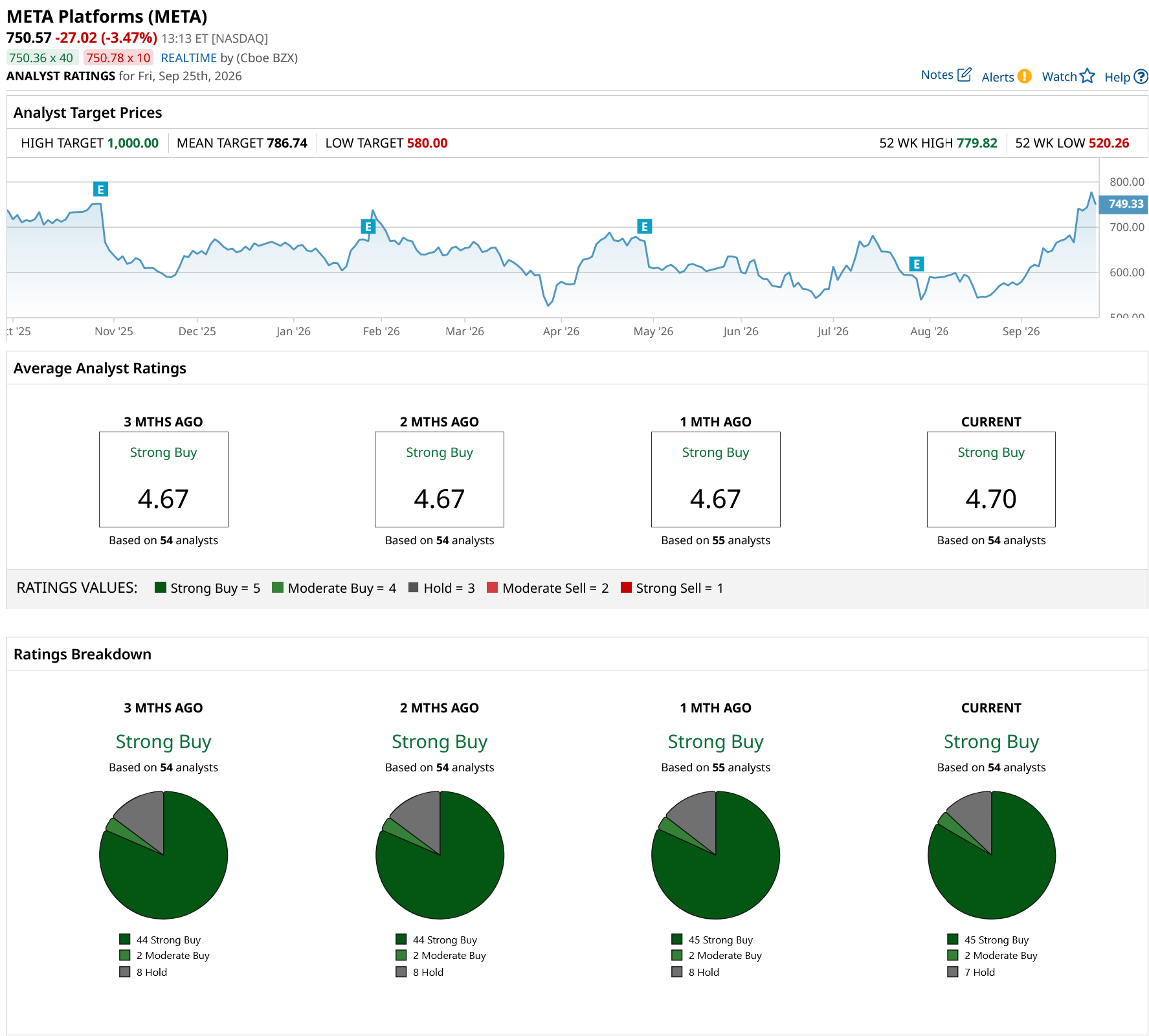
Wall Street’s overall rating is “Strong Buy.” Among the 54 analysts covering META, 45 rate the stock a “Strong Buy,” two assign a “Moderate Buy,” and seven recommend “Hold.”
Price targets likewise reflect expectations for further appreciation. The average price target stands at $786.74, representing a potential upside of 5%, while the Street-high target of $1,000 implies a 33% gain from current levels.
On the date of publication, Aanchal Sugandh did not have (either directly or indirectly) positions in any of the securities mentioned in this article. All information and data in this article is solely for informational purposes. For more information please view the Barchart Disclosure Policy here.