
Is Softer Guidance Altering The Investment Case For Campbell's Stock?
- Campbell's has completed two share repurchase programs totaling 6,283,901 shares for about US$286.5 million and extended its US$1.85b five year credit facility maturity to April 2031, while also introducing four new Campbell's Sauces flavors in the U.S. retail market.
- The combination of buyback completion, unchanged credit terms on a longer dated facility and new sauce launches indicates that management is balancing capital returns, funding flexibility and product development, even as recent earnings and guidance underwhelmed investors.
- We will now look at how Campbell's investment narrative could shift in light of softer guidance and a completed buyback.
Compare how Campbell's capital return moves stack up against other resilient packaged food and consumer staples stocks using our hand picked 30 resilient stocks with low risk scores for steadier balance sheets and cash flows.
Campbell's Investment Narrative Recap
For Campbell's to make sense in a portfolio, you need to believe the shelf stable pantry model can still generate reliable cash while the brand mix slowly adapts to changing tastes. Recent guidance softness and the 14.5% share price drop keep the near term focus on stabilising margins, managing tariff and input cost pressures, and keeping volume erosion in soups and snacks contained.
The biggest swing factor right now is execution on cost savings and mix, because earnings rely heavily on productivity gains rather than rapid revenue growth. The key risk sits on the other side of that same coin. If inflation, tariffs or weaker category demand drag margins below plan, the room to maintain a 5.04% dividend and fund reinvestment could become tighter.
The extension of Campbell's US$1.85b five year credit facility to April 2031 is the most relevant move here. Terms remain unchanged, which means the main outcome is additional time. That extra year helps keep liquidity predictable while the business works through softer guidance, tariff developments and the integration work behind its broader portfolio.
For you as a shareholder, the facility matters because debt is not well covered by operating cash flow today and funding is entirely from higher risk borrowing rather than deposits. Stable committed credit gives management more room to keep investing in marketing, product development and supply chain efficiency. Execution in those areas ties directly into whether earnings can move toward forecasts without placing additional strain on the balance sheet.
Campbell's narrative projects US$9.6b revenue and US$594.6 million earnings by 2029. This implies broadly flat revenue trends and an earnings increase of about US$196.6 million from US$398.0 million today.
Uncover how Campbell's fair value indicates a 5% potential upside to its current price before that discount to fundamentals narrows.
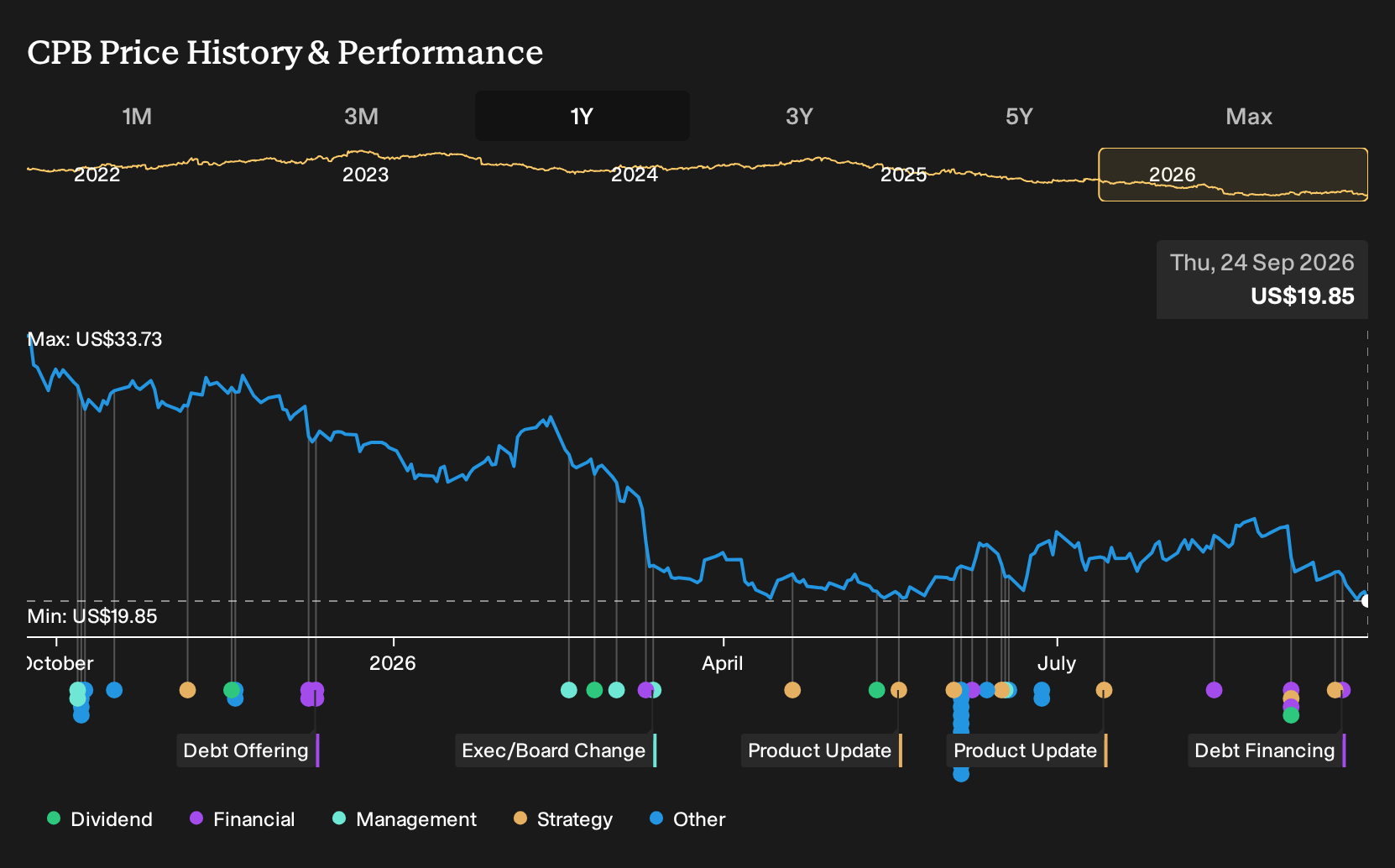
Exploring Other Perspectives
One alternate angle is tariff risk. The most bearish Campbell's analysts were already building in pressure from higher import costs, with 2029 earnings pencilled at about US$541.8 million on roughly US$9.7b revenue. That is well below the more optimistic US$793.7 million earnings view, so this completed buyback and credit extension could prompt sharper forecast revisions.
Explore 3 other Campbell's fair value estimates, including one that suggests as much as 29% downside from the current price!
The Verdict Is Yours
Disagree with existing narratives? Extraordinary investment returns rarely come from following the herd, so trust your own judgment.
- A great starting point for your Campbell's research is our analysis highlighting 2 key rewards and 4 important warning signs that could impact your investment decision.
- See our latest analysis for Campbell's. The report includes a comprehensive fundamental analysis summarized in a single visual, the Snowflake, making it easy to evaluate Campbell's overall financial health at a glance.
Looking For More Ideas Beyond Campbell's?
If the Campbell's story has sharpened your thinking on risk, income and balance sheets, it can help to compare it with other businesses that target different angles of return and resilience.
- For investors who want quality at a reasonable entry point, scan a curated pool of companies that combine fundamentals with appealing valuations using the 30 high quality undervalued stocks.
- If income stability matters most to you, focus on companies that pair higher yields with more durable payout profiles through the 8 dividend fortresses.
- When capital preservation and lower volatility are the priority, filter for companies with sturdier finances and more defensive profiles via the list of solid balance sheet and fundamentals (24 results).
This article by Simply Wall St is general in nature. We provide commentary based on historical data and analyst forecasts only using an unbiased methodology and our articles are not intended to be financial advice. It does not constitute a recommendation to buy or sell any stock, and does not take account of your objectives, or your financial situation. We aim to bring you long-term focused analysis driven by fundamental data. Note that our analysis may not factor in the latest price-sensitive company announcements or qualitative material. Simply Wall St has no position in any stocks mentioned.
Have feedback on this article? Concerned about the content? Get in touch with us directly. Alternatively, email editorial-team@simplywallst.com