
Top 3 Japanese Nuclear Stocks To Watch In September 2026
Government bond markets are in a new danger zone, with sharp moves in long-term yields pushing up financing costs for capital intensive projects worldwide. For Japanese nuclear energy stocks, that backdrop puts a spotlight on companies tied to reliable baseload power and long-lived assets. This article highlights three nuclear focused Japanese stocks from our screener that investors can study if they want targeted exposure to this theme.
The three nuclear energy stocks covered below are only a starting sample, and the full screen surfaced 34 more companies with equally focused stories around uranium supply, fuel cycle services, and reactor exposure that are not listed here.
To identify and analyze the highest conviction nuclear opportunities built around baseload power and long life assets, go straight to the Nuclear Energy Stocks screener.
Hitachi (TSE:6501)
Overview: Hitachi is a diversified industrial and technology group whose Energy segment designs, builds, and services nuclear power plants and related control-and-safety systems.
Operations: Hitachi generates about ¥3.5t from Energy, ¥3.4t from Connective Industries, ¥3.0t from Digital Systems & Services, and ¥1.4t from Mobility, with Japan its largest market.
Market Cap: ¥24.8t
Hitachi gives you nuclear exposure through its energy infrastructure and plant systems rather than as a pure play. This matters if you want nuclear in the context of a much broader industrial portfolio.
"Persistent, robust demand for power grid upgrades and renewable energy integration, notably in Europe and North America, is driving substantial growth in Hitachi's Energy sector; continued investment in electrification and grid modernization is expected to support revenue and margin expansion in upcoming years."
The real swing factor is how one pressure on long-duration energy projects ultimately feeds through to Hitachi's pricing power and profitability.
That pricing power question is exactly what the full narrative for Hitachi unpacks, showing where electrification tailwinds might be masking or amplifying future returns.

ITOCHU (TSE:8001)
Overview: ITOCHU is a global trading and services group that links its broad commodities portfolio to nuclear energy through nuclear fuel supply chains.
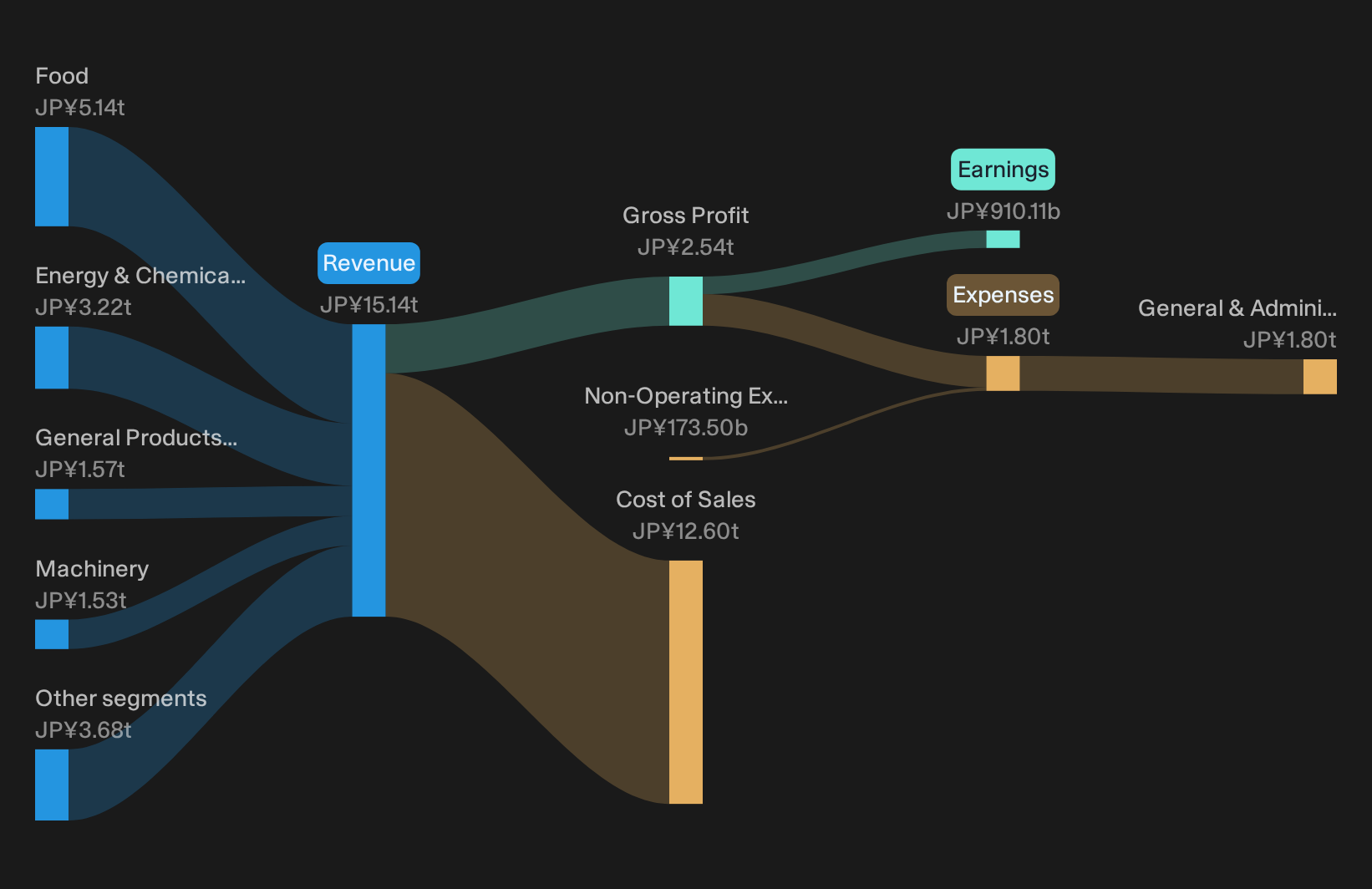
Operations: ITOCHU generates ¥5.1t from Food, ¥3.2t from Energy & Chemicals, ¥1.5t from Machinery, and ¥1.3t from Metals & Minerals, with additional contributions from other segments.
Market Cap: ¥15.3t
ITOCHU provides exposure to nuclear energy from the fuel side by tying its broad trading reach directly into reactor supply and long term power contracts.
"Continued investment in sustainability, such as decarbonization and circular economy initiatives, is likely to generate new revenue streams as global demand for green energy and sustainable products increases."
The key consideration for ITOCHU is how changes in its fuel mix and commodity cycle may affect the stability of its profits over time.
That shifting mix is exactly what the full narrative for ITOCHU pulls apart, showing where accelerating decarbonization efforts could decouple ITOCHU's earnings profile from the wider commodity cycle.
Mitsubishi Heavy Industries (TSE:7011)
Overview: Mitsubishi Heavy Industries develops and sells heavy machinery worldwide, with nuclear power generation systems and fuel-cycle services as a key energy pillar.
Operations: Mitsubishi Heavy Industries generates about ¥2.2t from Energy Systems, ¥1.4t from Aircraft, Defense & Space, and ¥0.9t from Plants & Infrastructure Systems, with smaller contributions from other lines.
Market Cap: ¥13.1t
Mitsubishi Heavy Industries matters for this nuclear energy screen because its reactor designs, fuel cycle technologies, and long term plant services plug directly into how utilities plan reliable, low carbon baseload power for decades.
"MHI's early-mover advantage and leadership in next-generation decarbonization technologies, especially in hydrogen, ammonia, and carbon capture, position the company to capitalize on global climate policy acceleration, creating potential new high-margin revenue streams and differentiating it from peers as governments and industry scale investments."
The real swing factor is how one unseen pressure on funding these capital heavy projects ultimately filters into future pricing power and margin resilience.
That funding pressure is exactly what the full narrative for Mitsubishi Heavy Industries unpacks, highlighting where accelerating decarbonization demand could outweigh financing risks and reshape Mitsubishi Heavy Industries' earnings profile.

Seeking Alternatives Beyond Nuclear Ideas
Fresh themes can move quickly. Breakout sectors may gain momentum, tired stories can fade, and the most attractive entry points are often identified by early readers before the broader crowd arrives. Consider the ideas below.
- Target steadier compounding potential by reviewing a curated 14 dividend fortresses focused on companies that aim to sustain income streams while volatility trends lower in the background.
- Explore structural tech momentum by scanning 87 AI infrastructure stocks featuring businesses that supply the picks and shovels for AI build outs while that demand may still be under the radar.
- Evaluate potential materials tailwinds by assessing 17 top copper producer stocks with miners and producers connected to electrification demand before sentiment changes and some entry points become less accessible.
This article by Simply Wall St is general in nature. We provide commentary based on historical data and analyst forecasts only using an unbiased methodology and our articles are not intended to be financial advice. It does not constitute a recommendation to buy or sell any stock, and does not take account of your objectives, or your financial situation. We aim to bring you long-term focused analysis driven by fundamental data. Note that our analysis may not factor in the latest price-sensitive company announcements or qualitative material. Simply Wall St has no position in any stocks mentioned.
Have feedback on this article? Concerned about the content? Get in touch with us directly. Alternatively, email editorial-team@simplywallst.com