
Balancing without new taxes
WITH Budget 2027 less than two weeks away from being presented, it is time to preview government finances amid external uncertainties from elevated crude oil prices and domestic challenges in ensuring it is a people-friendly budget.
In Budget 2026, the government tabled a RM422.6bil budget, comprising RM343.1bil in operating expenditure (opex) and the balance RM79.5bil as net development expenditure (DE).
In terms of sources of income, the government projected total revenue of RM343.1bil, of which 78.8% came from taxes (both direct and indirect), and the balance comprised non-tax revenue.
The government also projected a budget deficit of RM74.6bil, or 3.5% of gross domestic product (GDP), for 2026.
As of the first half of financial year 2026 (1H26), based on data from Bank Negara Malaysia (BNM), the government’s revenue and opex stood at RM165.4bil and RM177.8bil, respectively, while net DE amounted to RM32.5bil, resulting in an overall deficit of RM44.9bil.
Compared with 1H25, overall revenue rose 12.1% year-on-year (y-o-y), while opex increased by 14.5% y-o-y.
In 1H26, the government’s net DE fell by RM0.3bil to RM325bil and the budget deficit widened by 10.9% y-o-y to RM44.9bil, up from RM40.5bil in 1H25.
The nation’s overall budget deficit stood at about 4.2% in 1H26, well below the targeted 3.5% under Budget 2026.
Due to the Iran war, which has disrupted oil supplies and raised global prices, the government’s subsidies and social assistance ballooned to RM31.5bil in 1H26, with some two-thirds incurred in the second quarter of financial year 2026 (2Q26) when the impact of higher oil prices was fully felt.
Given elevated global oil prices and higher revenue from oil and gas-related activities, the government’s revenue and expenditure for 2026 are expected to increase significantly to RM365bil and RM363bil, respectively.
The revenue increase will likely come from higher dividends from Petroliam Nasional Bhd or PETRONAS and increased collection from petroleum-related taxes, which should offset the greater fuel subsidy bill which is expected to hit RM40bil this year from the original forecast of RM15bil.
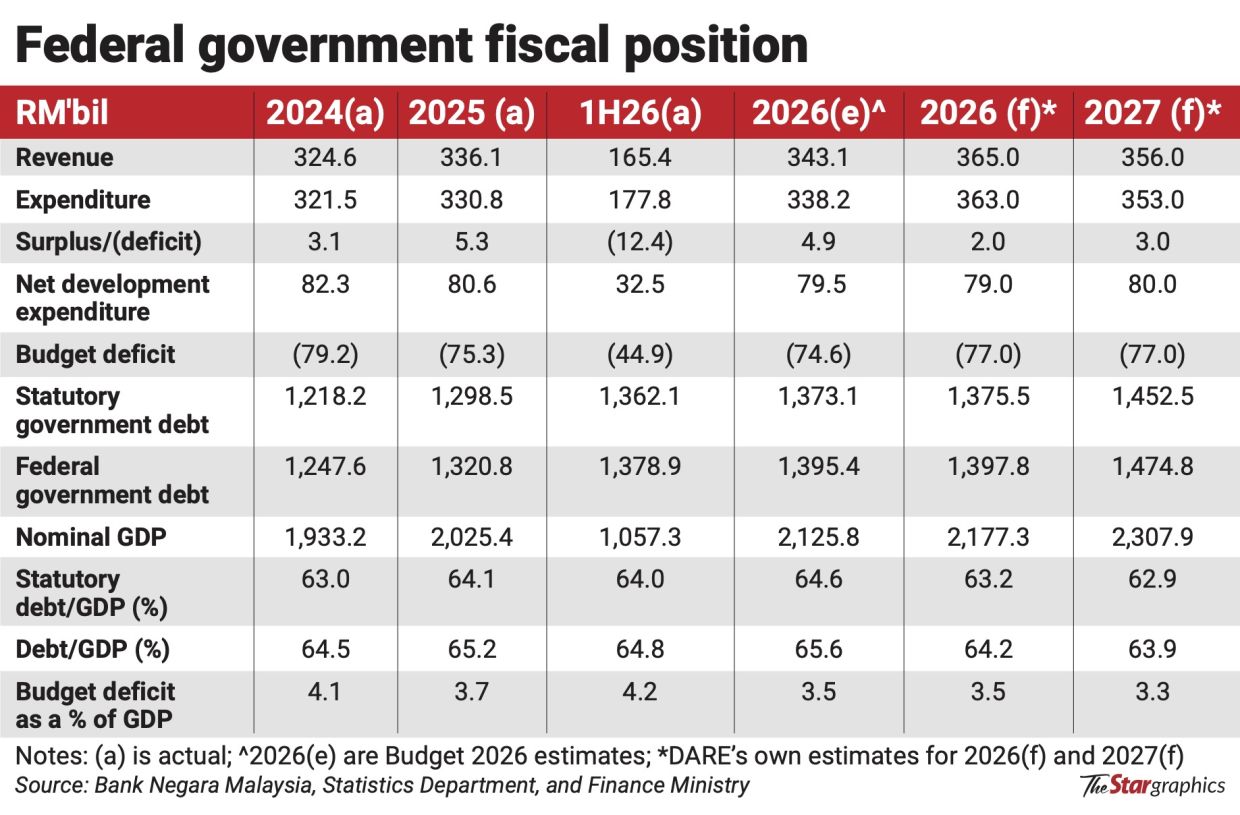
Net DE is expected to fall marginally to RM79bil this year and increase to RM80bil in 2027.
With GDP hitting a high note of 6% in 2Q26, we will likely see slower growth momentum in 2H26, likely coming in at about 5%, bringing the full-year 2026 GDP to 5.3%, which is still above BNM’s guided GDP growth of between 4% and 5%.
Growth in 2027 will be slower than in 2026, due to the negative base effect from strong net export performance this year. GDP growth is now envisaged at between 4.5% and 5% in 2027.
Despite the higher subsidy bill, the government has taken measures to mitigate the impact of increasing fuel subsidies by reducing expenditure where it could.
As a result, the government is likely to meet the 3.5% budget deficit target this year.
For 2027, the government will remain committed to reducing its budget deficit and, based on our estimates, a 3.3% deficit target is achievable, as shown in the accompanying table.
Manageable debt
Malaysia’s debt-to-GDP ratio fell marginally to 64.8% in 1H26 and is expected to moderate to 64.2% by year-end, due to faster nominal GDP growth.
In 2027, for similar reasons, although the government’s debt level is expected to rise to RM1.47 trillion, the ratio will likely remain below the statutory limit, coming at 63.9% of GDP.
Despite holding a strong majority in Parliament, Barisan Nasional’s recent political mileage from two state elections, in collaboration with Perikatan Nasional, has added further pressure on the unity government’s ability to govern and continue its reform agenda.
Given the higher cost of living, elevated oil prices, and the impact of higher and wider reach coming from sales and service tax (SST), Budget 2027 is not expected to see the government introducing any new taxes.
However, the government may impose higher tax rates on certain industries, especially those in the sin sectors.
That said, as Budget 2027 priorities are anchored on raising the ceiling for national growth, raising the floor for the people’s living standards and driving governance reform, the government is likely to announce a new minimum wage of at least RM1,900 per month, effective Jan 1, 2027.
This follows previous RM200 increases in the minimum wage, although it remains short of a real living wage of RM3,100. The government will also likely raise its Sumbangan Tunai Rahmah and Sumbangan Asas Rahmah cash handouts by another RM2.5bil, bringing the total to RM17.5bil in 2027.
An election budget?
Budget 2027 is seen as the last budget before the 16th General Election (GE16) is called, and the government is unlikely to be unfriendly to both businesses and the rakyat with higher or new taxes.
This is despite the nation’s tax revenue accounting for only 12% to 13% of GDP.
While debates over reintroducing the foods and services tax (GST) rage on, the government will continue to rely on SST for now, with some tweaks.
The bottom line is that, whether it is called GST, SST, or any other name, they are all regressive as they will always hit the bottom-income earners the hardest.
Hence, a better approach is a simpler system in which only consumers pay a final tax.
For businesses, a simpler tax system would be to do away with GST refunds, and businesses should remit only the net GST payable, removing the short-term cash mismatch.
Budget 2027 is likely an election budget and a budget for all – businesses, households, and individuals.
Despite the lack of new taxes, the budget will be pragmatic, forward-looking and realistic, balancing the nation’s needs while remaining people-friendly.