
3 UK Stocks Riding The Shift From Auto Supply Chains To Defence
The West Midlands auto belt is under pressure, yet political backing for Jaguar Land Rover and fresh talk of “Made in Europe” rules are quietly opening doors for UK Aerospace & Defence Contractors Benefiting from Automotive Supply-Chain Diversification. Supply firms are already exploring new end markets. If investors overlook this trend, they could miss where capital, skills and future orders migrate next. This article examines three stocks most exposed to that shift.
The three stocks below are a starting sample of UK Aerospace & Defence Contractors Benefiting from Automotive Supply-Chain Diversification. The full screen surfaced 11 more listed businesses with equally compelling narratives that are not covered here. To identify and analyze the highest-conviction plays, go straight to the UK Aerospace & Defence Contractors Benefiting from Automotive Supply-Chain Diversification screener.
Morgan Advanced Materials (LSE:MGAM)
Morgan Advanced Materials looks well suited to this aerospace and defence screen, because its high-spec carbon and ceramic components sit close to where West Midlands auto suppliers may want to redeploy precision skills toward tougher thermal and performance requirements.
Morgan Advanced Materials manufactures advanced carbon and ceramic components for sectors like aerospace, defence and clean transportation, with revenue spread across Thermal Products of £351 million, Performance Carbon of £312 million and Technical Ceramics of £353 million. The company has a market value of about £716 million.
"The company's nearly completed capex programme to expand semiconductor production capacity may position it to participate in double-digit market growth once inventory destocking is resolved and electrification/EV trends accelerate."
What happens to margins if a single pressure point in its portfolio review breaks in the right direction will be crucial for investors.
If that margin inflection point matters to you, read the full narrative for Morgan Advanced Materials to see how semiconductor capex, portfolio moves and defence demand could be quietly accelerating.

Bodycote (LSE:BOY)
Bodycote is effectively the heat-treating backroom for aerospace and defence metalwork, which is exactly where displaced West Midlands auto capacity may look as it shifts toward higher-spec components that need carefully controlled thermal processing.
Bodycote provides heat treatment and thermal processing services across automotive, aerospace, defence, energy and industrial markets. It generates £478 million from Precision Heat Treatment, £229 million from Specialist Technologies and £32 million from Non-Core activities, and carries a market value of about £1.60b.
"The accelerating localization of manufacturing supply chains and reshoring in key Western economies is likely to significantly reduce the international flow of manufactured goods, undermining Bodycote's cross-border customer base and limiting opportunities for revenue growth in regions where it is heavily invested, especially as the company expands in Asia and Eastern Europe."
What happens if one unseen shift in where complex parts are processed reshapes both Bodycote’s pricing power and long-term margin profile?
That inflection risk is exactly why reading the full narrative for Bodycote can help you see whether Bodycote is quietly positioned for reshoring-driven upside.
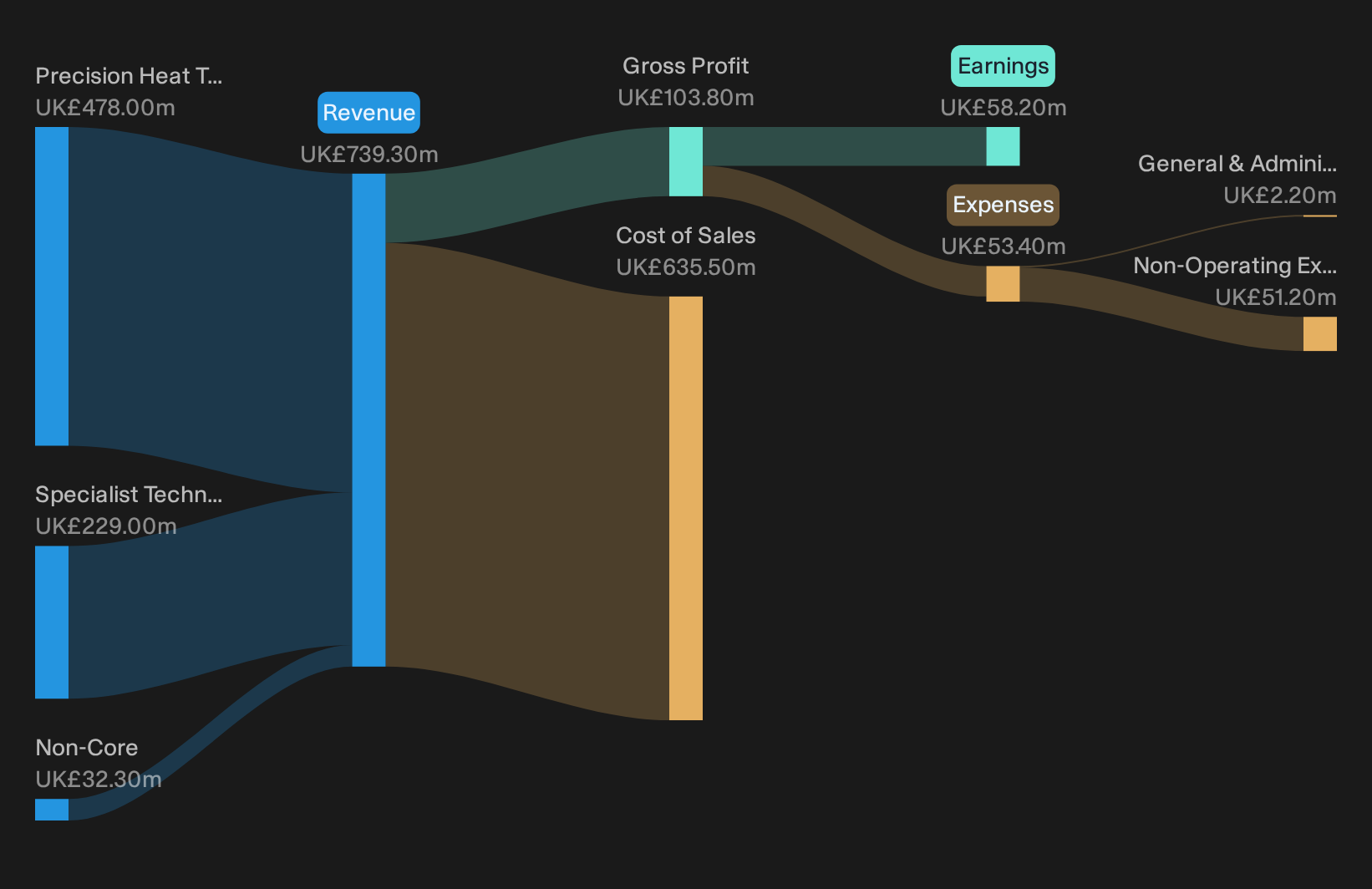
RS Group (LSE:RS1)
RS Group is the plumbing behind industrial production, and as West Midlands suppliers edge toward aerospace and defence work, the distributor’s broad maintenance and engineering toolkit can quietly become part of how those factories reconfigure lines, upgrade automation and keep equipment running.
RS Group supplies a wide range of maintenance, repair and operations products and services, generating £414.9 million from its RS PRO brand and £2.47b from other product and service solutions, and carries a market value of about £3.48b.
"Global acceleration in industrial automation and digital transformation may affect demand for RS Group's broad and technical product range and influence the company’s revenue profile as cyclical conditions change."
What happens if one quiet shift in how customers source critical components tilts both pricing power and margin potential in RS Group’s favour.
That quiet tilt in pricing power is exactly what the full narrative for RS Group unpacks, revealing how RS Group could turn automation demand into accelerating cash generation.

Curious About Alternative Opportunities?
Fresh ideas move first. Screen for breakout momentum and under the radar stocks before the crowd catches them, while the data still matters and price dislocations linger. Act now.
- Track down cash generative small caps before they start flying by scanning the curated list of 37 profitable AI stocks that aren't just burning cash that are already past the early burn phase.
- Spot income workhorses investors often miss by reviewing the hand picked 1 dividend fortresses built to highlight yield, balance sheet strength and dependable cash coverage.
- Zero in on companies where resilience meets opportunity by scanning the curated 4 resilient stocks with low risk scores and see which tickers still look overlooked while risk remains contained.
This article by Simply Wall St is general in nature. We provide commentary based on historical data and analyst forecasts only using an unbiased methodology and our articles are not intended to be financial advice. It does not constitute a recommendation to buy or sell any stock, and does not take account of your objectives, or your financial situation. We aim to bring you long-term focused analysis driven by fundamental data. Note that our analysis may not factor in the latest price-sensitive company announcements or qualitative material. Simply Wall St has no position in any stocks mentioned.
Have feedback on this article? Concerned about the content? Get in touch with us directly. Alternatively, email editorial-team@simplywallst.com