
Labor Deal Could Be A Game Changer For Metro (TSX:MRU)
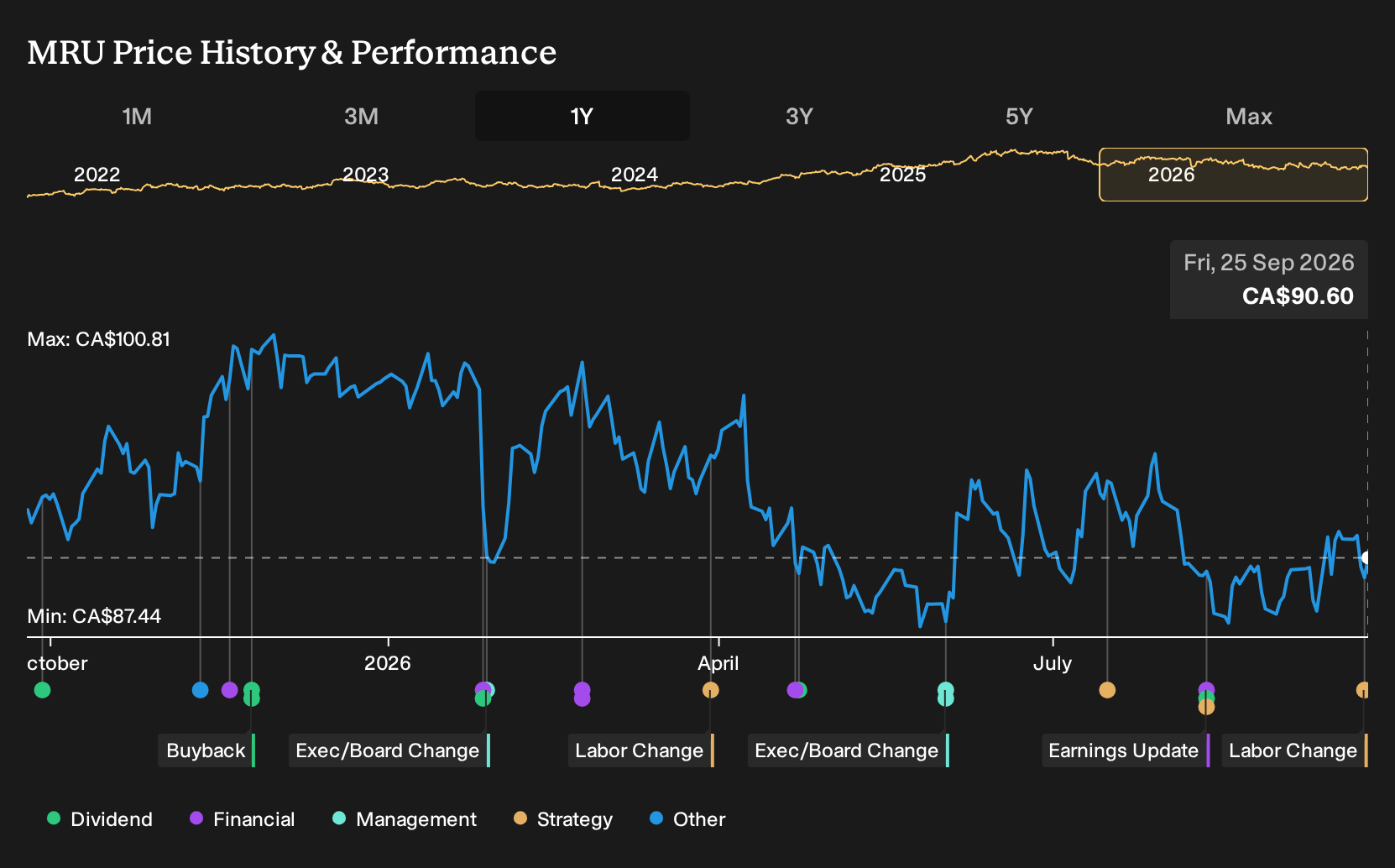
- Metro reported that unionized employees at its Laval Produce distribution centre, transportation operations, and head office have ratified a five and a half year collective agreement, formally ending the labour dispute that started on 30 March 2026.
- The extended agreement gives Metro clearer visibility on labour costs and operating continuity across a key distribution hub that supports its food retail and pharmacy network.
- We will now look at how Metro's investment narrative might be affected by this long term labour agreement at its Laval distribution centre.
Scan how Metro's labour resolution compares with other retailers by reviewing union exposed operators in our 8 resilient stocks with low risk scores that aim to keep operations resilient even when negotiations heat up.
Metro Investment Narrative Recap
To own Metro, you need to believe the grocery and pharmacy network can keep steady customer traffic while managing cost pressure from labour, suppliers and higher operating expenses. The Laval agreement reduces near term disruption risk at a key produce hub, which supports day to day availability and helps protect Metro’s broader store modernization and automation efforts.
The biggest short term swing factor remains how well Metro holds margins against discount competitors and inflation driven vendor pricing. The extended contract adds visibility on labour costs, although any wage step ups could limit room to offset sharper food price competition or higher SG&A tied to e commerce and new distribution assets.
The fresh labour deal fits alongside Metro’s ongoing automation and distribution investments, which analysts have linked to margin efficiency as more volumes move through upgraded centres. Reliable access to produce from Laval should help those supply chain projects run closer to plan, rather than being constantly rerouted around a dispute.
There were no other fresh announcements tied to this contract. The relevant comparison is with the broader narrative that hinges on stable earnings growth of about 6.6% a year and revenue growth of roughly 3.7% a year. For that story to stay intact, you want to see Metro convert this labour stability into consistent execution on private label, pharmacy and e commerce initiatives without a further step up in operating costs.
What The New Laval Agreement Means For Metro's Forecasts
Metro's long term labour peace in Laval now sits alongside a forecast that revenues reach CA$24.6b and earnings hit CA$1.1b by 2029. Analysts are assuming revenue growth of 3.5% a year and expect earnings to rise by about CA$116m from CA$983.7m today to that 2029 consensus level.
Uncover why Metro's fair value indicates an 11% potential upside to its current price that may not last much longer.
Exploring Other Perspectives
Two fair value estimates from the Simply Wall St Community cluster between CA$100.45 and CA$133.96, so private investors already span a wide pricing band for Metro. When you factor in labour peace at Laval and weigh it against risks like discount competition and rising distribution costs, you can quickly see how sharply opinions can differ.
Explore another Metro fair value estimate, including one that suggests potential upside of up to 48% from the current price.
The Verdict Is Yours
Disagree with existing narratives? Extraordinary investment outcomes rarely come from following the herd, so trust your own process.
- A great starting point for your Metro research is our analysis highlighting 3 key rewards and 1 important warning sign that could impact your investment decision.
- See our latest analysis for Metro. The report includes a comprehensive fundamental analysis summarized in a single visual, the Snowflake, making it easy to evaluate Metro's overall financial health at a glance.
Looking For More Investment Ideas Beyond Metro?
Once you have a handle on Metro, it can help to widen the lens and compare it with other opportunities that share similar qualities or offer something very different for your portfolio.
- If you want potential mispricing plus balance sheet strength, scan our 5 high quality undervalued stocks that combine solid fundamentals with room for the market to reassess them.
- If income is a priority, review our 1 dividend fortresses that aim to pair yields above 5% with a focus on durability.
- If you prefer to limit downside risk first, start with our list of solid balance sheet and fundamentals (7 results) that many investors use as a hunting ground for resilient holdings.
This article by Simply Wall St is general in nature. We provide commentary based on historical data and analyst forecasts only using an unbiased methodology and our articles are not intended to be financial advice. It does not constitute a recommendation to buy or sell any stock, and does not take account of your objectives, or your financial situation. We aim to bring you long-term focused analysis driven by fundamental data. Note that our analysis may not factor in the latest price-sensitive company announcements or qualitative material. Simply Wall St has no position in any stocks mentioned.
Have feedback on this article? Concerned about the content? Get in touch with us directly. Alternatively, email editorial-team@simplywallst.com