
How Secure Delivery Launch At FedEx (FDX) Has Changed Its Investment Story
- FedEx has launched FedEx Authenticated Delivery in the U.S. and Canada, using secure QR code verification to release eligible high value and sensitive shipments only to authorized recipients as part of its broader Proof of Delivery portfolio.
- The new QR code based authentication tightens control over misdelivery, fraud and theft risk, which directly targets premium verticals such as healthcare, aerospace, electronics and luxury goods where shipment security is a core requirement.
- We will look at how FedEx's investment narrative around technology and higher value freight relates to this new authenticated delivery layer.
Scan FedEx's push into secure, high value logistics against other potential opportunities by weighing it up alongside list of solid balance sheet and fundamentals (24 results).
FedEx Investment Narrative Recap
To own FedEx, you need to believe the company can keep turning its cost work and technology upgrades into steadier earnings, even while overall shipping demand looks fairly modest. In the short term, the key factor remains execution on DRIVE and Network 2.0, where progress on margins and free cash flow is already a clear focus for management.
The biggest near term risk still centers on mix and pricing. Any renewed softness in higher margin B2B or premium sectors, or tougher international pricing, could blunt that margin story. FedEx Authenticated Delivery helps, but appears incremental rather than a material swing factor for this core risk and catalyst pair.
The recent Appeal of Conscience Award for CEO Raj Subramaniam does not change the numbers, but it does reflect how FedEx positions its leadership around global responsibility and service quality. For a logistics group that relies on trust sensitive sectors such as healthcare and aerospace, that reputational layer can matter at the margin.
For investors, the operational question is whether this leadership profile supports consistent follow through on complex programs such as DRIVE, data and AI tools, and security heavy services including Authenticated Delivery. Execution across those areas ties directly into the key catalysts analysts focus on, including targeted cost savings, yield on premium freight, and the free cash flow goals laid out through 2029.
How FedEx Authenticated Delivery Fits Into The Consensus Story
FedEx's authenticated delivery push sits alongside a relatively measured analyst outlook, where the focus is less on rapid expansion and more on steady improvement in earnings quality. Analysts are working with a 1.0% annual revenue growth rate over the next three years, so security heavy services like QR code verification are usually treated as margin tools rather than big volume drivers. For you, the practical question is whether this kind of service helps FedEx attract and retain higher value customers in healthcare, electronics and aerospace who care more about shipment control than about shaving a few cents off price.
Current consensus expects earnings to move from US$4.4b today to US$5.6b by 2029, which is an increase of about US$1.2b. That shift relies on profit margins drifting from 4.7% to 5.7%, helped by DRIVE, Network 2.0 and a larger share of premium freight. Authenticated Delivery fits into that story by trying to make each high value shipment more defensible against fraud and theft, which can help support yield and keep service levels acceptable for sensitive verticals.
Security focused offerings also speak to how analysts think about FedEx's use of data and technology. QR based authentication, when layered onto routing algorithms, computer vision tools and tighter delivery windows, turns each package scan into another data point that can reduce disputes, claims and manual handling. That type of incremental operational tweak does not change the headline growth rate, but it can support the path to higher earnings if it cuts error costs and supports pricing on specialist freight.
For readers comparing FedEx with other logistics stocks, the implied 2029 P/E multiple of 19.7x on those US$5.6b earnings is an important marker. It sits above the current US logistics sector P/E of 18.8x, which means the analyst narrative effectively assumes FedEx earns a modest premium for its network, cost work and service mix. Secure delivery of sensitive shipments is part of why some investors may feel comfortable with that premium, especially when healthcare, aerospace and luxury goods customers sometimes prioritise reliability and traceability over raw cost per parcel.
FedEx's narrative projects US$97.7b revenue and US$5.6b earnings by 2029. This rests on 1.0% yearly revenue growth and an earnings increase of about US$1.2b from US$4.4b today.
Uncover why FedEx's fair value indicates a 24% potential upside to its current price before that discount starts to close.
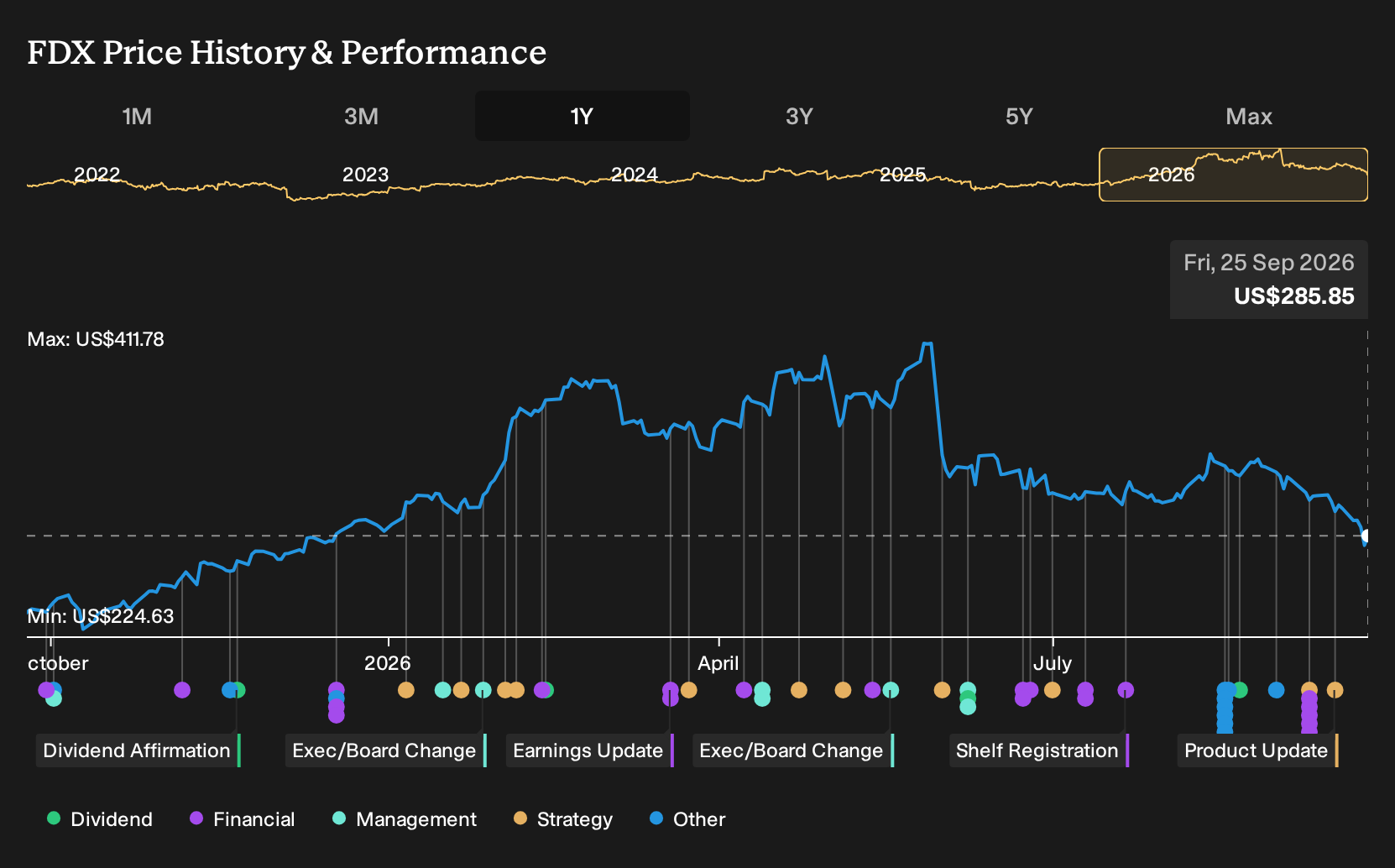
Exploring Other Perspectives
Some of the most bullish analysts frame FedEx Authenticated Delivery as a possible revenue catalyst, not just a margin tool. Before this launch, the optimistic narrative already assumed revenue reaching about US$109.5b and earnings of US$7.0b by 2029. You can compare that upbeat view with more cautious forecasts and decide which story feels closer to your own expectations.
Explore 3 other FedEx fair value estimates, including one that suggests as much as 82% upside from the current price!
Decide For Yourself
Disagree with existing narratives? Extraordinary investment returns rarely come from following the herd, so consider your own analysis and judgment.
- A great starting point for your FedEx research is our analysis highlighting 3 key rewards and 1 important warning sign that could impact your investment decision.
- See our latest analysis for FedEx. The report includes a comprehensive fundamental analysis summarized in a single visual, the Snowflake, making it easy to evaluate FedEx's overall financial health at a glance.
Looking For More Investment Ideas Beyond FedEx?
If the FedEx story has sharpened your thinking about risk, cash flow and earnings quality, it can help to set that against a wider watchlist of potential opportunities using the Simply Wall St Screener.
- For investors who care most about financial resilience, start with a 30 resilient stocks with low risk scores that may handle tough conditions in a more predictable way.
- If value is your priority, compare FedEx with a 32 high quality undervalued stocks that combines solid fundamentals with what may be more appealing pricing.
- Income focused readers can line FedEx up alongside a 8 dividend fortresses that can potentially support regular cash returns while still offering room for business execution to matter.
This article by Simply Wall St is general in nature. We provide commentary based on historical data and analyst forecasts only using an unbiased methodology and our articles are not intended to be financial advice. It does not constitute a recommendation to buy or sell any stock, and does not take account of your objectives, or your financial situation. We aim to bring you long-term focused analysis driven by fundamental data. Note that our analysis may not factor in the latest price-sensitive company announcements or qualitative material. Simply Wall St has no position in any stocks mentioned.
Have feedback on this article? Concerned about the content? Get in touch with us directly. Alternatively, email editorial-team@simplywallst.com