
Why ‘All-Time High’ Is the Most Misleading Phrase in Investing and How You Can Avoid Getting Trapped in the Woods with QQQ
The Invesco QQQ Trust (QQQ) just hit a “record high.” Some might also call it an “all-time high.” It has never been higher. And while QQQ has undoubtedly been one of the best investments over time, this phrasing strikes me as hype, incomplete information, and encouraging excessive speculation.
As a reminder, I do not really care which way the stock market travels. I’m a risk manager and hedged investor. That means while the investment management industry tends to spend a lot of time capturing the moment, I take a different approach. I am simply trying to take it all in and determine the answer to this simple question:
Is the next major move for the broad market UP or DOWN?
Note that I said “major move. For me, that could mean 5%-20%, depending on the security. QQQ is more of a “next 5%,” while the ProShares UltraPro QQQ ETF (TQQQ), which is a 3x leveraged ETF tracking QQQ, is at least twice that.
This, in turn, determines position sizing for me. I’m a portfolio manager, not a stock-guesser. And that’s why this all-time high hype, which is quite prevalent now, is in danger of leading traders and investors to take on a lot more risk than they should. Let’s explore this with some timely examples.
QQQ hit an all-time high recently. It’s true, no denying that. But here’s my question: is that good?
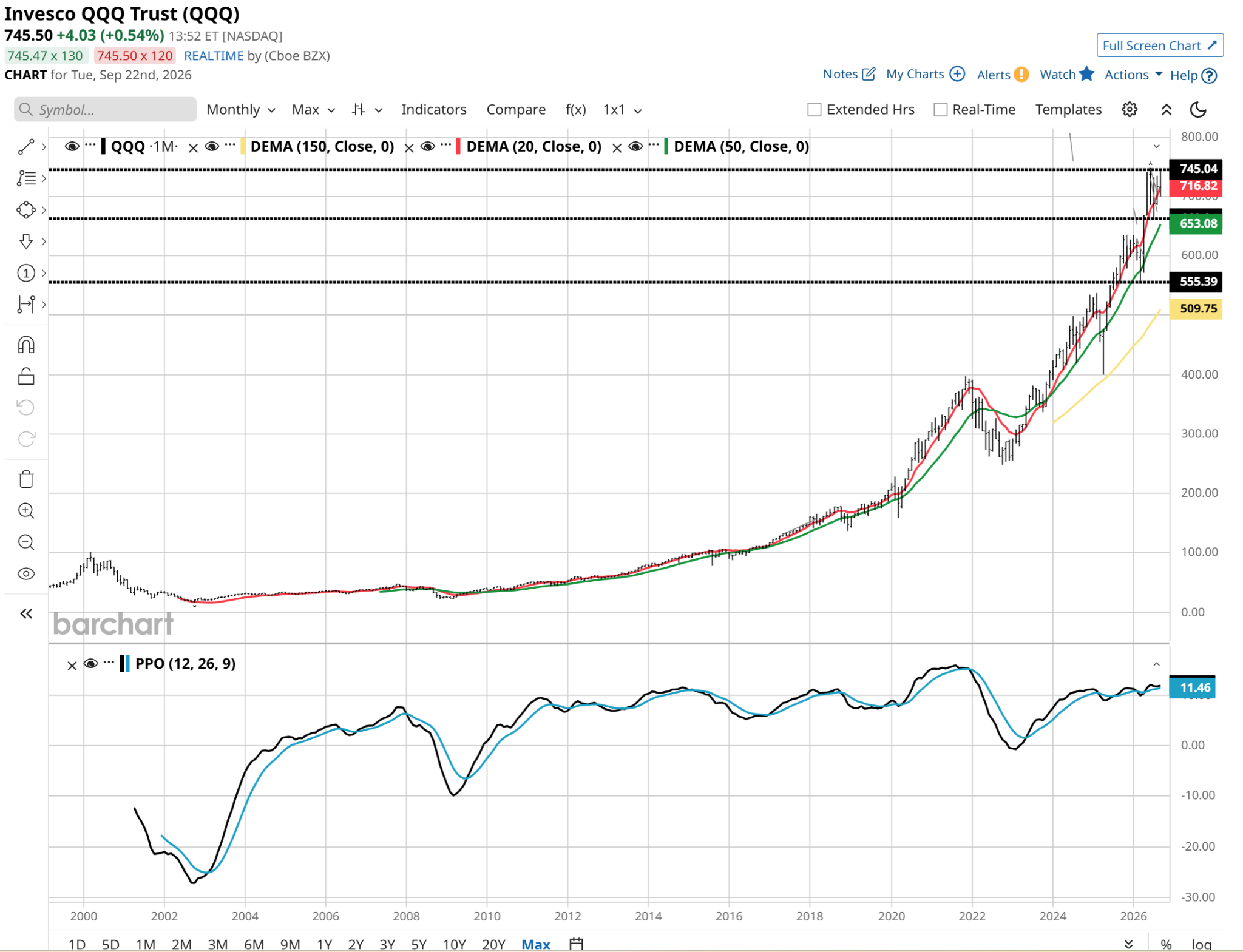
Well, it is better than being below an all-time high, if you own QQQ. However, here’s another, related fact about this popular ETF. It has gone net-nowhere since the start of June. Roughly from $746 to $746. Was that in a flat line? No, it took a trip through $662 to get there. An 11% decline, followed by a 12% rally. That’s the math of investment loss at work.
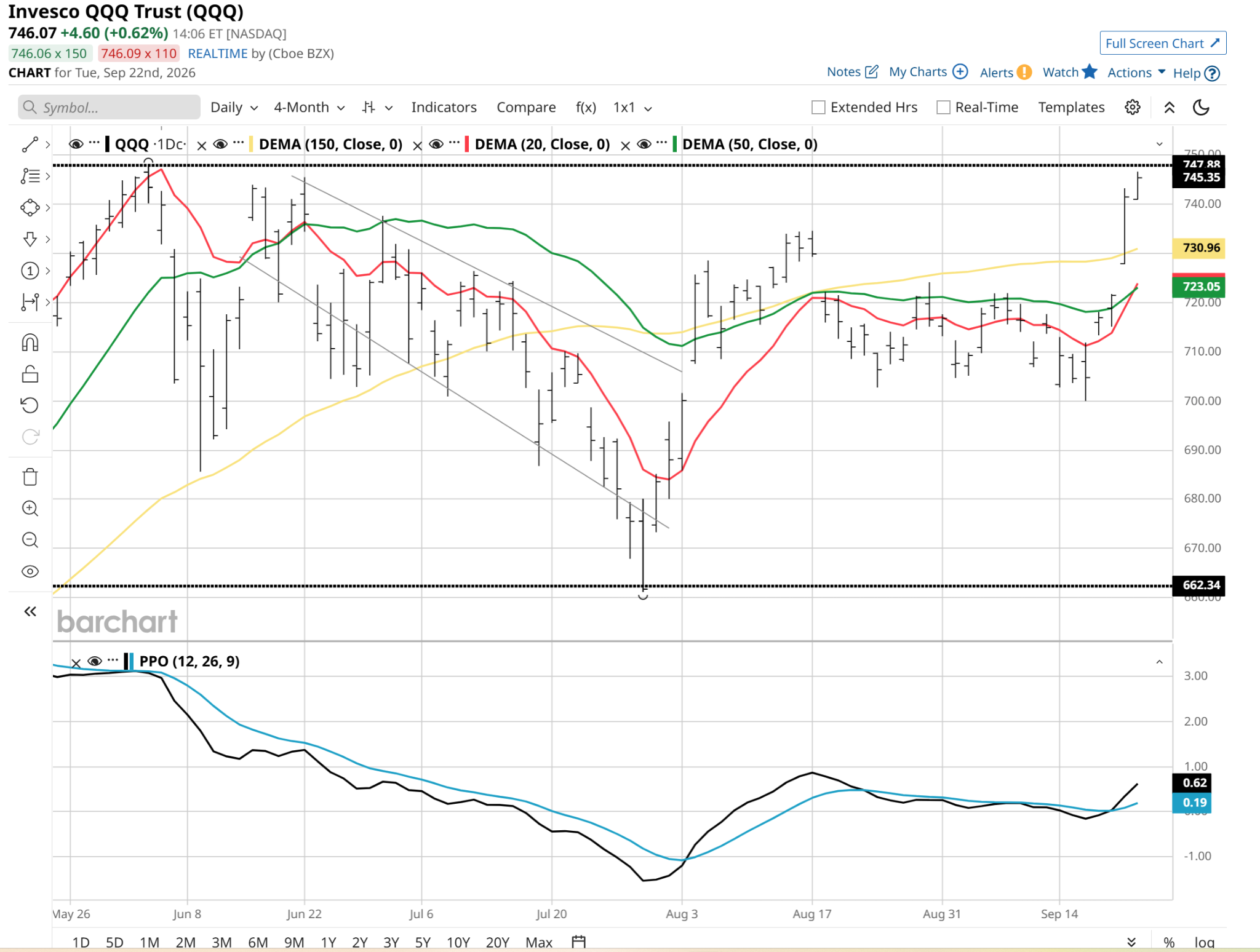
As we see below, all-time high means nothing without context. I’ve highlighted in yellow a recent two-year period that ended with QQQ at an all-time high in early 2024. How well did it do to get there? It generated zero return through that time… from late 2021! Like I said, context matters.
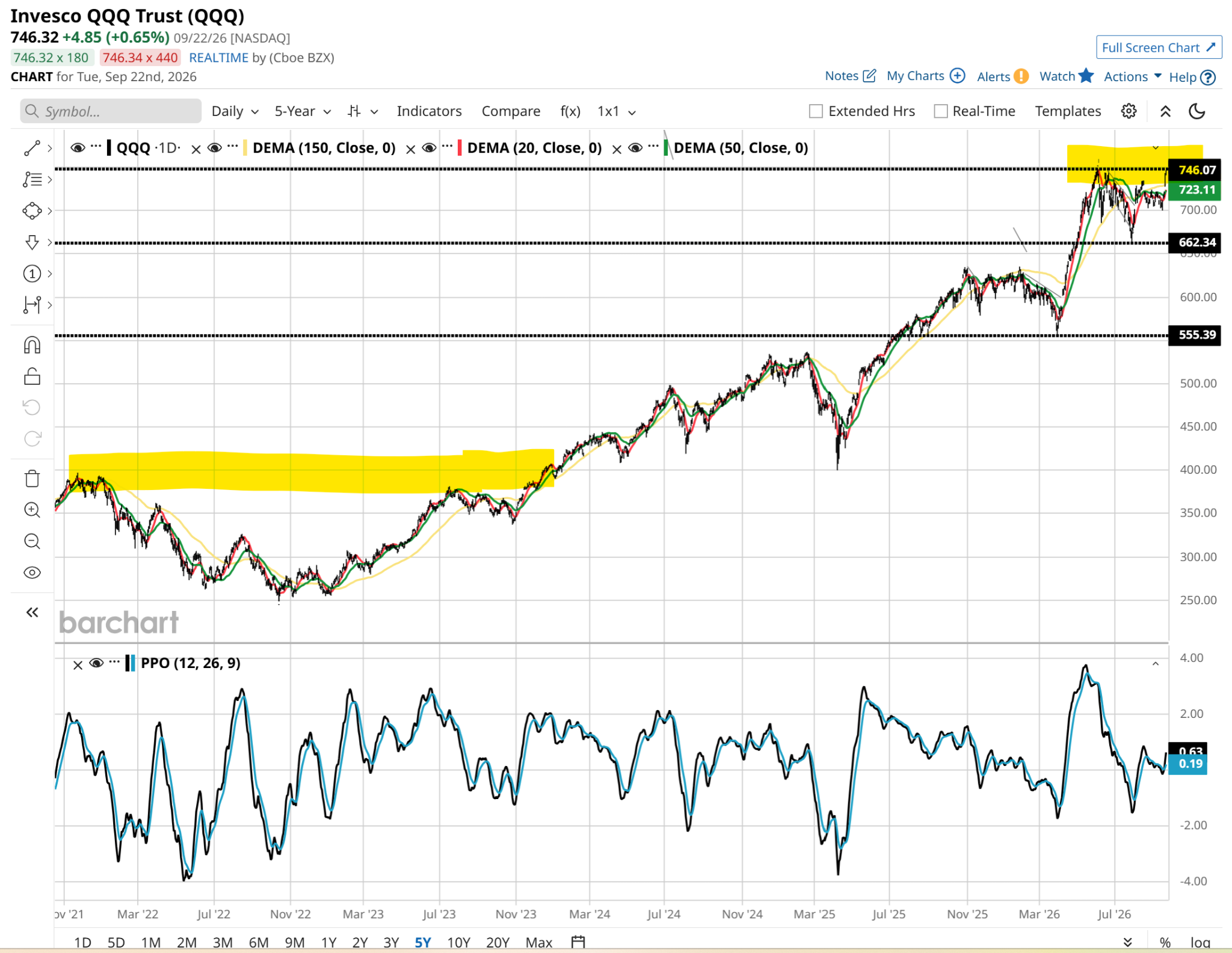
Let’s show one more on QQQ. Shortly after it debuted in late 1998, it had a giant move, about 100%, in just over a year’s time. What happened next, from those frothy heights? 16 years “in the desert” for QQQ investors. The internet bubble popped, and while the world was changed for the better because of the new technology we had at our fingertips, the stock market could not keep meeting lofty expectations. It really did take 16 years just to get back to break even from early 2000.
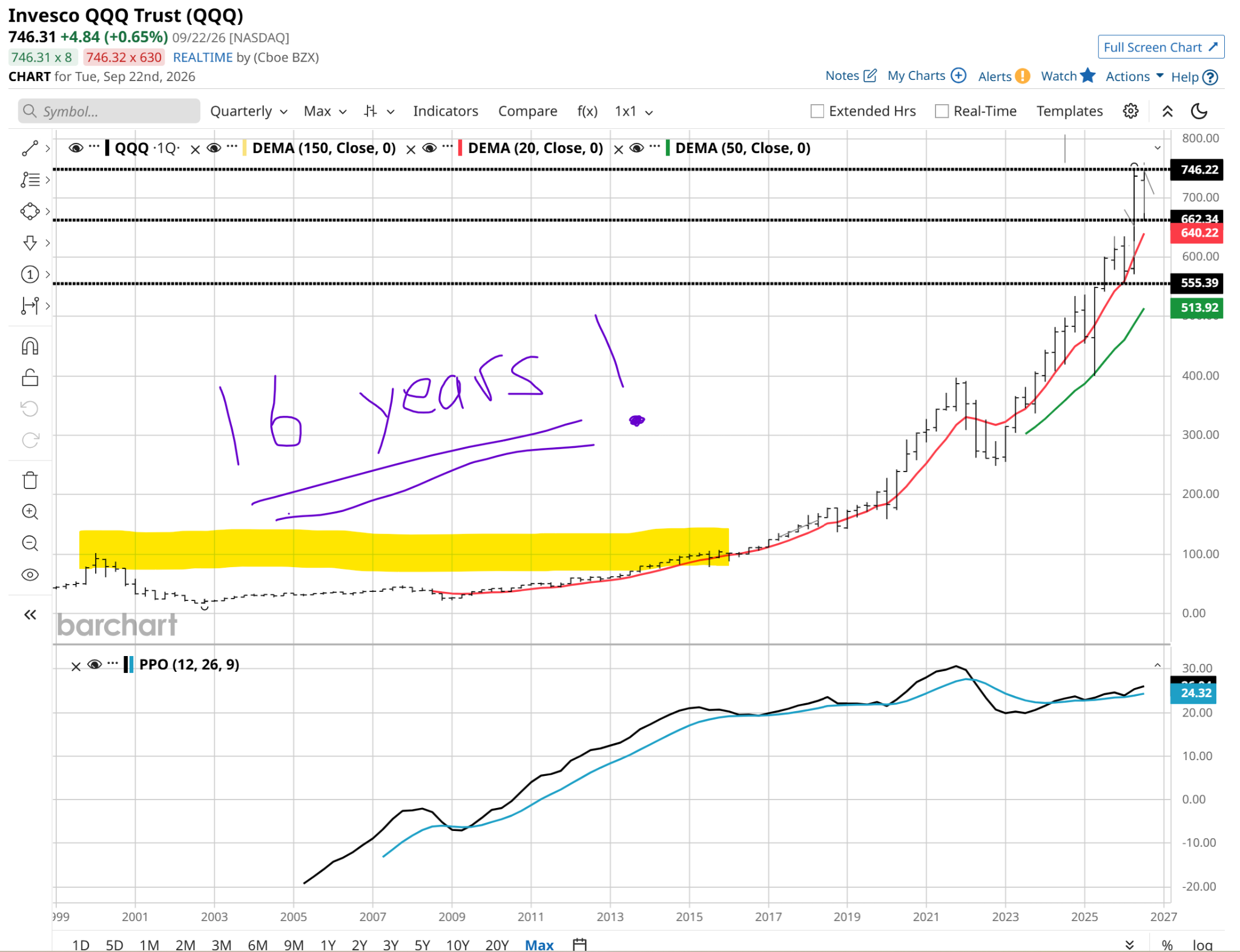
Many market pundits treat a “new all-time high” as an automatic victory for equity investors, using the phrase as shorthand for momentum, strength, and compounding wealth. In reality, a nominal high tells you absolutely nothing about the time, pain, or opportunity cost required to get there.
Celebrating a stock that hits a new peak after a multi-year or multi-decade drought is like cheering a runner who spent 15 years lost in the woods before finally finding the starting line again.
S&P 500 Heavyweights and Their Multi-Year Droughts
Will a multi-year drought happen again? It’s definitely possible. And while I’m choosing to focus on QQQ, consider the plight of many single stocks, which should give any long-term investor reason to consider how long they can afford to wait just to get back to even. Or, as others call it, getting back to “all-time highs.” Many blue-chip stocks, such as Microsoft (MSFT), Oracle (ORCL), International Business Machines (IBM), Exxon Mobil (XOM), Coca-Cola (KO), Intel (INTC), and Cisco (CSCO) have had price appreciation droughts of a decade or two. Or longer.
A new all-time high is a historical snapshot, not an automatic “go buy it” strategy. I’m a technician, and I get the idea of a breakout to new highs, all-time or over a shorter time frame. However, buying an asset simply because it broke a previous price record ignores starting valuations, duration drag, and the time value of money. For active risk managers, our goal isn’t to applaud a stock for finally recovering to where it had been. It is to avoid getting trapped in the wilderness in the first place.
Rob Isbitts is a semi-retired CIO, former fiduciary investment advisor, and Barchart columnist. Check out his other work at ETFYourself.com (featuring the Fresh Charts weekly trading post), and ROAR.PiTrade.com, helping investors to better-manage their own portfolios.
On the date of publication, Rob Isbitts did not have (either directly or indirectly) positions in any of the securities mentioned in this article. All information and data in this article is solely for informational purposes. For more information please view the Barchart Disclosure Policy here.