
Building Better Commodity Portfolios – Part 5 Monitoring the Portfolio (Portfolio Construction Is Never Finished)
Dual Edge Research publishes two powerful newsletters that work great individually — and even better together. The Bull Strangle Newsletter focuses on stocks and options, combining stock ownership with premium-selling strategies to generate consistent income and market-beating returns. The Smart Spreads Newsletter specializes in seasonal commodity futures spreads, offering a diversified approach with low correlation to equities. Together, they deliver a complete investment perspective — one focused on income, the other on diversification — all under one simple subscription.
Introduction
The first four parts of this series have focused on building a commodity spread portfolio. We began by separating trade selection from portfolio construction, then examined position sizing, diversification and correlation, capital capacity, and portfolio heat. But even a carefully constructed portfolio begins changing almost immediately after trades are entered. Markets move, positions approach their seasonal exits, volatility changes, new opportunities appear, and available capacity expands and contracts. Portfolio construction is therefore not a one-time decision. It is an ongoing process.
Individual positions still need to be monitored, but the portfolio itself must also be evaluated as a single structure. The question is no longer simply whether each trade remains attractive. We also need to ask whether the combination of positions continues to represent the best use of capital and risk capacity.
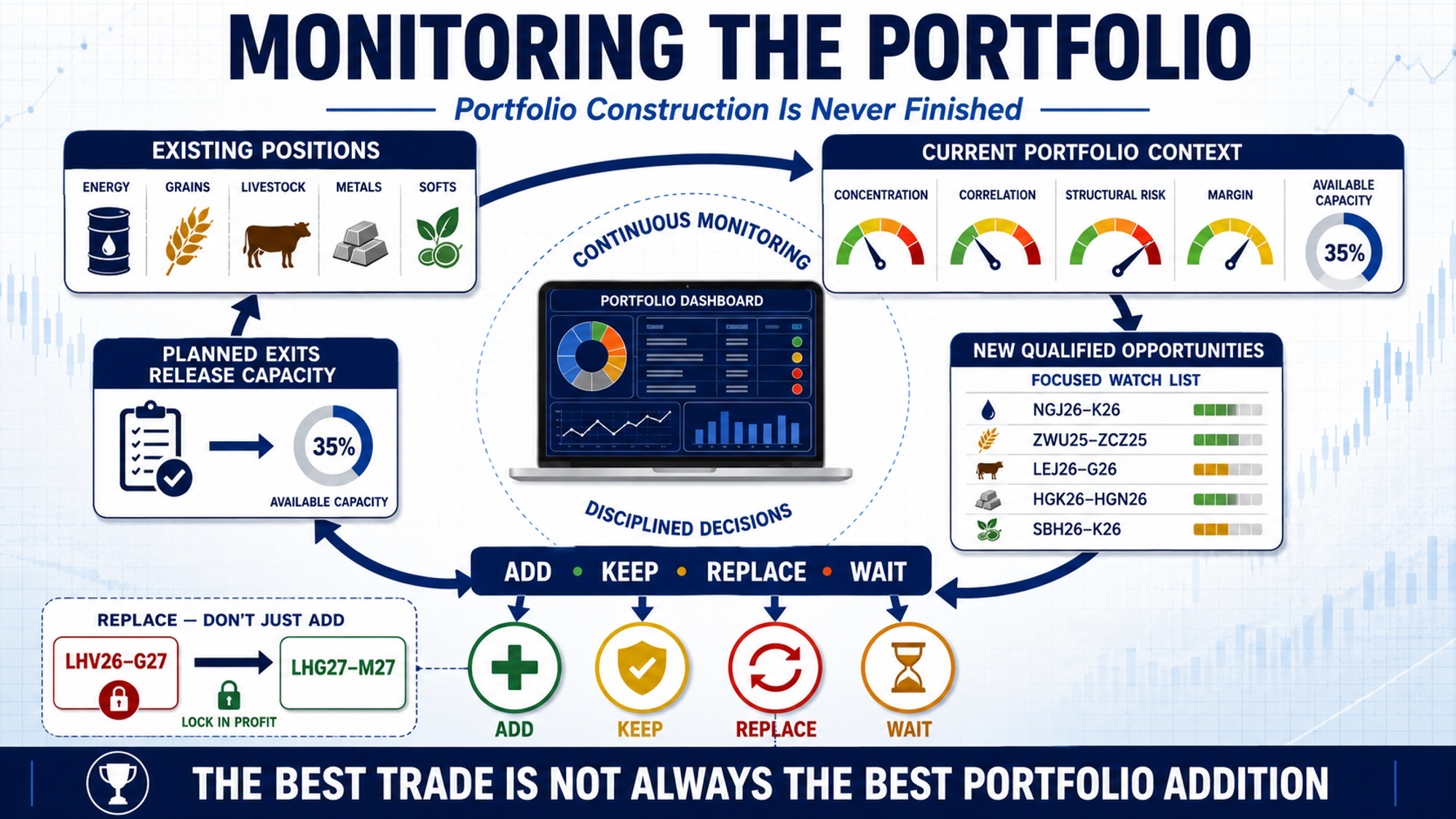
Start With What You Already Own
When evaluating new opportunities, it can be tempting to begin with the watch list. Which spread has the highest historical profit? Which has the strongest win percentage? Which seasonal window looks most attractive? Those remain important questions, but portfolio management should begin somewhere else: with the positions already being held. Existing positions determine the portfolio's starting point. Before adding another trade, we should understand the current exposure by commodity and market class, the long-short spread exposure, structural volatility, correlated clusters, and the amount of capacity already being consumed. A new trade does not enter an empty portfolio. It enters a portfolio that already contains accepted risks and opportunities.
This means the same trade can be an excellent addition to one portfolio and an unnecessary concentration in another. The trade itself has not changed. Its portfolio context has.
The Best Trade May Not Be the Best Addition
Suppose the highest-ranked opportunity on the watch list is another petroleum spread with excellent historical characteristics. If the existing portfolio has little energy exposure, the trade may fit extremely well. But if the portfolio already contains several petroleum spreads, adding it may increase an existing concentration and consume more capacity than its individual characteristics suggest.
Another qualified opportunity in grains, meats, metals, or soft commodities might provide a more independent source of exposure. This does not mean selecting inferior trades simply for diversification. Every position should still satisfy the underlying selection criteria. But among qualified opportunities, portfolio fit becomes another selection criterion. The highest-ranked trade and the best portfolio addition will often be the same position—but they do not have to be.
Existing Positions Must Compete With New Opportunities
Monitoring can also reveal opportunities to improve the portfolio without increasing its overall exposure. One tactic I frequently use is to effectively roll a profitable position into a more attractive spread farther out on the curve. For example, suppose I hold a Lean Hogs V26-G27 spread that has already generated a nice profit. At the same time, an LHG27-M27 spread appears on the watch list with exceptionally attractive characteristics. Rather than simply adding the new position and increasing my overall livestock exposure, I may close the closer-in spread, lock in its profit, and establish the farther-out position.
This accomplishes several things at once. It realizes the gain on the existing trade, moves capital toward an opportunity that currently appears more attractive, and avoids simply stacking another related position on top of existing exposure. Because the farther-out structure may also be at an earlier stage of its development, the change can reduce current portfolio exposure while maintaining participation in the market. The important point is that existing positions and new opportunities should not always be evaluated separately. Sometimes the best use of a new trade is as a replacement rather than an addition.
Monitor Exposure, Not Just Profit and Loss
Most traders naturally monitor open positions by looking at profit and loss. That information matters, but P&L alone says surprisingly little about portfolio structure. A profitable portfolio can still become increasingly concentrated, while a portfolio experiencing temporary losses can remain appropriately constructed.
Monitoring should therefore extend beyond current returns. I want to know whether one commodity or market class has become disproportionately important, whether several positions share similar directional exposure, whether multiple spreads are approaching higher-volatility periods simultaneously, and whether previously diversified positions are beginning to behave more similarly. Markets that normally appear relatively independent can temporarily synchronize in response to common economic, weather, or supply shocks.
Structural Risk Changes With Time
Commodity spreads have another characteristic that makes monitoring particularly important: their structural risk can change simply by the passage of time. A spread entered well ahead of front-month expiration may initially develop gradually. As expiration approaches, convergence pressures, hedging activity, and liquidity shifts can accelerate price movements. Wider spacing between contract expirations can also create greater potential differentiation between the legs. A position can therefore contribute more portfolio heat later in its holding period even though no contracts have been added. This also helps explain why rolling from a profitable closer-in structure to an attractive farther-out spread can sometimes accomplish more than simply locking in a gain. It can also change the portfolio's structural risk profile.
Exits and Replacements Create New Capacity
Planned exits continually return capital and risk capacity to the portfolio. Existing trades consume capacity when they enter, move through their seasonal windows, and eventually exit. That capacity can then be allocated to new opportunities. But the process does not always require waiting for the scheduled exit. A profitable existing trade may sometimes provide the capital for a more attractive opportunity through the replacement process described above. In other cases, the best decision may be to keep the existing position and pass on the new trade. The objective is not constant turnover. It is to continually ask which combination of qualified positions best uses limited portfolio capacity.
Margin and Capacity Continue to Matter
Margin requirements can also change as clearinghouses and brokers respond to volatility, liquidity, and perceived market risk. The same portfolio can require more capital even though none of its positions have changed. A conservatively constructed portfolio should be able to absorb reasonable changes without forcing an immediate response. This reinforces the importance of maintaining excess capacity. If every available dollar is continuously committed, a particularly attractive new opportunity may require closing an existing trade for the wrong reason. Maintaining flexibility allows replacement decisions to be based on the relative attractiveness of the trades rather than financial necessity.
A Continuous Feedback Loop
Portfolio management can ultimately be viewed as a continuous feedback loop. Existing positions determine current exposure, concentration, heat, and available capacity. New qualified trades are evaluated against that starting point. Some are added, some are passed over, and occasionally a new opportunity justifies replacing an existing position. As trades exit, capacity is released, and the process begins again. Monitoring does not mean constantly changing positions in response to short-term movement. In many cases, good monitoring leads to no action at all. Its purpose is to keep decisions deliberate rather than reactive.
The first five parts of this series have now established the major pieces of portfolio construction: position sizing, diversification, capital capacity, portfolio heat, and ongoing management. In Part 6, we will combine them into a single Smart Spreads portfolio framework—from identifying qualified opportunities to deciding what to add, what to keep, what to replace, and when to wait.
Additional Details
The Bull Strangle Newsletter focuses on stocks and options, combining stock ownership with disciplined option-selling techniques designed to generate consistent income while managing risk.
The Smart Spreads Newsletter focuses on seasonal commodity spreads, a historically proven approach that seeks opportunities across agricultural, energy, metal, and financial futures markets.
Each strategy is designed to stand on its own, but together they provide a diversified approach that can perform across a wide range of market environments. For traders looking to deepen their education, The Bull Strangle Strategy and Trading Commodity Spreads are both available on Amazon.
Visit BullStrangle.com to subscribe for just $1 for the first month.
For a video overview of the Bull Strangle Newsletter
For a video overview of the Smart Spreads Newsletter
Darren Carlat
Dual Edge Research
(214) 636-3133
DualEdgeResearch@gmail.com
Disclaimer
This information is for informational purposes only and should not be considered as investment advice. Past performance is not indicative of future results, and all investments carry inherent risk. Consult with a financial advisor before making any investment decisions.