
Exelon (EXC) Hourly Pricing Update Puts Its Undervalued Narrative Back In Focus
Exelon (EXC) is back in focus after subsidiary ComEd reported its Hourly Pricing program has reached 70,000 residential customers and delivered an estimated US$63 million in electricity supply savings since 2007.
The recent ComEd update lands after a softer stretch for Exelon’s stock, with the 30-day share price return down 9.23% and the 90-day move down 14.89%, even though the 5-year total shareholder return of 41.41% points to a much stronger long-term record.
Compare Exelon’s recent pullback with other regulated utilities by scanning a curated group of 30 resilient stocks with low risk scores, which aim to pair steadier balance sheets with more resilient share-price trends.
Recent weakness has reset expectations around Exelon, yet the business still carries a regulated utility profile and a sizeable US$41.6b market value. Are investors now looking at remaining upside, or at a story where most gains already sit in the rear-view mirror?
Most Popular Narrative: 17% Undervalued
Exelon’s most followed valuation story puts fair value at $48.71, above the last close at $40.34. This frames the recent share price pullback as a potential discount rather than a new normal.
The rebalanced US$41.7b capital plan that shifts US$1.5b into higher earning transmission while deferring US$1.1b of lower priority distribution projects positions Exelon to pursue its targeted 7.9% rate base growth with a tilt toward assets that can support operating EPS and cash flow.
See why 37 investors see Exelon as 17% undervalued.
Result: Fair Value of $48.71 (UNDERVALUED)
Still, the Exelon story can change quickly if regulators push back harder on rate cases, or if customer affordability issues keep tightening room for that US$41.7b spend.
Find out about the key risks to this Exelon narrative.
Another View: Exelon Through The SWS DCF Lens
The popular Exelon story leans on a fair value of $48.71, yet the SWS DCF model lands in a very different place. On that approach, Exelon at $40.34 screens as expensive against an estimated future cash flow value of $9.32, which points to a wide gap investors need to reconcile.
The question is simple. Are analyst earnings paths too optimistic, or is the DCF framework too conservative for a capital heavy regulated utility like Exelon, where cash flows are smoothed by long asset lives and rate decisions?
Look into how the SWS DCF model arrives at its fair value.
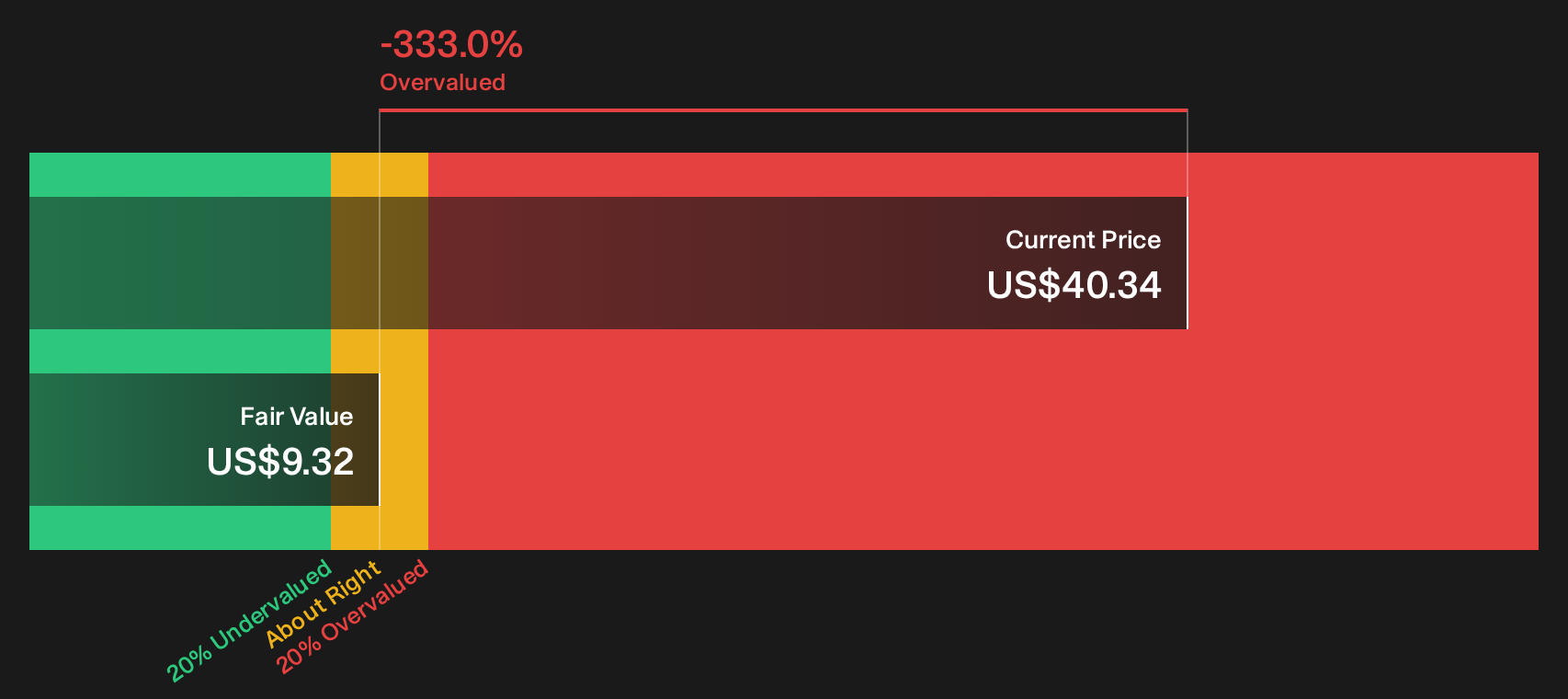
Simply Wall St performs a discounted cash flow (DCF) on every stock in the world every day (check out Exelon for example). We show the entire calculation in full. You can track the result in your watchlist or portfolio and be alerted when this changes, or use our stock screener to discover 32 high quality undervalued stocks. If you save a screener we even alert you when new companies match - so you never miss a potential opportunity.
Next Steps
Mixed messages around Exelon can be confusing. Move quickly, review the data yourself, weigh both sides, and then size your own conviction with 5 key rewards and 2 important warning signs.
Looking for more investment ideas beyond Exelon?
If Exelon has you thinking harder about risk, income, and upside, do not stop here. Use the Simply Wall St Screener to spot fresh opportunities that fit your playbook.
- Target potential mispricing and hunt for quality on sale with the 32 high quality undervalued stocks.
- Strengthen your income stream by scanning for reliably high payers through the 8 dividend fortresses.
- Dial down portfolio shocks by focusing on sturdier businesses in the list of solid balance sheet and fundamentals (24 results).
This article by Simply Wall St is general in nature. We provide commentary based on historical data and analyst forecasts only using an unbiased methodology and our articles are not intended to be financial advice. It does not constitute a recommendation to buy or sell any stock, and does not take account of your objectives, or your financial situation. We aim to bring you long-term focused analysis driven by fundamental data. Note that our analysis may not factor in the latest price-sensitive company announcements or qualitative material. Simply Wall St has no position in any stocks mentioned.
Have feedback on this article? Concerned about the content? Get in touch with us directly. Alternatively, email editorial-team@simplywallst.com