
3 Homebuilder Stocks To Watch After Berkshire Boosted Lennar Shares
Berkshire Hathaway’s decision to nearly double its Lennar stake has thrown fresh light on U.S. homebuilders, just as higher mortgage rates keep pressure on housing demand. Big, patient capital is leaning into this uncertainty, which can create mispricing that retail investors either exploit or avoid. This piece walks through three stocks exposed to that Berkshire signal and explains how the same news can mean very different things for your portfolio.
The stocks highlighted below are only a sample of what Berkshire’s renewed interest in homebuilders touches, and the full screen surfaced 13 more U.S. housing and building-products companies with equally compelling narratives that are not covered here. If you want to go straight to the source and identify your own highest-conviction ideas in this theme, head into the U.S. Housing-Cycle Value: Listed Homebuilders and Building-Products Suppliers screener.
KB Home (KBH)
Overview: KB Home builds and sells new single family homes, townhomes and condos across key U.S. markets, tightly linked to the housing cycle.
Operations: KB Home generates about $5.2b in revenue primarily from U.S. homebuilding activity, with roughly $24 million contributed by financial services.
Market Cap: US$2.9b
KB Home sits squarely in the housing cycle sweet spot for this screener, with earnings closely tied to new home demand, affordability and how buyers respond when big builders push fresh supply into markets Berkshire clearly cares about.
"KB Home’s growing pool of more than 1,500 sold homes that have not yet started construction creates a large, pre sold workstream that divisions can use to negotiate sharper trade pricing and steadier crew availability."
What happens to KB Home’s margins and pricing power if a single key assumption about buyer appetite for its higher priced communities breaks?
If that assumption feels fragile for you, read the full narrative for KB Home to see how KB Home’s pre sold backlog could be masking both risk and upside.

Lennar (LEN)
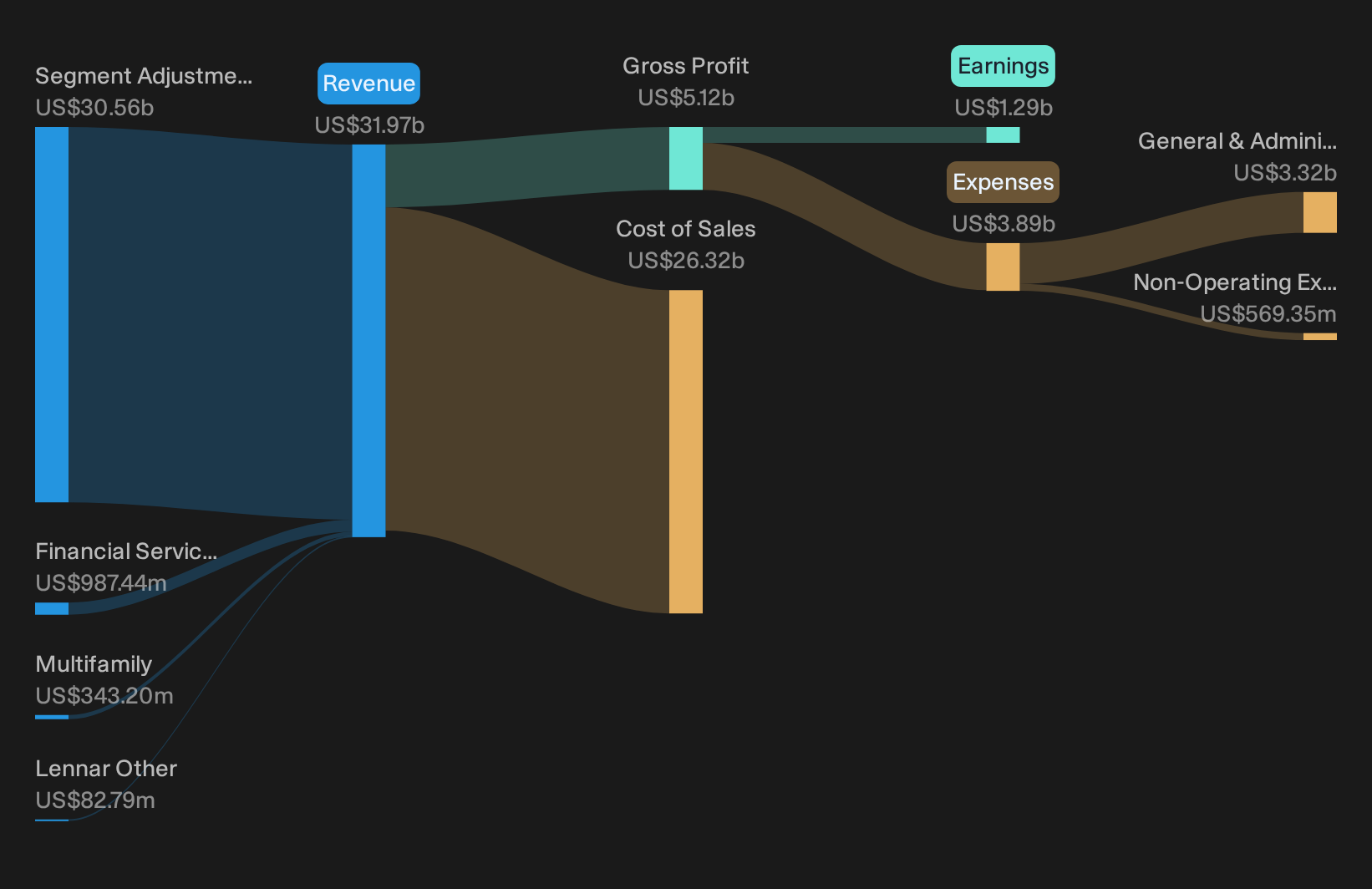
Overview: Lennar is a large U.S. homebuilder that designs, constructs and sells single family and multifamily homes tightly tied to the housing cycle.
Operations: Lennar generates about US$31.9b in revenue in the United States, with roughly US$987 million from financial services and US$343 million from multifamily.
Market Cap: US$19.7b
Lennar sits at the center of this housing cycle theme because its nationwide scale, broad buyer mix and land strategy all amplify whatever direction demand for new construction takes next.
"Higher mortgage interest rates have left the housing market weaker for longer, potentially impacting Lennar's future revenues and net margins."
What happens to Lennar’s pricing, incentives and long term earnings power if a single unseen pressure on entry level buyers suddenly eases?
That pressure can flip quickly for Lennar if you understand how incentives, land strategy and buyer mix interact inside the full narrative for Lennar and where the upside can accelerate.
NVR (NVR)
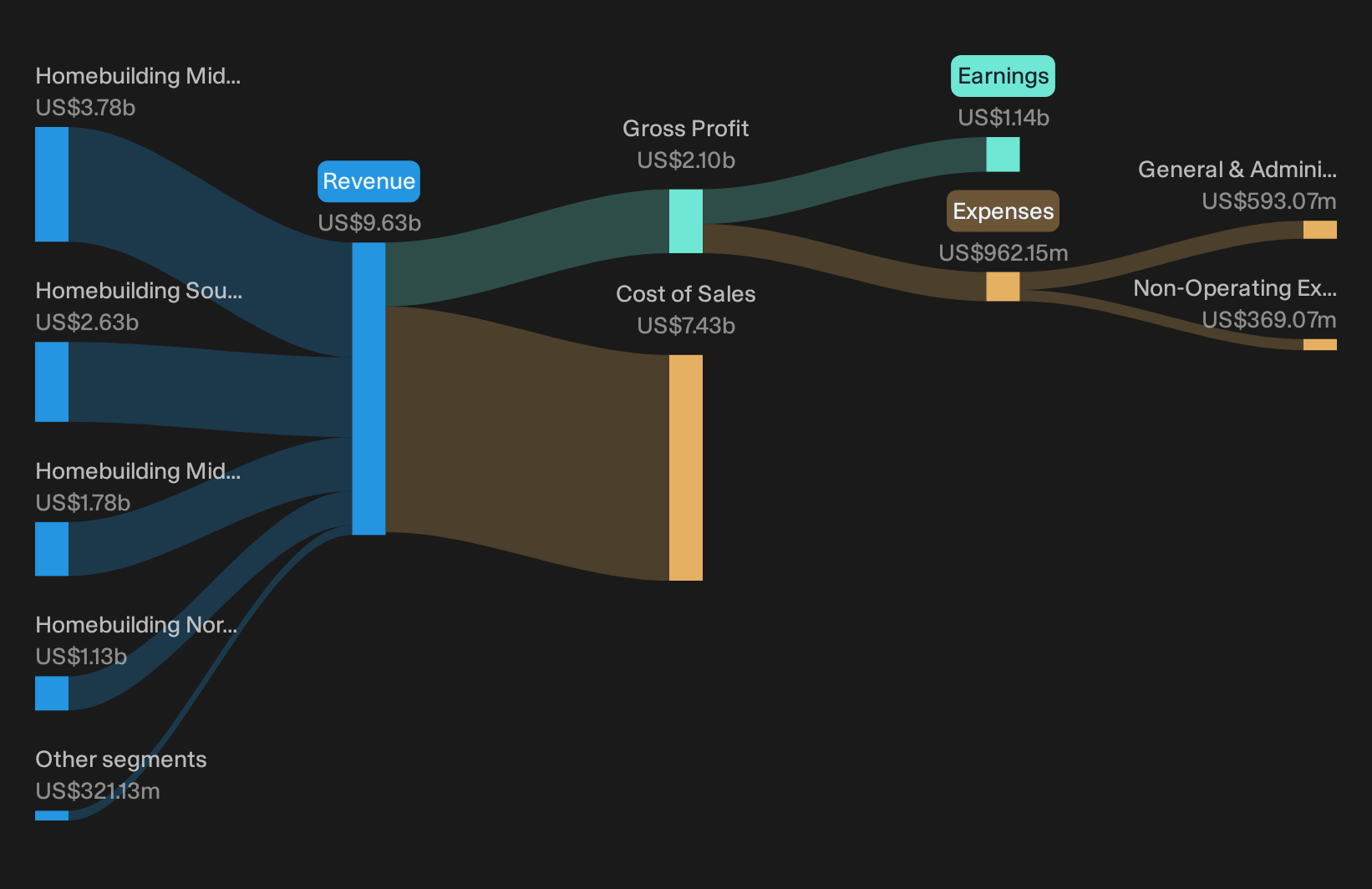
Overview: NVR builds and sells single family homes, townhomes and condos across multiple U.S. regions and brands, closely linked to housing cycles.
Operations: NVR generates about US$9.4b from homebuilding across Mid Atlantic, South East, Mid East and North East regions, plus US$237 million from mortgage banking.
Market Cap: US$16.8b
NVR matters for this housing cycle screen because its asset light approach to land allows it to respond to demand without significantly increasing balance sheet exposure when rates stay high longer than buyers expect.
"The mechanism is the Lot Purchase Agreement (LPA) model. NVR pays non-refundable deposits of approximately 10% of finished lot value to third-party developers for the right to take down lots on a quarter-by-quarter basis. The risk that peers absorb in housing downturns, NVR walks away from by forfeiting deposits."
The key uncertainty is what happens to NVR’s pricing power and margins if a single core assumption about lot costs changes.
If that cost thesis is what you are testing, the full narrative for NVR shows how NVR’s lot model could be masking both downside risk and accelerating upside.
Seeking Fresh Alternatives Beyond Homebuilders
Some opportunities are already breaking out, while others are quietly building momentum under the radar for now. Consider taking action instead of remaining on the sidelines.
- Target income that may hold up if markets start dropping by scanning a curated pool of quality payers in the 8 dividend fortresses.
- Focus on structural tech momentum by examining profitable operators inside the 37 profitable AI stocks that aren't just burning cash.
- Explore potential hard-asset exposure by reviewing producers screened in the 36 elite gold producer stocks.
This article by Simply Wall St is general in nature. We provide commentary based on historical data and analyst forecasts only using an unbiased methodology and our articles are not intended to be financial advice. It does not constitute a recommendation to buy or sell any stock, and does not take account of your objectives, or your financial situation. We aim to bring you long-term focused analysis driven by fundamental data. Note that our analysis may not factor in the latest price-sensitive company announcements or qualitative material. Simply Wall St has no position in any stocks mentioned.
Have feedback on this article? Concerned about the content? Get in touch with us directly. Alternatively, email editorial-team@simplywallst.com