
Qatar Partnership Could Be A Game Changer For JPMorgan Stock (JPM)
- Recent updates around JPMorgan Chase cover a dense run of fixed income issuance, a higher quarterly dividend of US$1.65 per share, new digital data controls for customers, and fresh capital commitments and financing talks across real estate and sustainable forestry.
- What stands out is how JPMorgan Chase is pairing heavy bond funding activity and a large Qatar Investment Authority partnership with new tools like the Chase Data Security Center, tying balance sheet flexibility directly to product development and customer trust.
- We will look at how JPMorgan Chase's capital efficiency story intersects with the Qatar partnership and new customer data controls.
Scan how JPMorgan Chase is handling bond issuance, dividends, and data controls, then widen your watchlist with our curated 30 resilient stocks with low risk scores focusing on balance sheet strength and resilience.
JPMorgan Chase Investment Narrative Recap
To own JPMorgan Chase, you need to believe its diversified banking, cards, payments, and wealth platform can keep converting large client relationships into stable earnings despite tighter rules and more fintech competition. Recent fixed income issuance and the higher US$1.65 quarterly dividend point to management prioritising funding flexibility and ongoing capital returns.
The near term swing factor remains how regulators set capital and liquidity requirements, because those rules dictate how aggressively the bank can lend, invest, and return cash. Recent bond deals, conference appearances, and the California legal ruling do not materially change that risk, but they do add incremental execution and reputation angles to monitor.
The fresh US$1.65 per share dividend announcement is the clearest operational signal in this batch of news. For a bank of the size of JPMorgan Chase, holding that payout while running large bond programs suggests confidence in the balance sheet and in the durability of cash flows from cards, payments, and fee businesses.
For catalysts, that dividend stream matters because it ties directly into capital return expectations that many shareholders watch closely. The main risks are that higher regulatory capital demands, fintech pressure, or legal and compliance costs narrow the room to keep that payout alongside reinvestment into payments, digital initiatives, and areas such as natural capital and real estate financing.
JPMorgan Chase is currently modeled by analysts to reach US$224.5b in revenue and US$67.8b in earnings by 2029. That profile lines up with an assumed 6.4% yearly revenue growth rate and implies a US$4.2b earnings increase from US$63.6b today.
Uncover how JPMorgan Chase's fair value indicates a 9% potential upside to its current price, before the gap between price and value tightens.
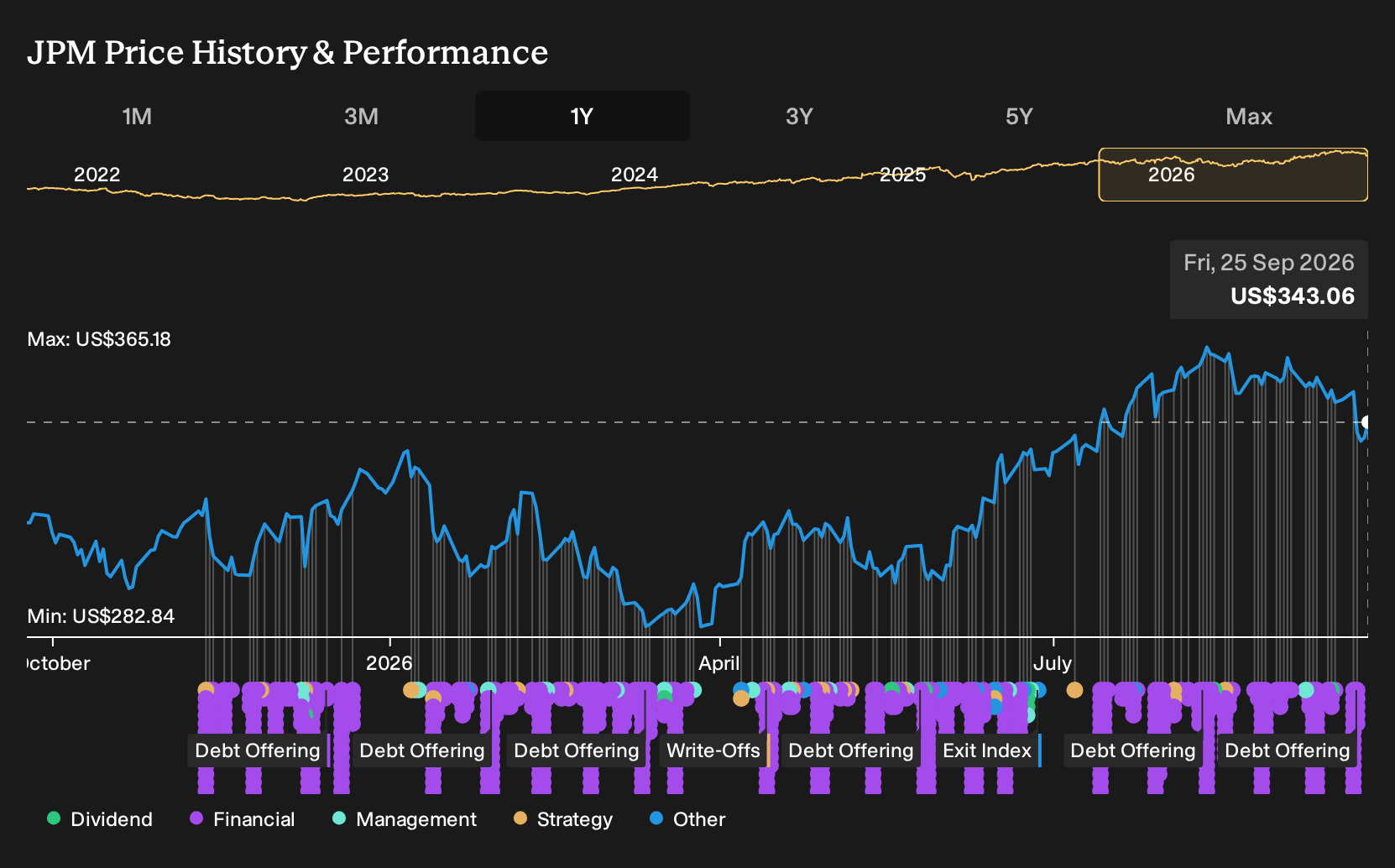
Exploring Other Perspectives
One alternative angle you should keep in mind is expense pressure. The most pessimistic analysts focus on JPMorgan Chase’s higher planned AI, token, and security spending and worry that fees and interest income might not keep pace. Their pre news models pointed to about US$223.6b of 2029 revenue and US$65.8b of earnings, far below the most optimistic US$76.0b earnings view. With this fresh run of bond issuance and upcoming CEO calls still unreflected in those spreadsheets, it is worth exploring several viewpoints before deciding how you feel about the story.
Explore 11 other JPMorgan Chase fair value estimates, including one that suggests up to 5% downside from the current price.
Form Your Own Verdict
Disagree with existing narratives? Extraordinary investment returns rarely come from following the herd, so trust your own research and judgment.
- A great starting point for your JPMorgan Chase research is our analysis highlighting 3 key rewards and 1 important warning sign that could impact your investment decision.
- See our latest analysis for JPMorgan Chase. The report includes a comprehensive fundamental analysis summarized in a single visual, the Snowflake, making it easy to evaluate JPMorgan Chase's overall financial health at a glance.
Looking for more investment ideas beyond JPMorgan Chase?
Once you have a view on JPMorgan Chase, it can help to compare that conviction with other opportunities that fit clear, rules based filters. The Simply Wall St Screener lets you do exactly that by surfacing groups of companies that share the traits you care about most.
- For investors who want potential upside with a margin of safety, focus on strong fundamentals and valuation support with a carefully filtered set of 32 high quality undervalued stocks.
- If preserving capital matters just as much as growing it, concentrate on balance sheets and risk profiles with a targeted 30 resilient stocks with low risk scores that screens for resilience.
- For those hunting for future leaders that are not yet widely followed, widen your radar with a curated pool of 16 high quality undiscovered gems that pair quality metrics with quieter trading histories.
This article by Simply Wall St is general in nature. We provide commentary based on historical data and analyst forecasts only using an unbiased methodology and our articles are not intended to be financial advice. It does not constitute a recommendation to buy or sell any stock, and does not take account of your objectives, or your financial situation. We aim to bring you long-term focused analysis driven by fundamental data. Note that our analysis may not factor in the latest price-sensitive company announcements or qualitative material. Simply Wall St has no position in any stocks mentioned.
Have feedback on this article? Concerned about the content? Get in touch with us directly. Alternatively, email editorial-team@simplywallst.com