
Nippon Electric Glass (TSE:5214) Looks Cheap On New Thermal Lens Glass Win
Nippon Electric Glass (TSE:5214) has drawn fresh attention after its FI-02 infrared transmitting glass was selected for Heimann Sensor’s new wide-angle thermal camera lens unit, which is aimed at the expanding infrared sensing market.
Despite the Heimann Sensor win, Nippon Electric Glass shares have been under pressure in recent months, with a 90-day share price return down 24.65% and year-to-date share price return down 21.62%. At the same time, long-term total shareholder returns of 93.96% over three years and 119.15% over five years point to a very strong earlier compounding run that contrasts with the current price weakness.
Spot similar specialty glass and sensor plays that may be setting up for the next move by scanning our hand-picked 87 AI infrastructure stocks.Nippon Electric Glass now pairs a fresh product win with a share price that has retreated sharply from recent highs. Is the heavier move already in the rear-view mirror, or does the valuation still leave meaningful upside on the table?
Price-to-Earnings of 13.8x: Is it justified?
Nippon Electric Glass trades on a P/E of 13.8x, which sits below several reference points and suggests the current ¥4,875 share price bakes in fairly modest expectations compared with peers.
The P/E ratio compares the company’s market value to its net earnings, so it reflects what investors are willing to pay today for each unit of profit. For a specialist glass producer tied to electronics, displays, and industrial applications, earnings power over a cycle often matters more than a single product win or quarter.
Recent profitability, high quality earnings, and a return to the black give that P/E some grounding, even though forecast earnings growth of 5.6% per year is flagged as slower than both the wider JP market and the electronic industry. The market appears to be assigning a discount multiple, while the estimated fair P/E of 17.2x implies a level the valuation could move toward if investors reassess those moderate expectations.
Against direct peers and the broader electronic sector, the P/E of 13.8x looks restrained. It sits below the JP electronic industry average of 16.6x and well under the peer group average of 26.2x, which points to the market pricing Nippon Electric Glass more conservatively than many comparable stocks despite the fair value signal from that 17.2x P/E benchmark.
Explore the SWS fair ratio for Nippon Electric Glass.
Result: Price-to-Earnings of 13.8x (UNDERVALUED)
Still, Nippon Electric Glass faces real pressure if demand for displays and electronics stutters, or if competitors undercut on pricing in specialty glass niches.
Find out about the key risks to this Nippon Electric Glass narrative.
Another view on Nippon Electric Glass valuation
The P/E picture looks friendly for Nippon Electric Glass, but the SWS DCF model tells a different story. On that cash flow view, the estimated value is ¥1,804.74 per share, well below the current ¥4,875 level, which screens as overvalued rather than cheap.
This gap between earnings-based and cash-flow-based views raises a simple question for you: Which signal deserves more weight when the market is already paying well above our DCF estimate?
Look into how the SWS DCF model arrives at its fair value.
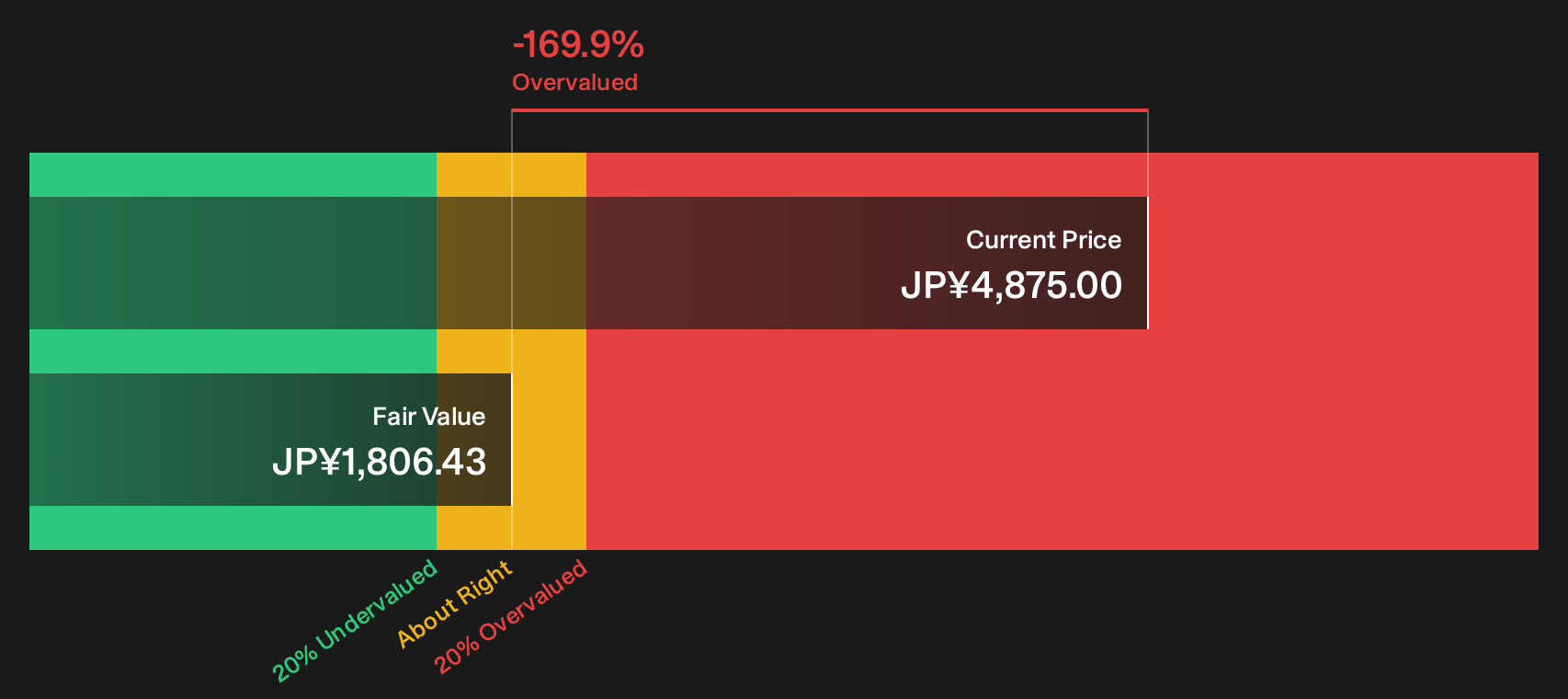
Simply Wall St performs a discounted cash flow (DCF) on every stock in the world every day (check out Nippon Electric Glass for example). We show the entire calculation in full. You can track the result in your watchlist or portfolio and be alerted when this changes, or use our stock screener to discover 18 high quality undervalued stocks. If you save a screener we even alert you when new companies match - so you never miss a potential opportunity.
Next Steps
If this mix of caution and optimism around Nippon Electric Glass feels familiar, then move fast and check the balance of both sides for yourself. To see the full set of trade offs that investors are weighing, review the 4 key rewards and 2 important warning signs
Looking for more Nippon Electric Glass style ideas?
If Nippon Electric Glass has sparked fresh thinking about your portfolio, do not stop here. The right next idea can change your whole return profile.
- Target steadier potential outcomes by reviewing a curated pool of 21 resilient stocks with low risk scores that focus on resilience instead of drama.
- Hunt for mispriced quality by scanning a 18 high quality undervalued stocks that blends solid balance sheets with compelling cash flow profiles.
- Catch under-the-radar opportunities early by checking a 74 high quality undiscovered gems before the wider market pays attention.
This article by Simply Wall St is general in nature. We provide commentary based on historical data and analyst forecasts only using an unbiased methodology and our articles are not intended to be financial advice. It does not constitute a recommendation to buy or sell any stock, and does not take account of your objectives, or your financial situation. We aim to bring you long-term focused analysis driven by fundamental data. Note that our analysis may not factor in the latest price-sensitive company announcements or qualitative material. Simply Wall St has no position in any stocks mentioned.
Have feedback on this article? Concerned about the content? Get in touch with us directly. Alternatively, email editorial-team@simplywallst.com