
Hancock Whitney (HWC) Is Back In The Spotlight, But What Is Driving It?
Why Hancock Whitney Is Back On Investors’ Radar
Hancock Whitney (HWC) returned to the spotlight after Argus trimmed its target price to $77.00, placing fresh attention on how the regional bank’s shares stack up against current expectations.
The share price of Hancock Whitney has softened in recent weeks, with the 30 day share price return down 1.83% and the 7 day move also lower. The stock still carries a 14.57% year to date share price return and a 3 year total shareholder return of 118.34%, which signals momentum that has not fully reversed despite the latest recalibration in expectations.
Compare Hancock Whitney’s reset expectations with those of other regional banks that have strong balance sheets and pricing gaps using our curated list of solid balance sheet and fundamentals (24 results) for context.
The recent pullback in Hancock Whitney looks small next to its 1 year and 3 year gains, which raises a simple tension. Is the price shift catching up to business reality, or is it just reflecting cooler sentiment before valuation work begins?
Most Popular Narrative: 12% Undervalued
Against Hancock Whitney’s last close at $73.85, the most followed narrative points to a fair value of $83.60, which frames the recent pullback as modest compared with that implied upside.
The analysts have a consensus price target of $83.6 for Hancock Whitney based on their expectations of its future earnings growth, profit margins and other risk factors. However, there is a degree of disagreement amongst analysts, with the most bullish reporting a price target of $91.0, and the most bearish reporting a price target of just $74.0.
See why 4 investors see Hancock Whitney as 12% undervalued.
Result: Fair Value of $83.60 (UNDERVALUED)
Still, the Hancock Whitney narrative could be challenged if credit costs rise again or if deposit outflows and integration expenses squeeze profitability more than analysts expect.
Find out about the key risks to this Hancock Whitney narrative.
Another View On Hancock Whitney’s Valuation
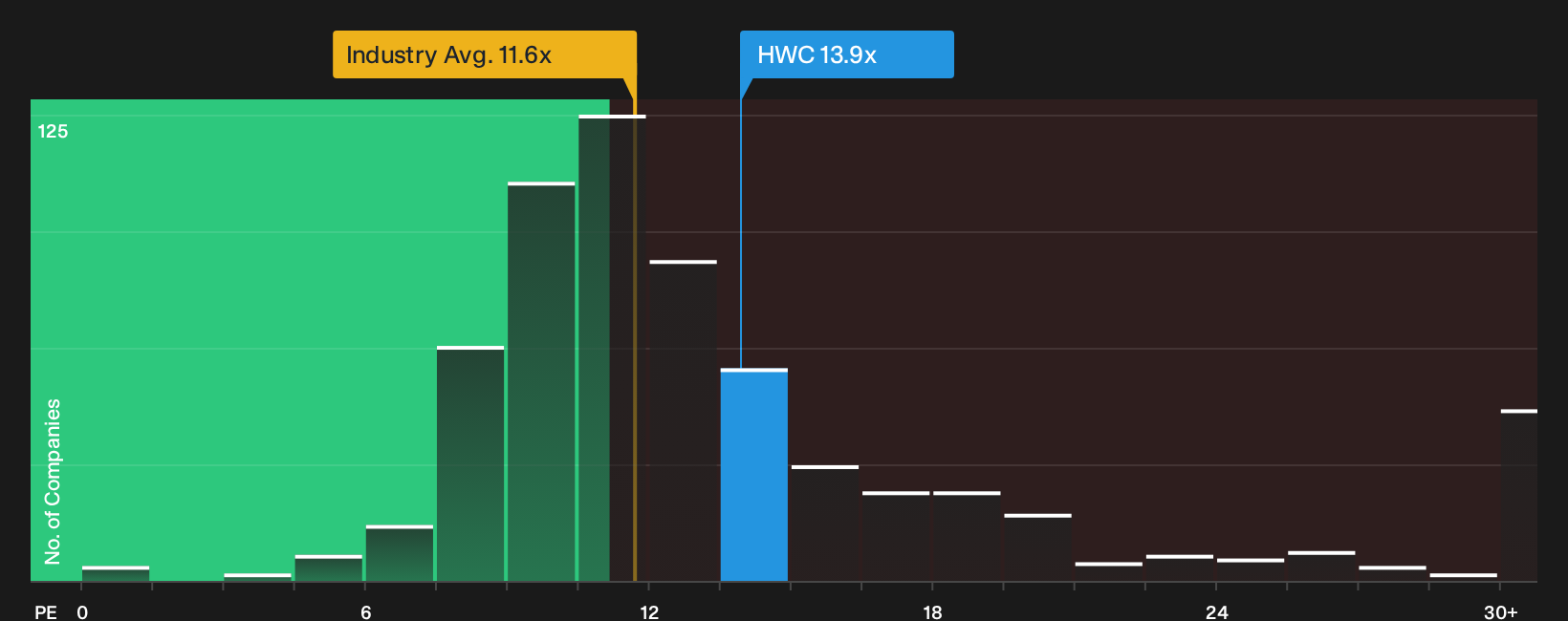
The story looks different once the focus shifts from analyst targets to what the market is already paying for Hancock Whitney today. The stock trades on a P/E of 13.9x, which is higher than the US Banks sector at 11.6x and above its peers at 12.1x.
That premium suggests investors already price in a fair amount of good news, even though the fair ratio for Hancock Whitney sits slightly higher at 14.5x. The gap is small, so the upside case on this lens is more about fine margins than a glaring bargain. This raises a simple question: Is that narrow buffer enough for you if sentiment changes?
See what the numbers say about this price — find out in our valuation breakdown.
Next Steps
Mixed signals on Hancock Whitney so far. If you want to move past headlines and sharpen your own take on the opportunity and the threat balance, start by reviewing the full breakdown of 3 key rewards and 1 important warning sign.
Looking For More Ideas Beyond Hancock Whitney?
If Hancock Whitney has sharpened your thinking, do not stop here. Broader context from other opportunities can make your next portfolio move much more informed.
- Target resilient balance sheets by scanning companies with strong fundamentals through our focused list of solid balance sheet and fundamentals (24 results).
- Hunt for potential mispriced opportunities by checking companies that screen as high quality yet priced as 32 high quality undervalued stocks.
- Prioritize stability and income by reviewing our curated 8 dividend fortresses that meet strict yield and robustness criteria.
This article by Simply Wall St is general in nature. We provide commentary based on historical data and analyst forecasts only using an unbiased methodology and our articles are not intended to be financial advice. It does not constitute a recommendation to buy or sell any stock, and does not take account of your objectives, or your financial situation. We aim to bring you long-term focused analysis driven by fundamental data. Note that our analysis may not factor in the latest price-sensitive company announcements or qualitative material. Simply Wall St has no position in any stocks mentioned.
Have feedback on this article? Concerned about the content? Get in touch with us directly. Alternatively, email editorial-team@simplywallst.com