
PG&E (PCG) Could Be 37% Undervalued After Dividend And Microgrid Updates
PG&E (PCG) has two fresh storylines for investors this month. Management affirmed a third quarter 2026 cash dividend of $0.05 per share and moved forward on community microgrid projects across Northern and Central California.
PG&E’s recent microgrid announcements and dividend affirmation come at a time when the broader market is weaker, with the share price down 32.3% over the past 30 days and 24.2% year to date, while the 1 year total shareholder return has declined 16.7% and the 5 year total shareholder return remains positive at 30.7%.
Scan beyond PG&E and explore other utilities investing in grid resilience and clean energy with our curated list of 40 power grid technology and infrastructure stocks.
PG&E now sits at a share price that reflects both wildfire and regulatory risk, as well as a renewed dividend plus grid investment story. Does that current balance still reward new buyers at this level, or does it mostly compensate existing holders?
Most Popular Narrative: 37% Undervalued
PG&E’s most followed valuation story currently anchors on a fair value of $19.66 versus the latest close at $12.34. This puts the stock on a wide narrative discount and brings wildfire policy, capital spending and long term earnings assumptions into sharp focus.
Expanding opportunities for capital investment in grid modernization, wildfire mitigation, and resilience, fueled by both regulatory mandates and the need to serve new electrification and decarbonization requirements, position PG&E to grow its rate base and regulated earnings steadily over the next decade.
See why 26 investors see PG&E as 37% undervalued.
Result: Fair Value of $19.66 (UNDERVALUED)
Still, the narrative can crack if wildfire liability reform stalls further or if regulators push back on PG&E’s long term capex recovery and allowed returns.
Find out about the key risks to this PG&E narrative.
Another View: PG&E Through A Cash Flow Lens
The P/E story presents PG&E as inexpensive, while the SWS DCF model indicates the opposite. On that cash flow view, an estimated value of $9.60 sits below the current $12.34 share price, which frames the stock as overvalued using this method. Which lens do you weigh more heavily as policy risk plays out?
Look into how the SWS DCF model arrives at its fair value.
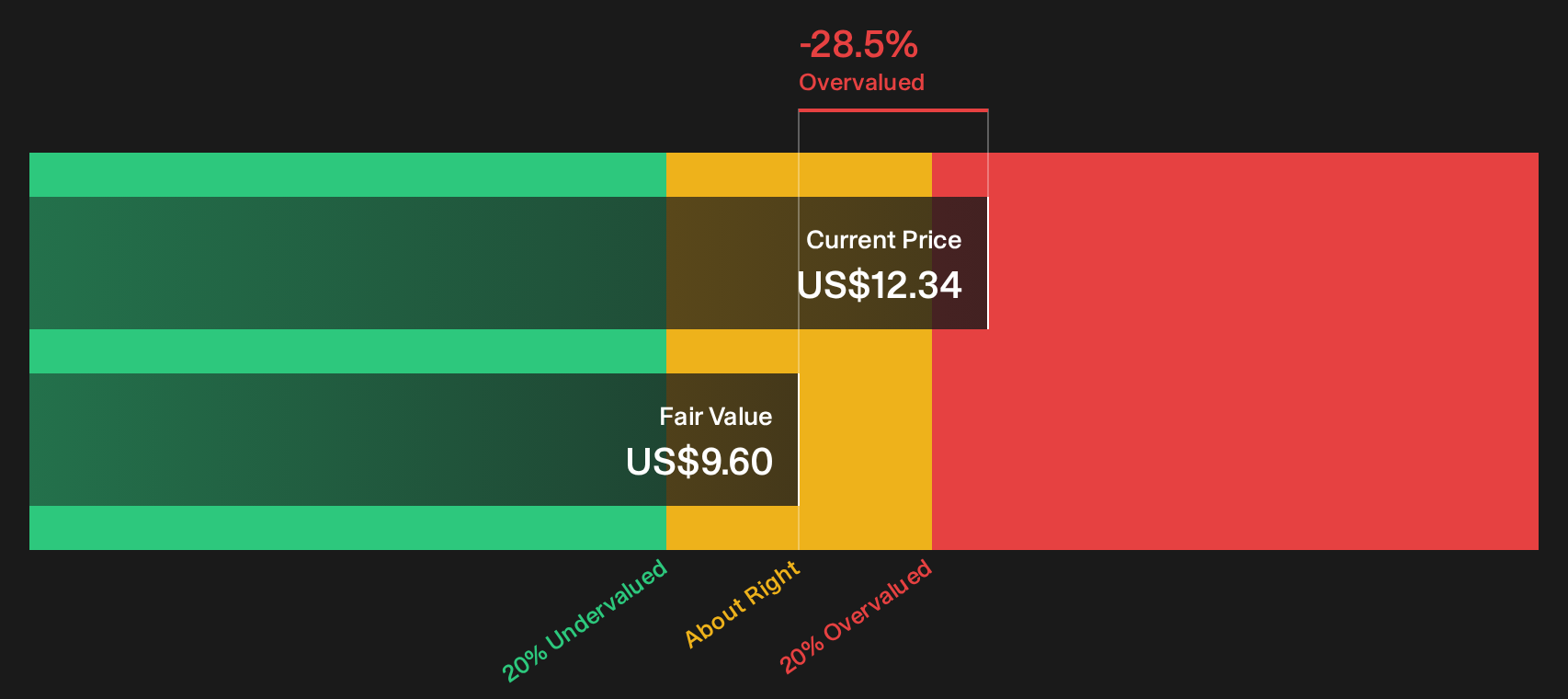
Simply Wall St performs a discounted cash flow (DCF) on every stock in the world every day (check out PG&E for example). We show the entire calculation in full. You can track the result in your watchlist or portfolio and be alerted when this changes, or use our stock screener to discover 32 high quality undervalued stocks. If you save a screener we even alert you when new companies match - so you never miss a potential opportunity.
Next Steps
Mixed signals around PG&E can be confusing, so move quickly from headline takes to your own judgment by weighing both sides of the story in detail and reviewing the 4 key rewards and 3 important warning signs.
Looking for more PG&E-adjacent investment ideas?
If this PG&E story has you rethinking your watchlist, you may want to broaden your scope and let a few targeted screeners surface opportunities you might otherwise miss.
- Focus on quality at a discount by scanning companies that look mispriced on fundamentals through the 32 high quality undervalued stocks.
- Strengthen your defensive side by reviewing businesses with resilient finances using the list of solid balance sheet and fundamentals (24 results).
- Explore a focused set of lesser-known opportunities with strong metrics via the 16 high quality undiscovered gems.
This article by Simply Wall St is general in nature. We provide commentary based on historical data and analyst forecasts only using an unbiased methodology and our articles are not intended to be financial advice. It does not constitute a recommendation to buy or sell any stock, and does not take account of your objectives, or your financial situation. We aim to bring you long-term focused analysis driven by fundamental data. Note that our analysis may not factor in the latest price-sensitive company announcements or qualitative material. Simply Wall St has no position in any stocks mentioned.
Have feedback on this article? Concerned about the content? Get in touch with us directly. Alternatively, email editorial-team@simplywallst.com