
How Stadium Payments Deal Will Impact Fiserv Stock
- Fiserv announced that the Winnipeg Blue Bombers have adopted its Clover platform across their venue, using the system for payment processing, point of sale and venue management in high volume game day conditions.
- The deal gives Fiserv another reference customer in Canadian sports and entertainment, expanding real world use of Clover in complex, peak traffic environments that test reliability and operational reporting.
- We will now look at how Fiserv's investment narrative could be influenced by Clover's deployment across a major Canadian sports venue.
Compare Fiserv's stadium push with other payment and venue-operations plays by scanning our hand picked 85 AI infrastructure stocks that benefit when digital transaction rails become mission critical for live events.
Fiserv Investment Narrative Recap
To own Fiserv, an investor needs to believe the payment and banking software franchise can turn its high recurring revenue base, Clover and core modernization into steadier earnings despite muted top line expectations. The Winnipeg Blue Bombers contract fits this, since it shows Clover operating in a complex, high traffic venue that stresses uptime, reporting and connectivity.
The key short term swing factor remains execution against reset 2026 guidance and Project Elevate cost work, rather than one stadium contract. Weakness in Merchant and Financial Solutions and lowered revenue and margin targets keep the risk tilted toward further pressure if demand softens or new deployments like Clover do not scale as hoped.
The most relevant recent disclosure for this stadium announcement is the fraud related dispute involving FiCare Federal Credit Union and several other institutions. It highlights how any perceived gaps in security or response times can quickly become operational and reputational issues for a provider that sells reliability as a core part of the value proposition.
For a reader watching Fiserv, this sits alongside the Clover win as a reminder that the same rails handling stadium concessions are also expected to manage fraud and chargebacks for banks and credit unions. Progress on AI led security tools and call center execution could become just as important to near term sentiment as new venue wins or core banking deals.
Fiserv's analyst narrative points to revenues of US$21.3b and earnings of US$3.1b by 2029, based on current consensus. That implies revenue that is broadly flat each year, while profits would need to rise by about US$0.3b from earnings today of US$2.8b.
Uncover why Fiserv's fair value indicates a 30% potential upside to its current price that may not last much longer.
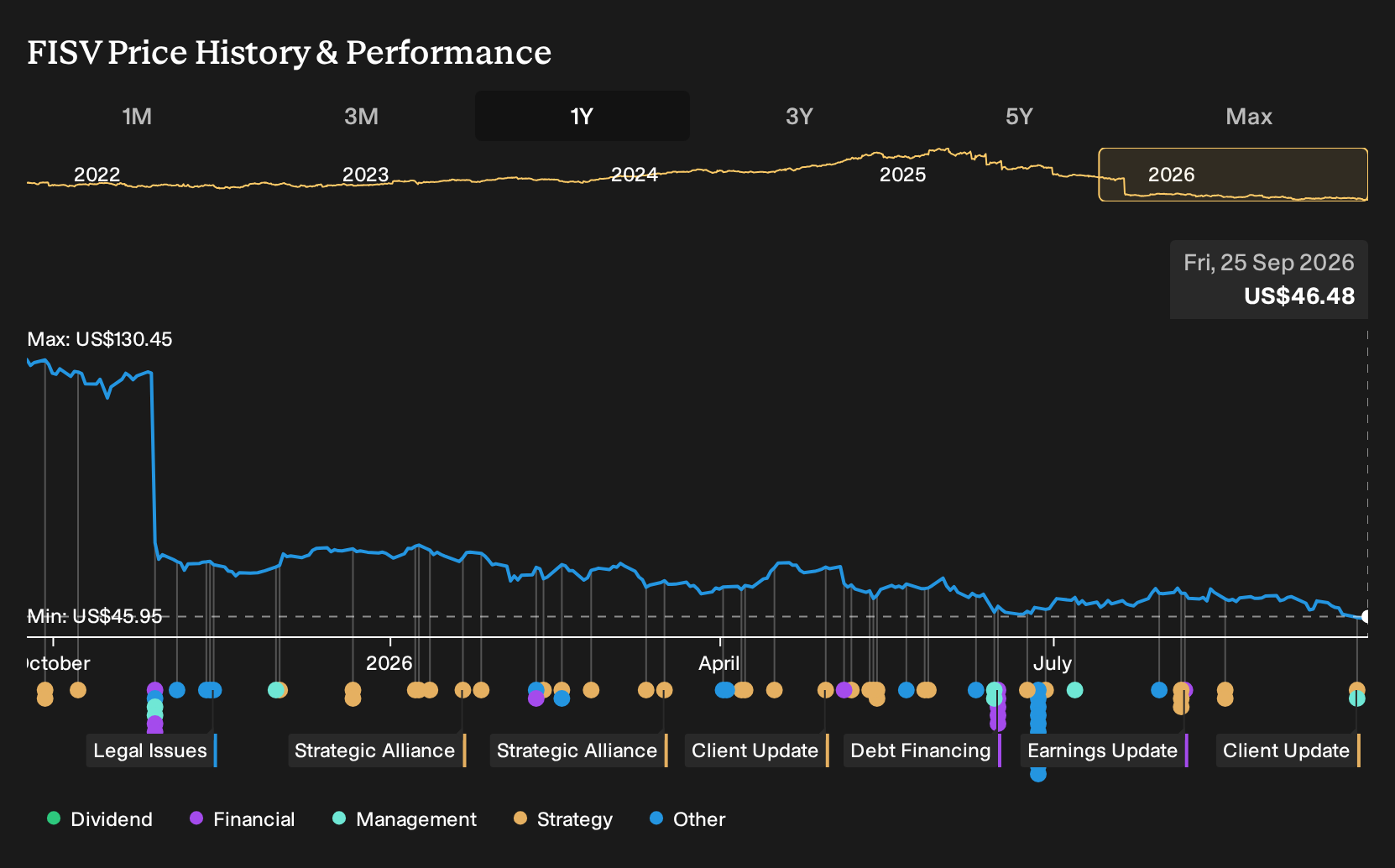
Exploring Other Perspectives
For a different angle, focus on the risk that new payment giants and blockchain based rails could chip away at Fiserv’s relevance, even as the Winnipeg Blue Bombers deal showcases Clover in action. The most pessimistic analysts were modeling revenue of about US$20.3b and earnings near US$2.9b by 2029, so their pre news view of Fiserv was far more cautious than consensus. These are wide opinion gaps. Use them as a prompt to compare several narratives and decide which assumptions you find most convincing as fresh deals and the fraud dispute play out.
Explore 13 other Fiserv fair value estimates, including one that suggests as much as 14% downside from the current price.
Reach Your Own Conclusion
Disagree with existing narratives? Extraordinary investment returns rarely come from following the herd, so go with your instincts.
- A great starting point for your Fiserv research is our analysis highlighting 3 key rewards and 1 important warning sign that could impact your investment decision.
- See our latest analysis for Fiserv. The report includes a comprehensive fundamental analysis summarized in a single visual, the Snowflake, which makes it easy to evaluate Fiserv's overall financial health at a glance.
Looking For More Ideas Beyond Fiserv?
If this Fiserv story has you thinking about where payment rails, cash flows and balance sheets intersect, it can help to widen the lens and compare a few very different types of opportunities side by side.
- For investors who want quality and value working together, start with a 32 high quality undervalued stocks that pair solid fundamentals with prices that still look reasonable on key metrics.
- If resilience matters more than excitement for your portfolio, consider a 30 resilient stocks with low risk scores that score well on financial strength and business stability.
- To uncover lesser known businesses before they hit the mainstream, scan a 16 high quality undiscovered gems that already show strong fundamentals but get less day to day attention.
This article by Simply Wall St is general in nature. We provide commentary based on historical data and analyst forecasts only using an unbiased methodology and our articles are not intended to be financial advice. It does not constitute a recommendation to buy or sell any stock, and does not take account of your objectives, or your financial situation. We aim to bring you long-term focused analysis driven by fundamental data. Note that our analysis may not factor in the latest price-sensitive company announcements or qualitative material. Simply Wall St has no position in any stocks mentioned.
Have feedback on this article? Concerned about the content? Get in touch with us directly. Alternatively, email editorial-team@simplywallst.com