
Fortive (FTV) Slides As Undervalued Narrative Faces A Reality Check
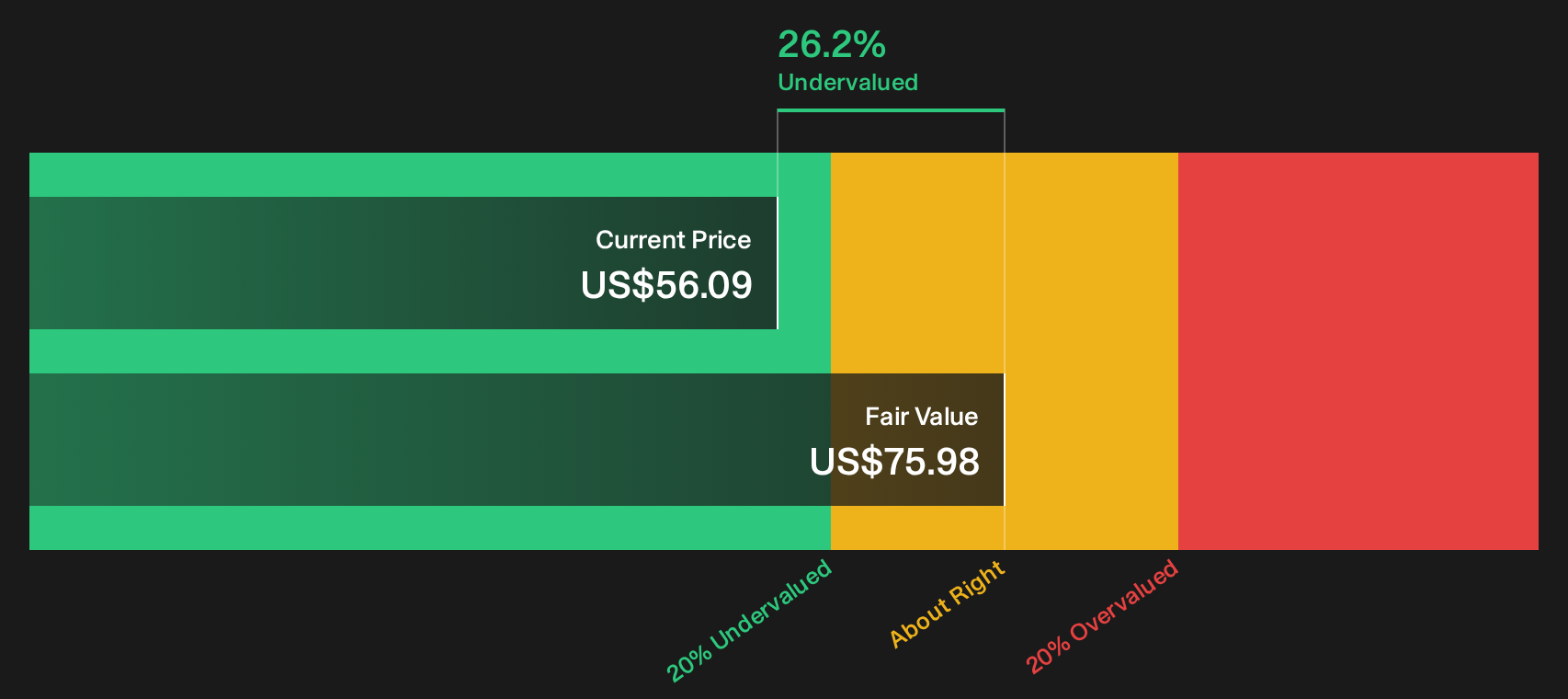
Fortive (FTV) is back on screens after a recent move in the share price, with the stock closing at US$56.09. Investors are weighing this shift against longer term return and earnings trends.
Over the past month the 6.0% decline in Fortive’s share price contrasts with a 1.3% share price gain year to date, while a 16.1% total shareholder return over the past year hints that recent weakness may reflect shifting views on future growth or risk rather than a broken longer term story.
Scan how Fortive compares with other industrial and infrastructure players on fundamentals, balance sheet strength, and recent price action using a curated list of list of solid balance sheet and fundamentals (24 results).
Recent trading now poses a simple question for Fortive: Are sellers reacting to something in the underlying US$4.3b revenue and US$602.2m profit engine, or has sentiment simply moved faster than the business?
Most Popular Narrative: 22% Undervalued
Fortive’s most followed valuation story points to a Fair Value of $72.00 against the recent close at $56.09, which puts the current share price at a clear discount while hinging heavily on how recurring revenue and margin mix evolve from here.
Ongoing use of free cash flow above US$1b a year for a mix of buybacks and focused bolt on acquisitions, following nearly US$2b of repurchases and recent technology add ons such as UV Smart and Aeroqual, provides scope for per share earnings growth and potential improvement in return on invested capital beyond what is implied by organic revenue alone.
See why 1 investors see Fortive as 22% undervalued.
Result: Fair Value of $72.00 (UNDERVALUED)
Still, that bullish Fortive narrative could come under pressure if the recent mix shift toward lower margin products persists, or if Q3 and Q4 margin headwinds deepen.
Find out about the key risks to this Fortive narrative.
Another View On Fortive’s Valuation
On earnings multiples, Fortive looks less generous. The stock trades on a P/E of 28.1x, above both the US Machinery industry at 24.5x and the peer average at 26.5x, and above its own fair ratio of 22.2x, which points to valuation risk if sentiment cools.
Investors can weigh that against what our DCF work implies by reviewing how the SWS DCF model treats Fortive’s cash flows and sensitivities Look into how the SWS DCF model arrives at its fair value.
Next Steps
Mixed signals on Fortive can be useful if you use them as a prompt to check the data yourself and move quickly while sentiment is still forming. To see the balance of concerns and potential upside that other investors are focused on, start with 3 key rewards and 1 important warning sign.
Looking for more Fortive-sized investment ideas?
If Fortive has you thinking more broadly about opportunity and risk, use that momentum now and line up a fresh watchlist before the next move hits.
- Target resilient balance sheets and steady fundamentals by reviewing the list of solid balance sheet and fundamentals (24 results), which is built to surface financially robust businesses.
- Hunt for potential value opportunities by scanning the 32 high quality undervalued stocks, which combines quality metrics with pricing that may look appealing.
- Prioritize income and stability by checking the 8 dividend fortresses, which focuses on companies offering higher yields with screening on financial strength.
This article by Simply Wall St is general in nature. We provide commentary based on historical data and analyst forecasts only using an unbiased methodology and our articles are not intended to be financial advice. It does not constitute a recommendation to buy or sell any stock, and does not take account of your objectives, or your financial situation. We aim to bring you long-term focused analysis driven by fundamental data. Note that our analysis may not factor in the latest price-sensitive company announcements or qualitative material. Simply Wall St has no position in any stocks mentioned.
Have feedback on this article? Concerned about the content? Get in touch with us directly. Alternatively, email editorial-team@simplywallst.com