
This Asset Manager Stock Gets Paid on Money It Never Owns. Could It Set You Up for Life?
Key Points
Money managers aren’t paid for performance, but rather, simply for overseeing investors’ assets.
The business is typically a high-margin one as well, supporting generous dividends.
One investment manager, in particular, consistently capitalizes on its sheer size.
Ever hear the phrase, "It takes money to make money?" It's often true, in the sense that you must put your own capital at risk if you want to grow it. But it's not true in all cases.
Take the asset management business as an example. Whether you're talking about hedge funds, mutual funds, or registered investment advisors managing individuals' money, these businesses generate revenue from money that's never actually owned -- just controlled -- by the people overseeing it.
Missed AI’s "Act 1"? Act 2 Could Be 15x Bigger. Most investors think they missed the AI boat because they didn't buy Nvidia in 2005. But according to our analysts, we’re only at the end of "Act 1"—the R&D phase. "Act 2" is the global rollout. Continue »
And there's one asset manager most investors are more familiar with than perhaps they even realize. That's BlackRock (NYSE: BLK). But is this publicly traded money manager one you'd want to buy and hold forever?

Image source: Getty Images.
A closer look at BlackRock
You may or may not have heard the name. You've almost certainly heard of its primary profit center, however. Although it's not all that it is, BlackRock is the name behind the iShares family of exchange-traded funds, or ETFs. As of the end of June, it was managing a world-leading $15.3 trillion worth of investors' assets, contributing to Q2 revenue of nearly $7.1 billion, almost $2 billion of which was converted into net income. Modest fees collected for management of these funds account for most of its top line.
There's an important detail about the business quietly buried in these results, too. That is, it's not performance-based. Money managers collect a quarterly fee regardless of how much money their clients make in any given quarter, or even if they lose money during that three-month stretch. Investment managers simply work to garner and then keep as much client money as possible, sometimes by minimizing losses more so than maximizing gains. And yes, there's often a lot of reminding investors to "think long-term" involved.
BlackRock is good at this aspect of the business, too. That's what its numbers indicate anyway. Just three years ago, it was overseeing only $9.4 trillion. While market gains certainly helped during this time, over the past 12 months, the company has experienced net cash inflows of $868 billion as investors seek the best way to allocate their capital.
A great lifetime pick
It's not a high-growth business. It's a high-margin one, though, and for BlackRock's shareholders in particular, net returns have been strong largely thanks to this stock's persistently big dividend growth. The current quarterly payment of $5.73 per share is 39% higher than the per-share payout of $4.13 five years ago, and 150% more than the $2.29 per share it was dishing out just 10 years ago.
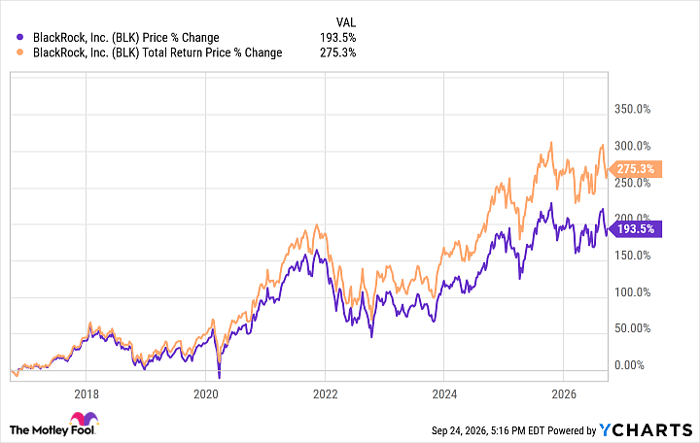
Data by YCharts.
It can easily afford these growing dividend payments, too. The company earned $12.19 per share during the second quarter ending in June, up nearly 20% year over year, and capping off a year-to-date bottom line of $26.25. It's a testament to how consistent -- and consistently profitable -- the asset management industry can be, especially when the manager's been around as long as BlackRock, and has figured out how to navigate the ever-evolving business.
More to the point (and in answer to the question), yes, a stake in BlackRock could indeed set you up for life, whether you plan on reinvesting its dividend payments or collecting and then using its cash payments.
James Brumley has no position in any of the stocks mentioned. The Motley Fool has positions in and recommends BlackRock. The Motley Fool has a disclosure policy.