
The price of 100 dollars of oil has met with a wave of exports of AI computing power hardware! The Malaysian ringgit is expected to use a “double catalyst” to counterattack the foreign exchange market
The Zhitong Finance App learned that some senior foreign exchange market strategists said that the rise in oil prices and the boom in artificial intelligence provided positive factors for the Malaysian ringgit, and that the sovereign currency may rise. Although the ringgit has fallen 1.2% since September, lagging behind all other Asian currencies, Bank of Mitsubishi UFJ's latest forecast shows that the ringgit will appreciate to RM4.03 per dollar by the end of the year. Sumitomo Mitsui Bank expects it to reach RM4.0 against USD 1 by then. As of last Friday, the foreign exchange market closed up 0.3% to RM4.0738 per dollar.
High international oil prices and the expansion of AI hardware demand are providing Malaysian ringgit with two complementary support paths — energy export revenue buffers external shocks, and electronics industry exports, which are highly linked to the AI infrastructure process, enhance the ability to generate foreign exchange income. The core view of the Malaysian ringgit, which financial institutions are optimistic about, focuses on strong electronics exports, capital inflows, and policy stability to jointly support exchange rate restoration.
The key variable in the energy market is still whether the resumption of transportation in the Strait of Hormuz can actually reduce supply risks with the US and Iran. Iranian President Pezzahizyan's tough statement during the UN General Assembly last week, as well as the Houthi attack on Saudi Arabia, have successively strengthened market concerns about supply disruptions in the Middle East. On September 25, as news of the US and Iran exploring a phased end to the conflict heated up, Brent crude oil futures fell 2.1%, but still closed at $104.32 per barrel; by September 27, Trump said he had rejected Iran's proposal and expected negotiations to resume this week; Iranian Foreign Minister Alagzi emphasized that conditions would not be softened. There are still channels of negotiation between the US and Iran, but differences between strait traffic, port blockades, and nuclear issues make it difficult for the geo-risk premium in energy prices to quickly subside.
Export support brought about by the AI infrastructure frenzy is already reflected in Malaysia's trade data. According to official data, exports of goods increased 45.5% year on year in August to about RM191.05 billion; among them, exports of electronic and electrical products increased 66.5% year on year to about RM92.48 billion, accounting for 48.4% of total exports. The International Monetary Fund also listed Malaysia, China, South Korea, and Thailand as the top four net exporters of AI-related hardware in the world. All of this means that Malaysia can handle part of the increase in demand for global computing power investment through the packaging testing chain, which is critical in the electronics manufacturing and semiconductor industry chain.
Oil prices and AI computing power demand jointly support the ringgit exchange rate trend
Another rise in oil prices may increase the income of this energy exporter, and Malaysia's increasingly important position in the AI supply chain will also enable it to benefit from growing demand for semiconductors. As the political risk premium surrounding some state elections gradually subsides, strategists expect the ringgit to resume its upward trend.
Jeff Ng, head of Asian macro strategy at Sumitomo Mitsui Banking Corporation in the Singapore market, said: “As concerns about the macro environment ease, we may see the ringgit rebound after a round of pressure relief before the end of the year.” He said that considering Malaysia's exports of energy and electronics products, as well as the linkage between the ringgit and the strengthening of the RMB, “Malaysia's overall fundamentals are still improving.”
Driven by increased shipments of electronic products, including semiconductors, the country's exports increased by more than 35% each month for five consecutive months up to August. The average export growth rate in 2025 was around 6.7%. According to the International Monetary Fund, Malaysia, along with South Korea, China, and Thailand, currently ranks among the top four global net export economies for AI infrastructure-related hardware.
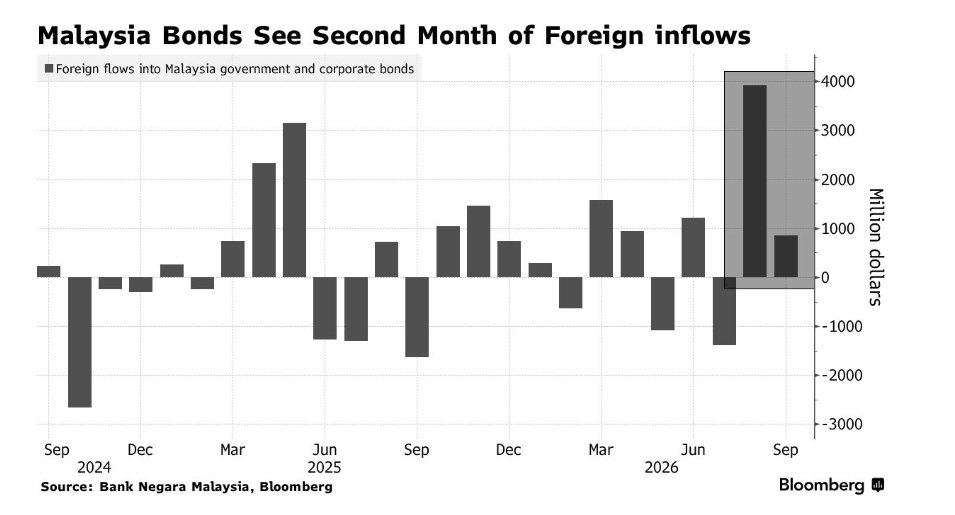
As shown in the chart above, Malaysian bond assets received foreign capital inflows for the second month in a row, benefiting from liquefied natural gas exports and AI infrastructure hardware exports.
Lloyd Chan, a Singapore-based foreign exchange strategist at Mitsubishi UFJ Bank, said: “Malaysia's electronics trade surplus has helped offset higher oil import bills.” He added that “we think there is room for the Malaysian ringgit to strengthen”, supported by attractive sovereign bonds and ringgit valuations.
According to the Bank for International Settlements, the actual effective exchange rate of the ringgit is about 2% lower than its 20-year average. Continued inflows into the bond market may help support the ringgit.
Investors will pay close attention to the S&P Global Malaysia Manufacturing Purchasing Managers' Index for September released on Thursday local time to find further signs of economic expansion, and the region is still coping with the impact of the situation in the Middle East. However, as one of the world's leading exporters of liquefied natural gas, Malaysia's ability to cope with rising energy costs is probably better than some other economies.
Goldman Sachs Group strategists, including Danny Suwanapruti, wrote in a report on September 18: “Since this year, Malaysia has been on the relatively favorable side of changes in international trade conditions,” and is best placed to benefit from AI investment and rising energy prices. They said that as central banks around the world turned slightly hawkish, “the conditions are in place for the ringgit to outperform other currencies,” and suggested going long for the ringgit and shorting the baht. Both Thailand and Malaysia can participate in the technology export cycle, but there are differences in energy balance structures, policy expectations, and capital flows, and the ringgit may gain a comparative advantage as a result.
The “dual positive catalyst” of ringgit: energy resists shocks, and AI technology enhances foreign exchange
The market understands the investment logic of ringgit, which is closely linked to the dual positive catalyst of “energy buffer+strong AI technology hardware exports”. Malaysia has an important liquefied natural gas export business, and rising energy prices can improve related export revenues, but the country also needs to import crude oil, and high oil prices will also increase the pressure on import expenses and fuel subsidies. Therefore, what determines the fundamentals of the exchange rate is the net result of oil and gas export revenue, energy import costs, and electronic product trade surpluses related to semiconductor sealing and AI infrastructure. The Bank of Mitsubishi UFJ clearly stated that the electronics industry trade surplus helps offset higher oil resource import bills. This also explains why “energy exporters” and “withstand rising oil import costs” can be established at the same time.
Looking at the AI system architecture, an agent extends a user request to continuous work such as model inference, search, tool call, code execution, and result verification. The infrastructure requirements then cover GPU computing, CPU execution, memory capacity and bandwidth, as well as storage and high-performance network infrastructure and optical interconnection systems. When demand is transferred to the hardware supply chain, Malaysia's main beneficiaries include existing electronics manufacturing, semiconductor assembly and advanced packaging, testing infrastructure, and ongoing design and 2.5D/3D advanced packaging upgrades. The Malaysian Investment Development Authority has clearly listed these directions as priorities for industrial upgrading. For the ringgit, the really important transmission chain is the transformation of global AI investment into local orders, production and export revenue, and further forms settlement demand; the increase in overseas computing power expenses itself will not automatically be converted into ringgit purchases in equal amounts.
The flow of funds is providing another layer of support. According to RAM Ratings data, the Malaysian bond market recorded a net foreign inflow of RM15.9 billion in August and continued to have a net inflow of RM3.5 billion in the first 17 days of September, indicating that bond assets are continuing to attract overseas capital. On the policy side, Bank of Malaysia maintained the overnight policy interest rate at 2.75% on September 3, while stressing caution against cost pressure and changes in domestic demand. Bond valuations, policy credibility, and foreign capital allocation requirements are expected to enhance ringgit support, but the actual exchange rate impact still depends on whether funds are hedged against foreign exchange and other cross-border payments.