
Insmed (INSM) Could Be 40% Undervalued On FDA Priority Review News
Insmed (INSM) is back in focus after the FDA accepted its supplemental New Drug Application for ARIKAYCE and granted Priority Review for Mycobacterium avium complex lung disease.
Short term sentiment around Insmed has cooled, with the 1-day share price return down 3.06% and the 7-day share price return down 1.81%, even as traders weigh the FDA’s Priority Review alongside a 90-day share price return of 12.50% and a 1-year total shareholder return that declined 14.01%.
Scan how traders are pricing this FDA catalyst for Insmed compared with peers working on rare disease treatments by reviewing the curated 16 high quality undiscovered gems.
Insmed now trades at a steep discount to both analyst targets and intrinsic estimates after the FDA news fueled a strong 90 day rebound. Is that simply caution around losses and drug risk, or a mispriced opportunity?
Most Popular Narrative: 40.2% Undervalued
On the most followed narrative, Insmed’s fair value of about $197.14 sits well above the last close at $117.83. This puts the current discussion squarely on whether the market is underappreciating its rare disease pipeline and respiratory portfolio.
The anticipated U.S. launch of brensocatib in bronchiectasis in the third quarter of 2025 is a major catalyst, expected to significantly increase revenue once it hits the market and starts generating sales late in Q3. The upcoming Phase II data for TPIP in PAH by mid-2025 and brensocatib in CRS without nasal polyps by the end of 2025 are key clinical milestones that could enhance future revenue streams if positive.
See why 21 investors see Insmed as 40% undervalued.
Result: Fair Value of $197.14 (UNDERVALUED)
Still, the Insmed narrative could flip quickly if FDA review timelines slip or if payers push back hard on brensocatib reimbursement and access.
Find out about the key risks to this Insmed narrative.
Another View On Insmed’s Valuation
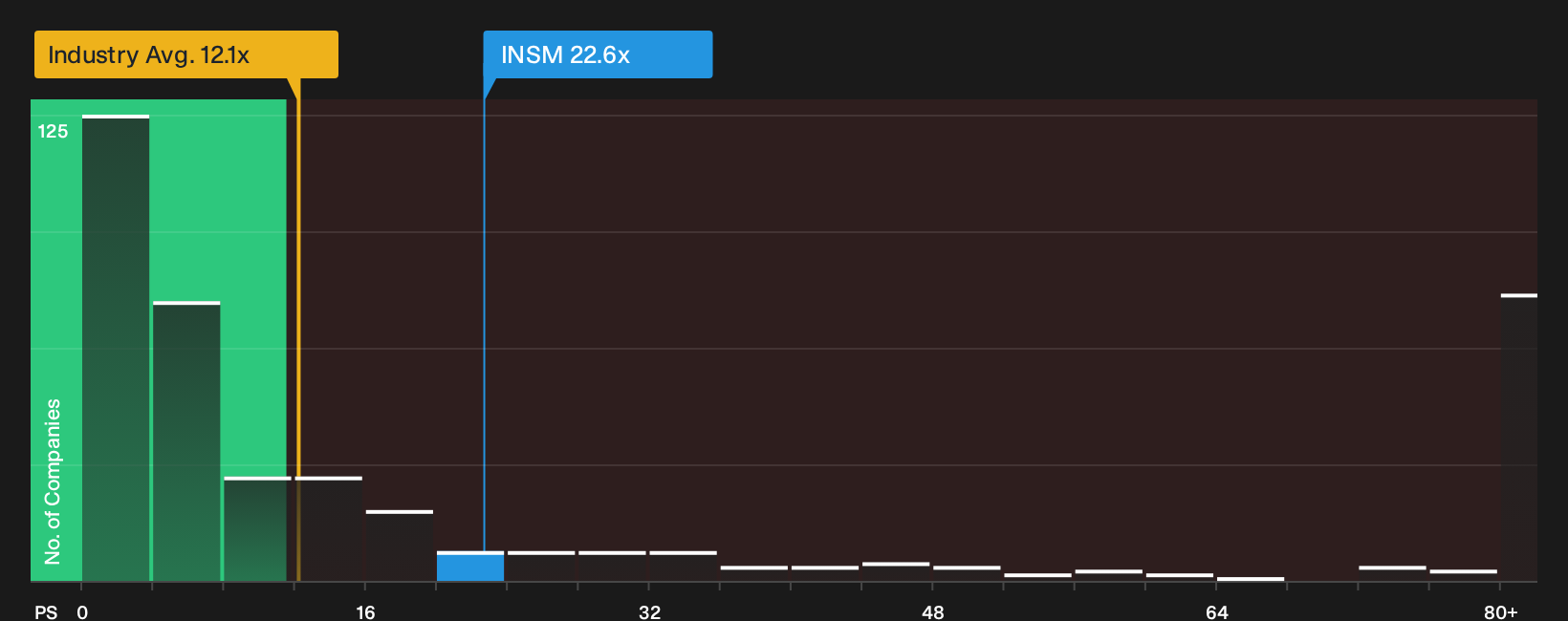
The first narrative leans heavily on future earnings targets and analyst fair value, yet the market is also sending a different signal through today’s P/S ratio. Insmed trades on 22.6x sales compared with 12.1x for the US Biotechs industry and 7.6x for peers, while the fair ratio sits lower again at 18.2x. That gap suggests investors are already paying a premium multiple while the story on profits is still ahead of them. This raises the question of whether the real disconnect lies in the earnings models or in how much you are willing to pay for revenue today.
For a deeper look at how this sales multiple stacks up against fundamentals and peers, See what the numbers say about this price — find out in our valuation breakdown..
Next Steps
The Insmed story has presented mixed messages so far. If you want to move quickly and form your own view, consider weighing the 3 key rewards and 2 important warning signs.
Looking for more Insmed-sized investment ideas?
Do not stop with Insmed. Use the Simply Wall Street Screener to quickly spot other opportunities that could suit your risk profile and portfolio goals.
- Target stronger fundamentals by scanning a list of solid balance sheet and fundamentals (24 results) that can help you avoid fragile balance sheets before they become a problem.
- Hunt for potential mispricings using a focused 32 high quality undervalued stocks that flags businesses where quality and valuation look better aligned.
- Dial down portfolio stress with a curated 30 resilient stocks with low risk scores so you are not relying on just one catalyst-driven idea.
This article by Simply Wall St is general in nature. We provide commentary based on historical data and analyst forecasts only using an unbiased methodology and our articles are not intended to be financial advice. It does not constitute a recommendation to buy or sell any stock, and does not take account of your objectives, or your financial situation. We aim to bring you long-term focused analysis driven by fundamental data. Note that our analysis may not factor in the latest price-sensitive company announcements or qualitative material. Simply Wall St has no position in any stocks mentioned.
Have feedback on this article? Concerned about the content? Get in touch with us directly. Alternatively, email editorial-team@simplywallst.com