
AI narrative+valuation depression, global funds are no longer “withdrawing” from the Chinese stock market
The Zhitong Finance App learned that, attracted by the prospects and valuation advantages of the artificial intelligence (AI) circuit, global fund managers are reversing the decline in Chinese stock positions that have continued for many years.
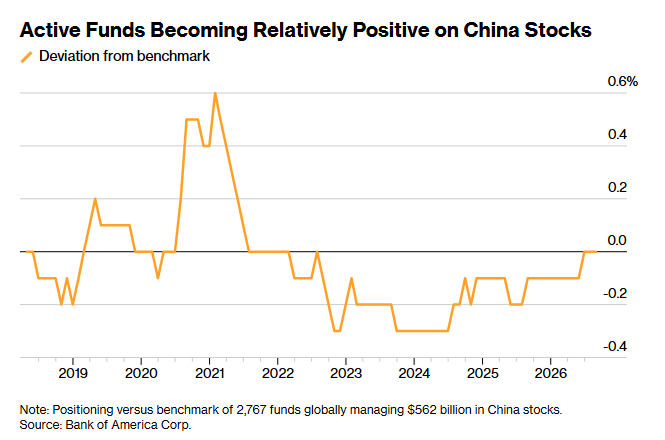
After analyzing nearly 2,800 global funds, Bank of America found that since June, the average allocation of active pure long funds to Chinese stocks has risen to a “benchmark neutral” level, ending a four-year “low allocation” state. The bank's strategist Nigel Taper said that these funds manage a total of 562 billion US dollars of Chinese stock assets.
This shift shows that the attractive valuation levels and profit expectations of growth sectors such as AI have improved, boosting confidence in fund allocation. Although this does not mean that the market will be bullish across the board, it indicates that fund managers have largely completed operations to reduce their exposure, removing a major obstacle to market recovery.
Gary Tan, portfolio manager at Allspring Global Investments, said, “The selling pressure is close to the bottom, and investors' focus is shifting from position adjustments to the fulfillment of corporate profits.” He added that his institution is selectively increasing positions in Chinese stocks. “The improvement in the Chinese market environment does not require global investors to turn bullish across the board; as long as they don't continue to reduce their holdings, that's enough.”
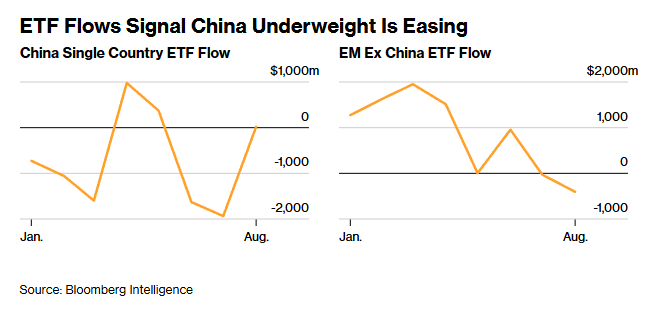
Other data on capital flows also confirm this trend. According to industry research data, exchange-traded funds (ETFs) focusing on mainland China and Hong Kong recorded an inflow of $19 million in August after outflows of US$1.94 billion in July. At the same time, the scale of capital outflows from emerging market funds, which do not include Chinese assets, is still expanding.
Industry research analyst Rebecca Sin said, “Among major emerging markets, Chinese ETFs have experienced the most drastic downsizing, but now the systemic underallocation situation may be bottoming out. The various factors contributing to the low allocation of Chinese assets have weakened.”
Valuation advantages also play a supporting role. The current price-earnings ratio of the MSCI China Index is about 10.2 times the expected profit for the next 12 months, which is 11.7 times lower than its 10-year average.
Furthermore, profits in some sectors related to the direction of domestic technology development have picked up. According to statistics, the net profit of listed companies in Shanghai increased 17.6% year-on-year in the first half of the year, despite weak performance in the real estate and consumer industries, benefiting from technological hardware and new economy companies.
However, this fragmentation also means that the recovery of the Chinese market is still uneven. The Shanghai and Shenzhen 300 Index fell about 11% this quarter, and investors are still maintaining a structured stock selection approach.
Herald van der Linde, head of Asia Pacific equity strategy at HSBC Holdings, said: “To invest in China, you want to buy China's future.” He is optimistic about the hardware technology and biopharmaceutical sectors, while the consumer industry and real estate are “China's past.”