
Non-agricultural and PCE will reveal the resilience of the US economy this week or further boost expectations of interest rate hikes
The Zhitong Finance App learned that a number of key economic reports to be released this week are expected to further prove that the US economy is strengthening and support the arguments of many Federal Reserve officials that interest rates should be higher. After recent data showed a sharp increase in retail sales in the US in August and the fastest growth rate in more than five years in September, market expectations for another rate hike as early as October have already heated up.
The good news on the growth side is also stinging: inflation is still above the Federal Reserve's 2% target, forcing the central bank to once again put pressure on households and businesses to raise interest rates after raising interest rates for the first time in more than three years at the beginning of this month. What makes the situation even more tense is that the Federal Reserve's next interest rate decision will be released a few days before the high-profile midterm elections. This week's data is likely to set the balance for this debate.
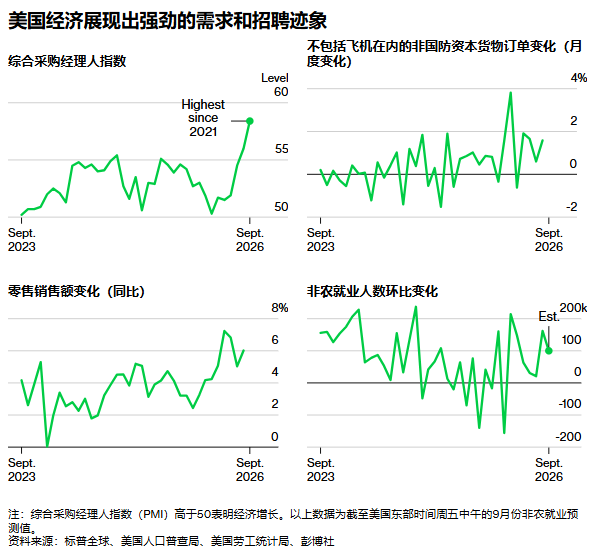
Economists expect data released on Wednesday to show the biggest increase in consumer spending during the year after adjusting for inflation in August. Although the Federal Reserve favors a calibrated adjustment to the core inflation index, which is expected to lower the year-on-year reading by up to 0.3 percentage points, the monthly picture is not that reassuring. The core personal consumption expenditure (PCE) price index, which excludes food and energy, is expected to rise 0.3% month-on-month, up from the previous two months.
The latest non-farm payrolls data will be released later on Friday, which is expected to show that employment growth remains steady. As of Friday, economists expect employers to add about 90,000 new employees in September, and the unemployment rate will remain at 4.1%.
Michael Feroli (Michael Feroli), the chief US economist at J.P. Morgan Chase, said that if companies continue to hire at the recent pace, the picture of a slow upward trend in interest rates may change.
“Over the past few years, inflation seems to have been driven by supply shocks,” Ferrori said, “but if the labor market tightens and wage growth accelerates, then I think we'll start to think that there's a bit too much good news on growth.”
A number of Federal Reserve officials used speeches and public appearances last week to repeatedly warn that inflation is still too high. Federal Reserve Governor Michael Barr (Michael Barr) said that further interest rate hikes may be needed to cool prices; Chicago Federal Reserve Chairman Austin Goolsbee (Austan Goolsbee) warned that the path back to the central bank's 2% target will not be painless.
Goulsby, Richmond Federal Reserve Chairman Tom Barkin (Tom Barkin), Cleveland Fed's Beth Hammack (Beth Hammack), and Philadelphia Federal Reserve's Anna Paulson (Anna Paulson) also pointed out that the overall economy is building momentum — even if only gradually.
“The concern is, will we see things heat up?” Hamak said on Friday, “Now when I visit the region and communicate with companies, I hear that spending is very resilient.”
A historic artificial intelligence boom is fueling construction and manufacturing, while businesses and households continue to consume in the face of soaring oil prices linked to the war in Iran.
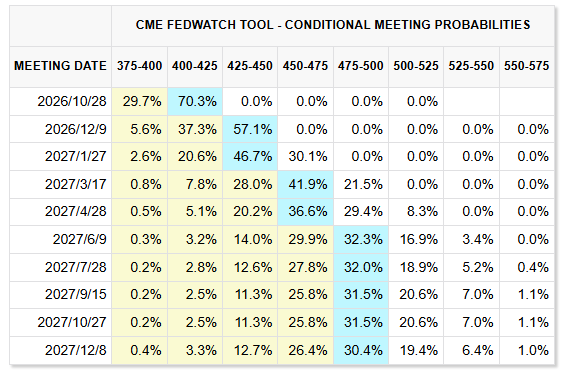
Bond yields are another factor policymakers need to consider, and investors are betting that the central bank will raise interest rates at least once this year. As of press time, the pricing of federal funds futures shows that the probability of an October rate hike is about 70%.
“Part of the inflation we're seeing now is because the economy is so strong,” said Beth Ann Bovino (Beth Ann Bovino), chief economist at Bank of America. “The possibility of another rate hike is becoming very real.”
Vulnerable American Families and Businesses
What needs to be explained is that not the entire economy is booming, and heavy reliance on the AI boom itself may become a burden. Patrick Harker (Patrick Harker), a former head of the Philadelphia Federal Reserve, who now lives at the Wharton School of Business at the University of Pennsylvania, warned that higher borrowing costs would reveal a potential vulnerability, particularly among vulnerable households.
“I really think we have to be careful,” Huck said. He said the economy is “running on a very large engine — data center construction, and the power grid construction that comes with it. The rest of the economy seemed to glide and wasn't really doing much”.
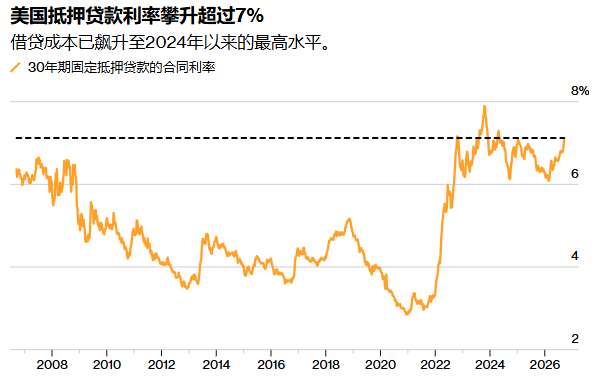
In the real economy, higher borrowing costs are significant. According to data from the New York Federal Reserve, credit card and car loan delinquency rates have continued to rise in recent years. In the first quarter of this year, the credit card delinquency rate rose to its highest level since 2011, and remained high in the second quarter. The housing market, on the other hand, has been held back by mortgage interest rates — which have risen to their highest level in more than two years.
Those affected by interest rates
To put it bluntly, one of those who felt the sting was Aurelius Chaves, president and owner of Midland Machinery, a road-building equipment manufacturer in Tonawanda (Tonawanda), NY. He has had to deal with rapidly rising costs, from employee health insurance to corporate insurance. When the Federal Reserve raised interest rates, both his own loan costs and equipment dealers who bought his products were impacted.
“My sales go through the dealer network, so when their costs go up, they start shrinking inventory,” Chavez said. “I know very well how much more interest will cost me next year for every 25 basis points increase in interest.”
As of now, Chavez said that the overall business is still being supported, and this feeling is confirmed by other readings. The “Orange Book” (Orange Book), compiled by institutional industry research, found that in a recent earnings call, more than two-thirds of the industry mentioned that economic recovery was accelerating, and most of this was due to a boom in AI investment.
Federal Reserve Chairman Kevin Warsh (Kevin Warsh) cited this strength, and he attributed the central bank's recent decision to raise interest rates in part to an optimistic outlook for accelerated growth. “If you think about the geopolitical landscape where shocks and uncertainties intertwine, you will begin to appreciate the resilience of the US economy,” Walsh told reporters on September 16.
If policymakers decide to raise interest rates again on October 28 — less than a week before the critical midterm elections — the challenge for Walsh will be how to package this message to those who put him in this position.
Although President Donald Trump has calmed down his sharp criticism of the Federal Reserve, he made his position clear at the May swearing-in ceremony for Walsh. “Unlike some of his predecessors, Kevin understood that when the economy is prosperous, that's a good thing,” Trump said. “We don't have to go crazy; just let it prosper.”