
Gaming And Leisure Properties (GLPI) Looks Cheap As Recent Weakness Tests The Bull Case
Gaming and Leisure Properties (GLPI) drew fresh attention after recent performance data showed the stock down about 9% over the past month and roughly 13% over the past 3 months, which has focused investors on its valuation.
Over the past year, Gaming and Leisure Properties has seen its share price performance soften, with the stock currently at $38.79 and a year-to-date share price return down 12.67%, while the 1-year total shareholder return is down 11.05% but remains positive over 3 and 5 years. This points to shorter-term momentum fading compared with the longer-term record.
Compare Gaming and Leisure Properties’ recent pullback with other income-focused real estate plays by scanning our curated list of 7 dividend fortresses for potential alternatives.
After a 12.67% year-to-date slide, Gaming and Leisure Properties trades well below a US$52.39 consensus target and at a steep discount to some intrinsic value estimates. How wide is that gap in practical terms for investors focused on income and real estate exposure?
Price-to-Earnings of 11.7x: Is it justified?
On simple valuation math, Gaming and Leisure Properties looks cheap, with its current P/E of 11.7x sitting alongside a $38.79 share price and a wide gap to some intrinsic value estimates that suggest a much richer valuation.
The P/E ratio compares what investors pay for each dollar of earnings. For a specialized REIT like Gaming and Leisure Properties, this metric helps you see how the market is pricing its current profit stream from long term triple net leases, rather than just focusing on short term share price swings.
Here, the number is low relative to multiple yardsticks. Management has produced a net profit margin of 58.5% compared with 45.9% a year earlier, and earnings growth of 34.9% over the past year against a 9.7% per year record over five years. Against that backdrop, a P/E of 11.7x versus an estimated fair P/E of 33.1x suggests the market is assigning a much lower earnings multiple than the level our regression based fair ratio points toward. The valuation could move closer to that level if sentiment or assumptions change.
Against peers, the discount looks even clearer. Gaming and Leisure Properties trades at 11.7x earnings compared with 18.5x for its direct peer set and 24.3x for the broader North American Specialized REITs group, a strong relative gap that shows investors are pricing its earnings well below sector averages despite higher recent earnings growth than the industry.
Explore the SWS fair ratio for Gaming and Leisure Properties.
Result: Price-to-Earnings of 11.7x (UNDERVALUED)
Still, Gaming and Leisure Properties faces real risk if gaming tenants see weaker cash flows or if higher interest costs pressure refinancing and acquisition plans.
Find out about the key risks to this Gaming and Leisure Properties narrative.
Another view on Gaming and Leisure Properties valuation
Gaming and Leisure Properties screens as even cheaper on a second yardstick. Our DCF model points to a future cash flow value of $98.48 per share, compared with the current $38.79 price, which flags the stock as heavily undervalued on this approach too. If both P/E and cash flow math signal a big gap, what does that say about the risk investors are pricing in?
Look into how the SWS DCF model arrives at its fair value.
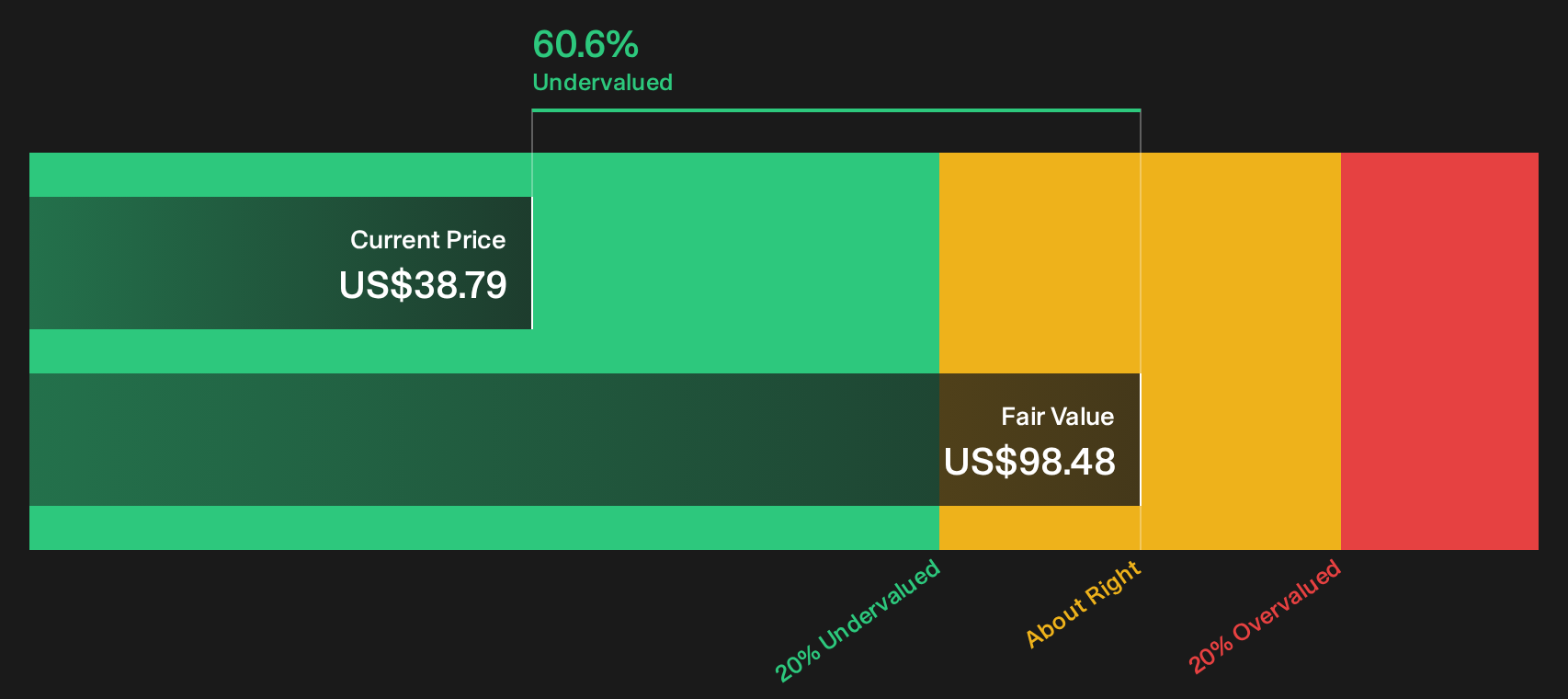
Simply Wall St performs a discounted cash flow (DCF) on every stock in the world every day (check out Gaming and Leisure Properties for example). We show the entire calculation in full. You can track the result in your watchlist or portfolio and be alerted when this changes, or use our stock screener to discover 32 high quality undervalued stocks. If you save a screener we even alert you when new companies match - so you never miss a potential opportunity.
Next Steps
Sentiment around Gaming and Leisure Properties is mixed, with both caution and optimism in play. Move quickly, review the figures for yourself, then weigh up the 5 key rewards and 2 important warning signs.
Looking for more investment ideas beyond Gaming and Leisure Properties?
If Gaming and Leisure Properties has sharpened your focus on value and income, broaden your watchlist with fresh ideas that could better match your goals.
- Target potential mispricings by scanning a curated set of 32 high quality undervalued stocks that combine attractive valuations with solid underlying fundamentals.
- Prioritize resilience by reviewing a list of solid balance sheet and fundamentals (24 results) so you are not caught holding fragile businesses when conditions turn.
- Spot early opportunities by tracking a 16 high quality undiscovered gems before wider attention crowds into the same trades.
This article by Simply Wall St is general in nature. We provide commentary based on historical data and analyst forecasts only using an unbiased methodology and our articles are not intended to be financial advice. It does not constitute a recommendation to buy or sell any stock, and does not take account of your objectives, or your financial situation. We aim to bring you long-term focused analysis driven by fundamental data. Note that our analysis may not factor in the latest price-sensitive company announcements or qualitative material. Simply Wall St has no position in any stocks mentioned.
Have feedback on this article? Concerned about the content? Get in touch with us directly. Alternatively, email editorial-team@simplywallst.com