
How Earnings Linked Dividends Will Impact Konecranes Stock Investors
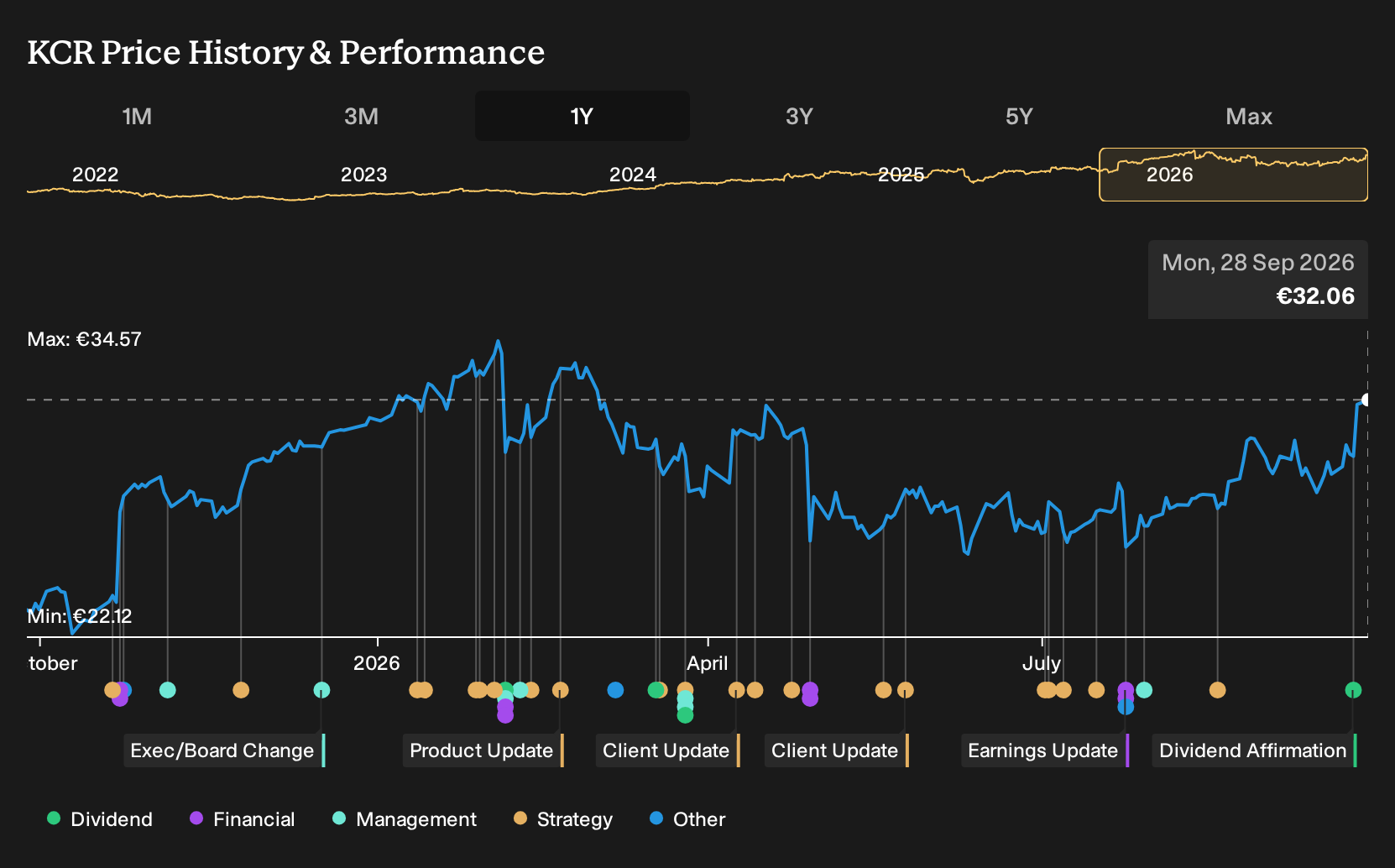
- Konecranes updated its dividend policy in September 2026, targeting a 40 to 60% payout of earnings over the business cycle, excluding exceptional items, instead of prioritising a stable or rising dividend.
- This tighter link between shareholder distributions and profitability highlights how Konecranes is prioritising balance sheet flexibility and operational resilience over rigid dividend commitments.
- We will now see how Konecranes' investment narrative is influenced by this earnings linked dividend policy shift and capital discipline.
Scan for other income focused plays that use disciplined payout rules with our curated list of 165 dividend fortresses combining shareholder returns with an emphasis on financial resilience.
Konecranes Investment Narrative Recap
To own Konecranes, you need to be comfortable with a material handling specialist that leans on cyclical industrial and port customers while pushing harder into automation, electrification and long term service contracts. The big near term swing factor is how order intake and pricing hold up against cautious customer spending and ongoing delivery bottlenecks in the Americas and Europe.
The updated dividend policy does not change that core thesis. It mainly clarifies that cash returns will flex with earnings. The key operational risk still sits in weaker Industrial Service and spare parts demand and any further softening in the order book, especially if foreign exchange moves or supply chain issues continue to eat into reported profitability.
The dividend policy announcement is the most relevant recent move for this discussion. Management now ties the payout to 40 to 60% of earnings over the cycle, excluding exceptional items. For you as a shareholder, that links cash distributions more directly to how well the cranes and service operations are actually performing at any point in time.
This approach can matter when order cycles turn or currency swings hit margins. A variable payout ratio lets Konecranes hold on to more cash when conditions are tougher, which can support working capital, product development and service capability, while still allowing higher distributions in stronger periods without over committing the balance sheet.
What The New Dividend Policy Means Against Konecranes' Forecasts
Forecasts around Konecranes matter more now that the payout is tied directly to reported profitability. With analysts expecting earnings to move from €383.7 million today to €569.3 million by 2029, the dividend stream you receive will increasingly track how close the business gets to those targets rather than any informal commitment to a smooth cash return profile.
Once the dividend is wired into earnings, your focus naturally shifts to the building blocks of those projections. Analysts are working off an assumption of 7.2% yearly revenue expansion over the next three years and an uplift in profit margins from 9.4% to 11.3%. If those inputs prove too optimistic in a softer demand patch, the payout ratio may still be intact, but the euro amount reaching your account could land well below what headline percentages suggest.
On the flip side, a richer order mix, better pricing or steadier service activity would be felt quickly through the distribution. The key point is that this is now a throughput mechanism. Konecranes converts orders and service work into earnings, then a 40 to 60% slice of that profit pool is set aside for dividends across the cycle, subject to exceptional items and any balance sheet constraints.
This arrangement often appeals to investors who want exposure to cyclical industrial cash flows without relying on a fixed dividend promise that might clash with a weaker year or heavier investment needs. You get a clearer line of sight from income back to business performance. At the same time, management keeps room to protect the balance sheet when order intake slows or when working capital and capex demands rise.
Income focused holders should still pay attention to how that 40 to 60% band is used in practice. A consistent tilt toward the lower end could signal a preference for internal reinvestment and optionality, while a habit of running at the top of the range might indicate confidence in the resilience of earnings, or a lack of large obvious reinvestment projects. Neither is inherently better. The key is whether those choices line up with your own expectations for risk, income stability and reinvestment discipline.
Konecranes' narrative projects €5.0 billion revenue and €569.3 million earnings by 2029. This assumes 7.2% yearly revenue growth and an earnings increase of about €185.6 million from €383.7 million today.
Uncover why Konecranes' fair value indicates an 11% potential upside to its current price that may not last much longer.
Exploring Other Perspectives
One alternate view on Konecranes leans heavily on competition risk. The most cautious analysts worry that pricing pressure and service commoditisation could squeeze profitability, even though they were still modelling around €5.0b revenue and about €540.8m earnings by 2029. That is a more pessimistic read than consensus, and the new earnings linked dividend policy may eventually shift those assumptions. Readers can compare these different angles and decide which story feels closer to their own expectations.
Explore 6 other Konecranes fair value estimates, including one that suggests as much as 38% downside from the current price.
Decide For Yourself
Don't just follow the ticker. Dig into the data and build a conviction that's truly your own.
- A great starting point for your Konecranes research is our analysis highlighting 4 key rewards and 1 important warning sign that could impact your investment decision.
- See our latest analysis for Konecranes. The report includes a comprehensive fundamental analysis summarized in a single visual, the Snowflake, making it easy to evaluate Konecranes' overall financial health at a glance.
Looking For More Investment Ideas Beyond Konecranes?
If Konecranes has sharpened your focus on payout discipline and balance sheet strength, it can be useful to line it up against other opportunities that share similar traits or offer a different mix of risk and income.
- For investors who want potential upside with quality filters in place, scan through 619 high quality undiscovered gems that pair solid fundamentals with quieter market attention.
- If capital preservation sits high on your priority list, compare Konecranes with a 222 resilient stocks with low risk scores that score well on resilience while still offering equity exposure.
- Income seekers who care about payout safety as much as yield can review a list of solid balance sheet and fundamentals (203 results) where dividends are supported by stronger financial footing.
This article by Simply Wall St is general in nature. We provide commentary based on historical data and analyst forecasts only using an unbiased methodology and our articles are not intended to be financial advice. It does not constitute a recommendation to buy or sell any stock, and does not take account of your objectives, or your financial situation. We aim to bring you long-term focused analysis driven by fundamental data. Note that our analysis may not factor in the latest price-sensitive company announcements or qualitative material. Simply Wall St has no position in any stocks mentioned.
Have feedback on this article? Concerned about the content? Get in touch with us directly. Alternatively, email editorial-team@simplywallst.com