
What WaFd (WAFD)'s Deposit Mix Shift Means For Shareholders
- Global bond yields moved toward 20 year highs, drawing cash into short term vehicles as WaFd’s everyday cash accounts and short rate exposure came into focus for how they influence funding costs and profitability.
- The bank’s shift in loan mix and deposit base, including movement toward higher yielding assets and potentially more rate sensitive deposits, highlighted WaFd as a possible underappreciated cash yield play for investors comparing it with bond and money market returns.
- We will now look at how WaFd’s sensitivity to higher short term interest rates could reshape the company’s broader investment narrative.
Compare WaFd’s rate exposure with other potential cash yield opportunities by scanning our hand picked 32 high quality undervalued stocks. These may offer stronger short term income potential than a basic savings account.
WaFd Investment Narrative Recap
To own WaFd, you need to believe the Build 2030 shift toward higher yielding commercial and small business banking can offset pressure from higher funding costs. The key short term swing factor is how fast WaFd can remix deposits toward lower cost, more stable balances while keeping loan yields attractive as global bond yields climb.
The biggest risk right now sits in deposit betas and funding competition. If everyday cash accounts and more rate sensitive deposits keep repricing upward faster than asset yields, margin pressure could intensify. The recent move in short term rates mainly sharpens this existing risk rather than creating a new one.
Recent commentary around WaFd’s runoff of low yielding single family mortgages and redeployment into higher yielding agency mortgage backed securities ties directly into the current rate story. That repositioning means asset yields are more responsive to higher short term rates, which matters when you compare WaFd against money market and T bill alternatives.
For you as a potential shareholder, the key question is execution on that balance sheet shift. If WaFd keeps rotating into higher yielding, low credit risk securities while managing credit quality and deposit costs, the stock may remain interesting as a cash yield proxy. If funding costs outpace those moves, the thesis weakens.
WaFd's analyst narrative points to forecast revenue of US$3.4b and earnings of US$1.0b by 2029, based on an assumed 64.7% yearly revenue growth rate and an earnings increase of about US$758.2m from current earnings of US$241.8m.
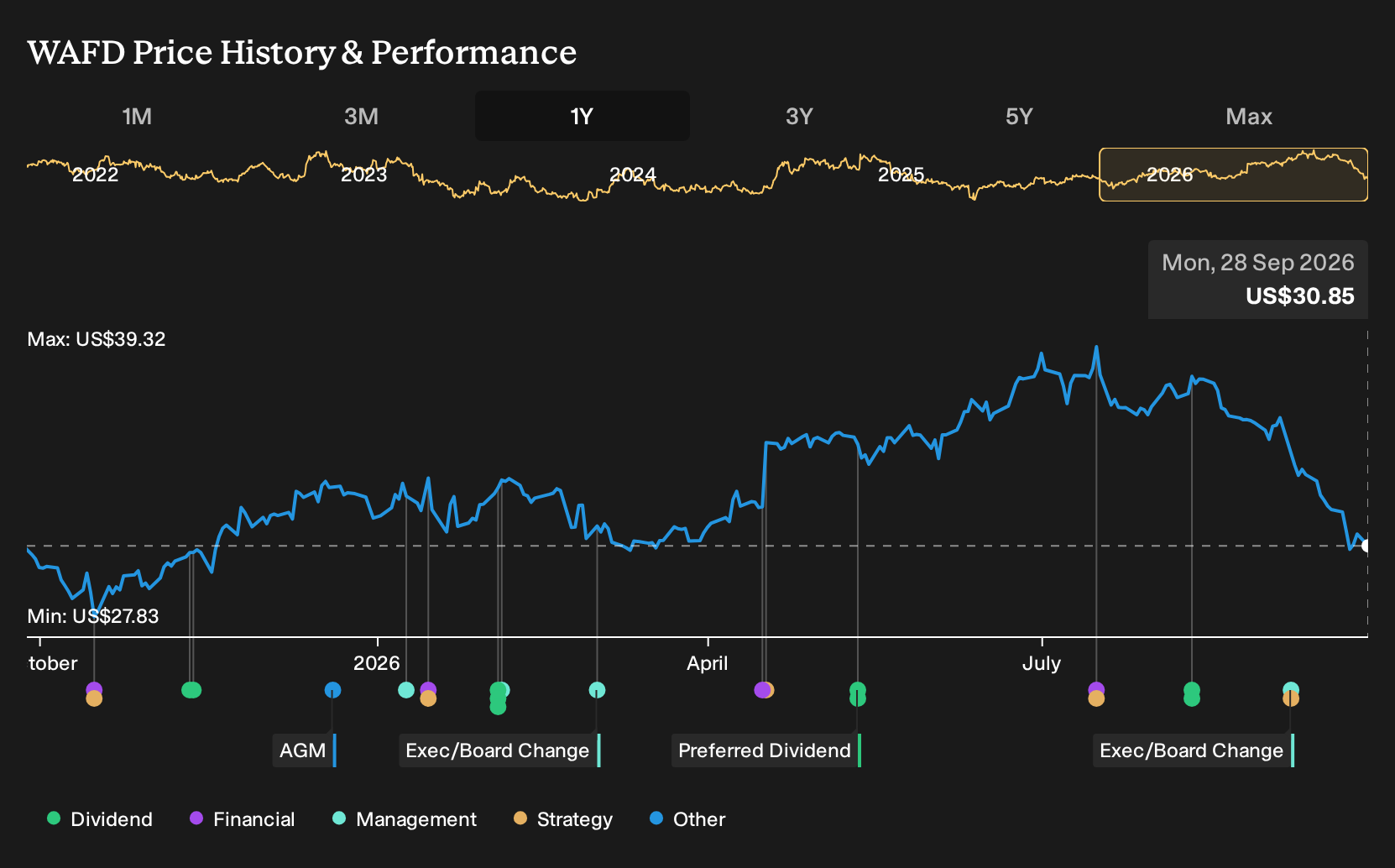
Uncover why WaFd's fair value indicates a 21% potential upside to its current price that could narrow quickly.
Exploring Other Perspectives
Three fair value estimates from the Simply Wall St Community cluster in a tight US$33.23 to US$37.25 band, so retail opinions on WaFd are concentrated rather than scattered. Those views do not yet reflect the recent move in global bond yields, which could reshape funding costs and prompt you to test very different scenarios.
Explore 2 other WaFd fair value estimates, including one that suggests it could be worth just $33.23.
Form Your Own Verdict
Don't just follow the ticker; dig into the data and build a conviction that's truly your own.
- A great starting point for your WaFd research is our analysis highlighting 5 key rewards that could impact your investment decision.
- See our latest analysis for WaFd. The report includes a comprehensive fundamental analysis summarized in a single visual, the Snowflake, making it easy to evaluate WaFd's overall financial health at a glance.
Looking For More Investment Ideas Beyond WaFd?
If WaFd has sharpened your focus on yield, balance sheet strength, and risk, it can help to put that in context by scanning a wider field of opportunities through the Simply Wall St Screener.
- For investors hunting for resilient businesses first and share price next, consider companies in our 30 resilient stocks with low risk scores that may help anchor your portfolio through different rate cycles.
- If your priority is reliable income, review stocks in the 6 dividend fortresses that focus on higher yields with an emphasis on consistency.
- When you want quality without the crowd, broaden your watchlist with the 16 high quality undiscovered gems that pair strong fundamentals with relatively lower market attention.
This article by Simply Wall St is general in nature. We provide commentary based on historical data and analyst forecasts only using an unbiased methodology and our articles are not intended to be financial advice. It does not constitute a recommendation to buy or sell any stock, and does not take account of your objectives, or your financial situation. We aim to bring you long-term focused analysis driven by fundamental data. Note that our analysis may not factor in the latest price-sensitive company announcements or qualitative material. Simply Wall St has no position in any stocks mentioned.
Have feedback on this article? Concerned about the content? Get in touch with us directly. Alternatively, email editorial-team@simplywallst.com