
Does Medical Loss Ratio Discipline Change The Bull Case For Oscar Health Stock (OSCR)?
- Oscar Health recently highlighted a roadmap to higher earnings per share, centered on stricter medical loss ratio discipline and new offerings such as the Lucy Healthcare Marketplace and AI powered tools.
- The focus on medical loss ratio control alongside digital platforms like Lucy indicates management attention on unit economics rather than solely on membership expansion.
- We will now examine how Oscar Health's focus on medical loss ratio discipline could reshape the broader investment narrative around the stock.
Compare Oscar Health's push into AI assisted insurance with hand picked peers by scanning 35 healthcare AI stocks, which are also leaning on data and automation to tighten unit economics.
Oscar Health Investment Narrative Recap
For Oscar Health to make sense in a portfolio, you need to buy into a simple idea. Tight control of the medical loss ratio and disciplined pricing matter more than raw membership growth. The current roadmap leans on AI tools and Lucy Marketplace to squeeze more efficiency from every policy, which supports that thesis.
The near term catalyst is clear. Investors are watching whether management can keep claims in line while repricing into a higher morbidity individual ACA market. The biggest risk is that morbidity, policy changes or regulatory shifts push the medical loss ratio above plan. The latest update does not fundamentally change that risk balance.
The most relevant recent development is management tying its earnings per share ambitions directly to medical loss ratio discipline and new AI powered products. That is an operational commitment. It puts clear weight on claims management, pricing accuracy and automation rather than only chasing headline growth in members.
Lucy Healthcare Marketplace and AI assisted workflows now sit at the center of that execution story for Oscar Health. These tools are designed to automate enrollment, guide members to more cost aware care decisions and trim administrative spend. The opportunity is meaningful, but so is the execution test if morbidity, regulation or policy shifts keep moving underneath the business.
Oscar Health's current analyst narrative points to forecast revenues of US$27.7b and earnings of US$1.2b by 2029, based on an assumed 21.9% yearly revenue growth rate and a move from US$550.7m in earnings today to the US$1.2b consensus, which is roughly a 2x increase in profit.
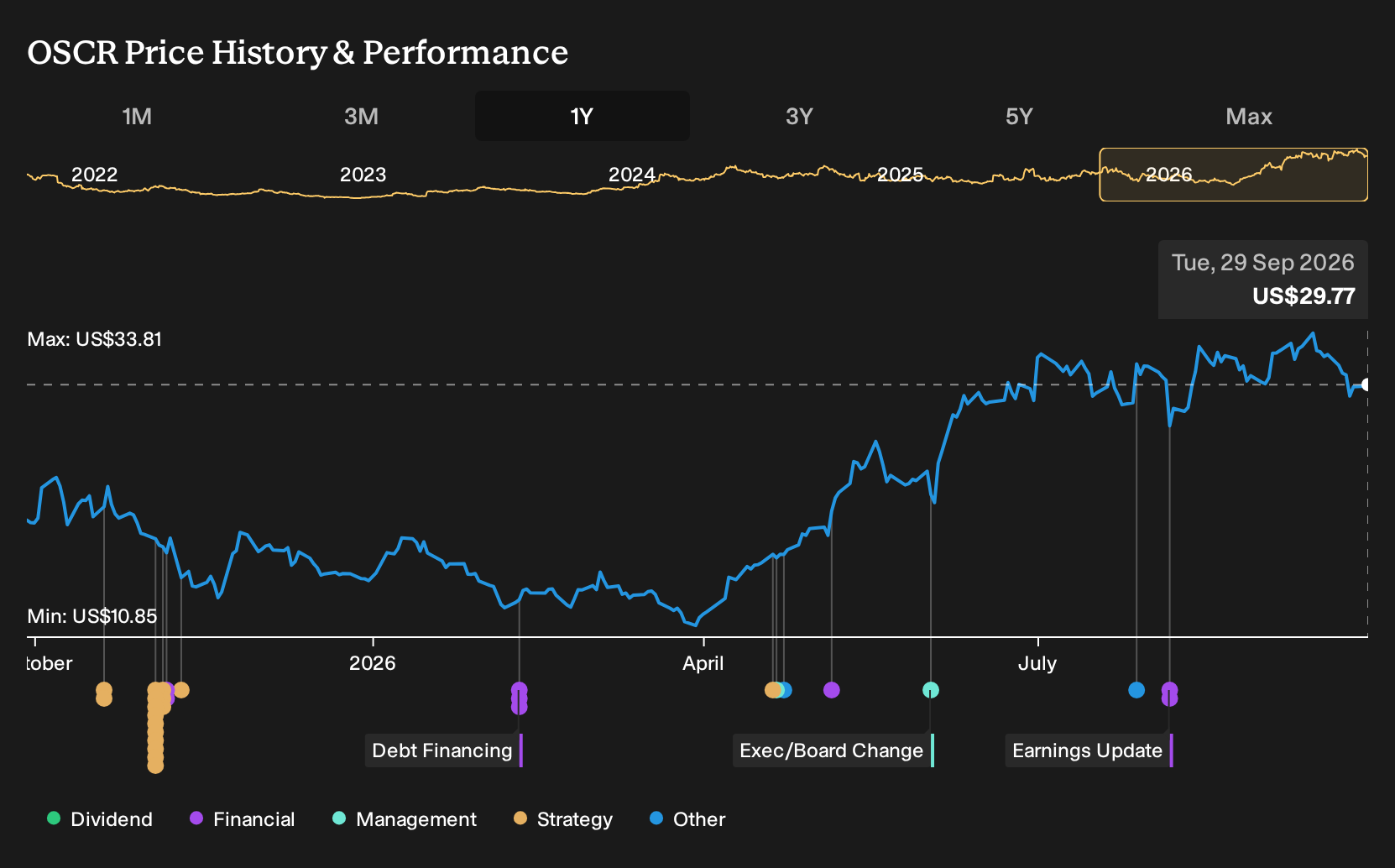
Uncover why Oscar Health's fair value indicates a 19% potential upside to its current price, which could close faster than expected.
Exploring Other Perspectives
One sharper worry in the alternate Oscar Health story is premium pressure. The most pessimistic analysts were only modelling revenue of US$19.6b and earnings near US$923.9m by 2029, far below the consensus. That group clearly fears tighter pricing approval, and today’s focus on AI and the medical loss ratio could shift those views.
Explore 7 other Oscar Health fair value estimates, including one that suggests it could be worth just $35.40.
Reach Your Own Conclusion
Disagree with existing narratives? Extraordinary investment returns rarely come from following the herd, so go with your instincts.
- A great starting point for your Oscar Health research is our analysis highlighting 3 key rewards and 2 important warning signs that could impact your investment decision.
- See our latest analysis for Oscar Health. The report includes a comprehensive fundamental analysis summarized in a single visual, the Snowflake, making it easy to evaluate Oscar Health's overall financial health at a glance.
Looking For More Investment Ideas Beyond Oscar Health?
If the Oscar Health story has sharpened your thinking about risk, reward and execution, broaden that work by scanning other companies on Simply Wall St that match different return and resilience profiles.
- Hunting for potential mispricing opportunities? Start with companies on our 31 high quality undervalued stocks that combine quality fundamentals with discounted prices.
- If downside protection matters most, focus on businesses in the 32 resilient stocks with low risk scores that score well on financial stability and volatility checks.
- If you prefer sturdy balance sheets as your foundation, filter candidates through the list of solid balance sheet and fundamentals (25 results) to see which stocks align with that approach.
This article by Simply Wall St is general in nature. We provide commentary based on historical data and analyst forecasts only using an unbiased methodology and our articles are not intended to be financial advice. It does not constitute a recommendation to buy or sell any stock, and does not take account of your objectives, or your financial situation. We aim to bring you long-term focused analysis driven by fundamental data. Note that our analysis may not factor in the latest price-sensitive company announcements or qualitative material. Simply Wall St has no position in any stocks mentioned.
Have feedback on this article? Concerned about the content? Get in touch with us directly. Alternatively, email editorial-team@simplywallst.com