
From HBM to DRAM and SSD, AI smart fanaticism is detonating storage demand! Micron (MU.US) Earnings Finale Debuts, Market Hopes for “Exceed Expectations+Repurchase” Gift Package
The Zhitong Finance App learned that as Meta Muse and OpenAI Astra promote the expansion of global AI applications into intelligent workflows with continuous execution and multi-step collaboration, global AI computing power demand is expected to usher in a new blowout expansion frenzy. This is also an important logic that has recently accelerated the spread of AI smart applications in the global stock market beyond expectations, transforming it into the growth expectations of many AI computing power industry chain leaders and computing power core vendors such as SK Hynix, Samsung, Micron, Nvidia, AMD, TSMC, etc.
Currently, the market is re-evaluating AI core hardware requirements such as CPU, memory, and storage to support these cutting-edge AI applications. As a result, the financial report of Micron (MU.US), one of the three major original memory chip manufacturers, will soon debut in the grand finale on Wednesday EST and become an important window for testing the specific progress of the storage supercycle and the unprecedented AI infrastructure frenzy. Previously, from mid-July to August, storage leaders such as SK Hynix, Samsung, Western Digital, Seagate, and US NetApp had announced strong performance that exceeded expectations. A series of AI computing power industry chain leaders, including TSMC, AMD, Nvidia, and Broadcom, have also announced strong performance data and optimistic AI computing power demand prospects.
Wall Street analysts agree that Micron's revenue for the fourth fiscal quarter of fiscal year 2026 is expected to be approximately $51.47 billion and earnings per share. Among them, consistent market revenue expectations mean that Micron's revenue is expected to increase by an astonishing 354.9% year over year. However, this strong threshold also means that Micron's performance and management quarterly outlook need to greatly exceed expectations, and may also require Micron to provide strong shareholder return results — such as stock repurchases, to achieve an upward trajectory after the disclosure of results.
The options market, on the other hand, included a sharp fluctuation of about 7.7% in both directions after the earnings report. Call options trading and volatility bias indicate that investors are more active in seeking upward returns. The key to J.P. Morgan Chase and UBS's shared optimism is that storage supply and demand may continue to be tight, and the long-term agreement is expected to enhance the visibility of Micron's future profits.
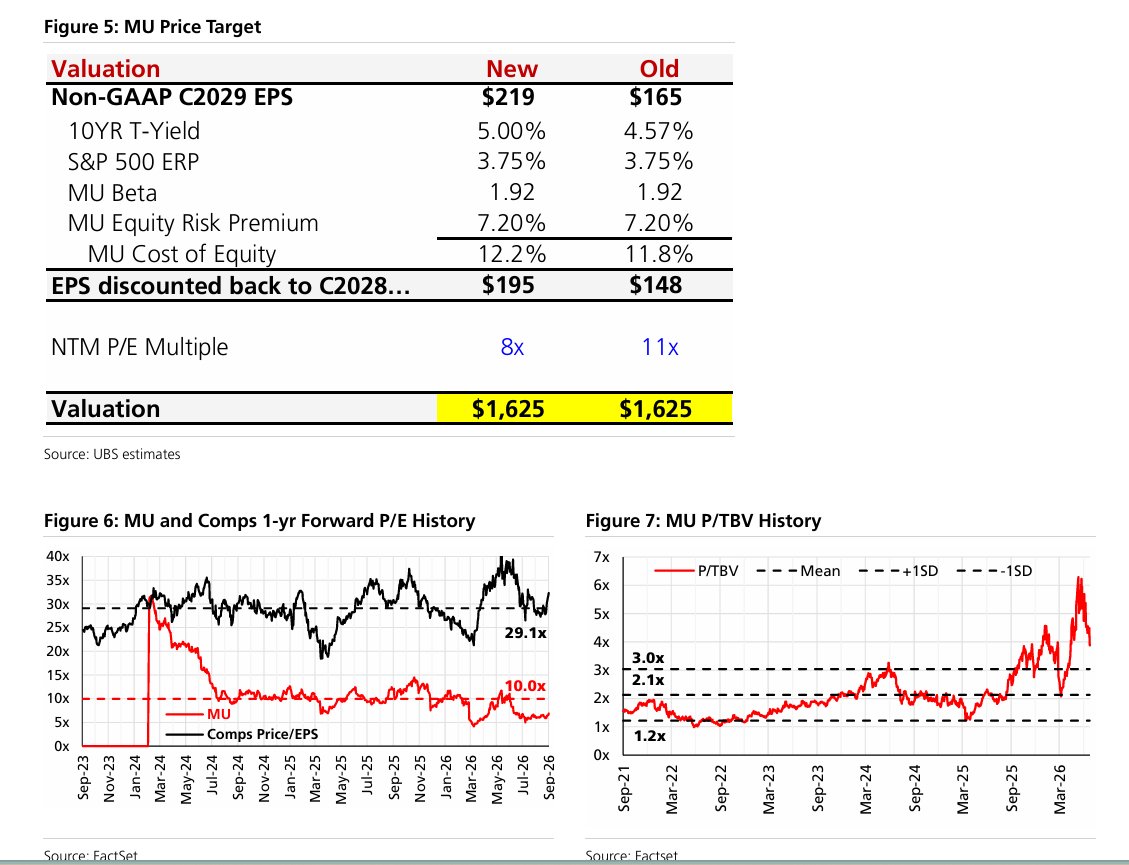
7.7% is an implied two-way margin corresponding to the cost of cross-modal options. It is not an upward forecast or a guaranteed trading range. In terms of analysts' price targets, the bullish Micron research report recently released by J.P. Morgan Chase shows that maintaining the most optimistic target price target price for 12 months is $1,540; UBS maintains a “buy” rating and a 12-month target price of $1,625; as of Tuesday's US stock market close, Micron's stock price closed up 1.05% to close at $1065.08. The stock price has risen by about 275% since this year.
According to AI application/AI model leaders Anthropic and OpenAI, the memory chip components of AI data center server clusters and AI GPUs are still the clearest supply bottlenecks at the AI computing power industry chain level. Market research agency TrendForce predicts that in 2026, server DRAM contract prices will increase by about 270% and enterprise-grade SSD prices will increase cumulatively by about 235%; HBM contract prices may still rise 70% to 140% in 2027, that is, they will continue to double. These data reflect the combined effects of the continued expansion of AI computing power demand and the increase in memory chip prices.
TrendForce estimates also show that shipments of NVL72 racks covering Blackwell and Vera Rubin platforms are expected to increase by more than 50% year on year in 2027; the accompanying market research shows that the output value of related systems is expected to rise from about US$226 billion in 2026 to US$711 billion in 2027, a sharp increase of 214% year over year.
The more AI agents work, the stronger the scale of storage demand — how demand spreads from HBM to DRAM and SSD
For the US-based memory chip giant Micron, in addition to simultaneously covering HBM, server DRAM, and NAND storage, and being able to participate in upgrades at different levels of smart infrastructure, the biggest advantage over SK Hynix and Samsung Electronics is undoubtedly that there is no need to worry about the operating pressure that may be caused by the huge political pressure imposed by the US government at the “return of chip manufacturing to the US” level and the uncertainty of the tariff policy that the Trump administration may change its face at any time.
Recent product advancements are expanding the range of tasks AI can perform. Meta expanded Muse to the small business scenario on September 29, connecting business tools such as QuickBooks, Shopify, Stripe, and Slack; on the same day, OpenAI launched Dots driven by GPT-6 Astra to configure independent cloud computers for agents, and support continuous execution of tasks and connections to a large number of applications. The potential growth of this type of product is that a single user instruction can trigger multiple processes such as planning, retrieval, reading files, calling tools, executing code, and verifying results. It is worth noting that these AI smart device technology developments in September directly affected Micron's subsequent demand and performance guidelines, and cannot be equated with a new source of growth for the August fiscal quarter that has already ended.
Judging from the inference system, the pre-filling phase requires processing the input context, the decoding phase continuously generates output, and the KV cache preserves a reusable attention state. With longer contexts, more concurrent tasks, and extended task duration, the system needs to simultaneously improve computational throughput, memory capacity, and data handling efficiency: HBM undertakes high-bandwidth active computing and caching, server DRAM provides greater capacity, and enterprise-grade SSDs store reusable contexts, files, and long-term data. High-performance server CPUs in data centers execute tool calls, search processing, code execution, and task orchestration, and high-speed networks are responsible for exchanging data across nodes. These also actively form the engineering logic of demand to accelerate the spread of demand to AMD, Intel, and ARM architecture server CPUs, optical interconnects, and storage systems. They also make data center power supply and cooling an important condition for large-scale deployment.
For Micron, this is an opportunity to cover multiple product lines of HBM, server DRAM, and enterprise SSDs. Cache reuse and algorithm optimization can reduce the resource consumption of a single task, but overall infrastructure requirements may still expand if more users, more tasks, and higher concurrency are attracted at a lower cost.
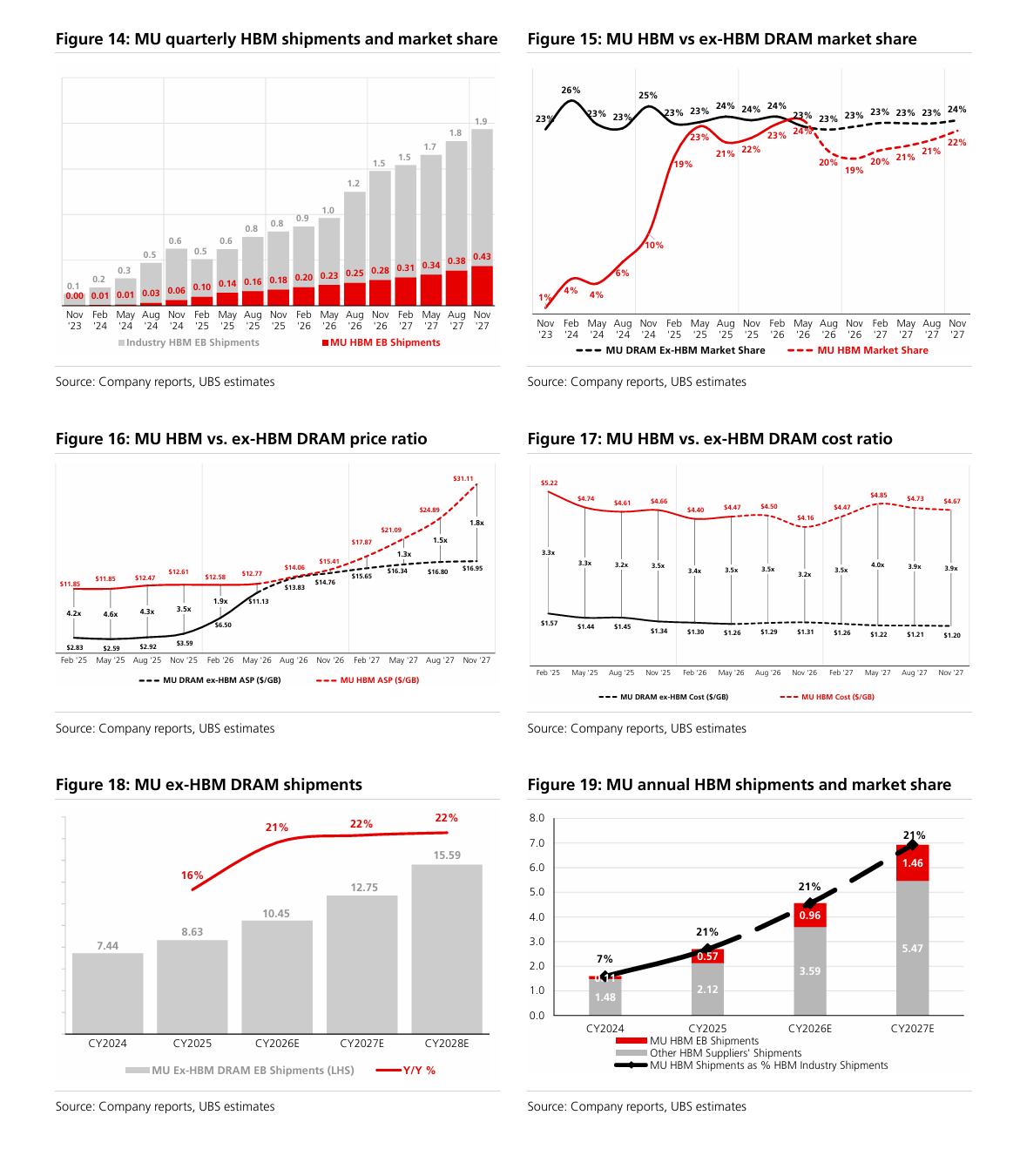
UBS expects DRAM and NAND bit shipments to increase by only about 3% and 4% month-on-month respectively in this fiscal quarter, while the average sales price will rise by about 23% and 22.5%, respectively, which largely indicates that its short-term profit forecast is mainly driven by pricing; whether long-term valuations can be further improved requires continuous demand, supply discipline, and long-term memory chip contract value fulfillment.
On the eve of Micron's fourth fiscal quarter earnings report, the options chain clearly showed a bullish trend
Hedge fund traders in the options market are unanimous in betting that the stock price of US-based memory chip maker Micron Technology (MU.US) may fluctuate up or down by nearly 8% after the fourth fiscal quarter results after the close of trading on Wednesday EST.
During the Tuesday afternoon session of the US stock trading session, the semiconductor giant's stock price once rose 1.8% and traded around $1,072 per share. Market participants are making plans before the earnings report is released. According to the option chain data due on October 2, the price of the flat value cross-option portfolio is about $82.28, which means that the expected share price fluctuation after the earnings report is released is about 7.7%. This expected fluctuation corresponds to the potential trading range after the financial report, which is roughly between $990 and $1,155 per share before the end of this week.
Trading activity showed a clear bullish trend, with a large number of bullish option transactions concentrated on key upward exercise prices. This optimism is also supported by the bias in volatility on the bullish option side: compared to a put option of the same magnitude as the current stock price, an illusory call option has a clear premium, indicating that market participants are more willing to pay to participate in a bullish rise than to buy protection against a panic decline. The volume of call options due on October 2 and with an exercise price of up to 1,100 US dollars is far ahead of the entire options chain, with more than 12,400 contracts changing hands; call options with an exercise price of 1,050 US dollars and 1,200 US dollars have also attracted significant demand.
In terms of put options, trading mainly focuses on the exercise price of $1,000 and $1,050, indicating that some cautious traders are laying out around key technical support levels to prevent disappointing financial reports.
At the same time, extreme tail risk positions show that there are speculative bets in the upper and lower extremes of the market: deep fictitious bullish options with an exercise price of 1,400 US dollars and 1,500 US dollars have appeared, corresponding to large-scale hedging positions concentrated on bearish options with an exercise price of 600 US dollars and 650 US dollars.
Wall Street analysts agree that Micron, headquartered in Boise, Idaho, will achieve earnings of $31.82 per share and revenue of $51.47 billion. Over the past two years, the company's revenue and earnings per share have exceeded market expectations by 100%.
AI computing power fanaticism is facing a major test! Micron's daily earnings market focuses on price increases, long-term contracts, and shareholder returns
As Meta Muse and OpenAI Astra drive smart devices to more complex office, programming, and commercial tasks, the market is re-evaluating AI inference's requirements for storage capacity, bandwidth, and data processing capabilities. The Micron financial report, which will be released after the market on September 30, US time, will be an important window for observing how this round of demand translates into revenue from core chip components related to AI infrastructure, and the profit and cash flow trends of leaders in the AI computing power industry chain. Among them, international financial giant UBS and Wall Street finance J.P. Morgan Chase are optimistic that the key to Micron is that tight storage supply and demand may continue, and long-term agreements are expected to enhance the visibility of Micron's future profits.
What J.P. Morgan values is tight supply and demand and mutual strengthening of long-term agreements. The bank expects the average sales price of DRAM in the August quarter to rise by more than 20% month-on-month, and the average sales price of NAND to rise by about 20% month-on-month. As for the slowdown in price increases mentioned earlier by management, Xiaomo is more inclined to understand it as a business option to maintain customer relationships and promote the signing of long-term agreements. Even after accounting for the HBM specification reduction, the bank still expects the HBM supply and demand gap of 20%, 19%, and 16% for the 2026-2028 calendar year, respectively.
Meanwhile, out of the 16 SCA agreements previously disclosed by Micron, 14 have a total remaining performance obligation of about 100 billion US dollars based on reserve prices; Komo expects that the future bit production ratio covered by the long-term agreement may have increased to more than 35%, and there is even a possibility that it will reach 50% or more. The 100 billion US dollars here is the amount of future contract performance. It is not confirmed revenue for the current year, and the increase in coverage is still yet to be verified by financial reports.
UBS, on the other hand, focused the discussion on “how long can high profits last.” According to the latest channel survey by this major international bank, the DRAM demand satisfaction rate in 2027 may still be only about 60%, server DDR bit demand is expected to increase by about 80% year on year, and SSD bit demand for servers and storage systems may increase by more than 100%; the bank expects the DRAM supply shortage to continue at least until the second quarter of 2028. UBS believes that long-term agreements will limit some of the benefits of short-term price increases, but they can support the profit base for future downward cycles. Institutions are not completely consistent with the price inflection point: Citi's latest bullish Micron research report predicts that DRAM and NAND prices may peak in the second quarter of 2027, while UBS placed the peak NAND price in the third to fourth quarter of 2027, so this guidance is particularly critical to determining the duration of the boom.
The significance of long-term agreements between these major memory chip manufacturers on the AI computing power theme is that customers exchange long-term procurement commitments for supply guarantees, while Micron obtains clearer production capacity plans and revenue visibility, which helps reduce the sensitivity of some businesses to short-term market prices.
Micron management also recently anticipated that these agreements will bring about $22 billion in cash guarantees and related financial commitments, of which approximately $18 billion is a cash guarantee. They reflect the customer's desire to lock in long-term supply and also help support production expansion arrangements; in accounting, this portion of the cash deposit is included in financing activities and will be gradually refunded during the latter half of the agreement. Therefore, what is more noteworthy in the financial report is the progress of new contracts, coverage, product structure and actual delivery, and how these changes can improve the predictability of future operating cash flow.
Furthermore, with Nvidia's major announcement of the largest single authorized repurchase plan in the history of the US stock market with a record 150 billion US dollars, and Micron rivals SK Hynix and Samsung both proposed incremental shareholder return plans, return on capital forms another important main line. Xiaomo expects free cash flow to exceed US$24 billion for the August quarter, and is concerned about the gradual return of excess cash flow arrangements after December 9, 2026; UBS predicts that Micron may repurchase about US$20 billion every quarter starting in the second quarter of fiscal year 2027, that is, in the February quarter of 2027, and then expand to US$40 billion to 50 billion US dollars. The latter Micron buyback outlook is an analysts' prediction model and is not a repurchase plan already announced by the company.
What can be deduced from this is that the Micron earnings report may be widely viewed by investors as a “cash cashout test” of the wave of AI computing power fanatical investments — whether demand expansion can form continuous orders, whether long-term agreements can stabilize profits, and whether cash accumulation can be converted into an increase in value per share will all influence what kind of valuation the market is willing to give to Micron.
Micron's stock price has accumulated a cumulative increase of more than 275% since this year, outperforming the 12% increase in the S&P 500 index and becoming one of the biggest winners in the AI-driven rise in global technology stocks. The company produces high-bandwidth memory chips used in conjunction with Nvidia's AI processors, and demand has increased dramatically; severe global supply shortages have prompted it to raise the prices of DRAM and NAND memory chips.
Citibank analyst Atif Malik said, “We expect the DRAM and NAND markets will continue to be in short supply, supported by strong AI-driven storage demand. We maintain our previous view that DRAM and NAND price increases will slow in the next four quarters, and prices may peak in the second quarter of 2027.”
The quantitative ratings given by Wall Street analysts and Seeking Alpha analysts are all optimistic about the stock, giving it a “buy” or higher rating. Over the past three months, Wall Street analysts' earnings per share expectations for Micron were raised 11 times and lowered 2 times; revenue expectations were raised 12 times and lowered 2 times.
Royal Bank of Canada analyst Srini Pajjuri said, “For the first fiscal quarter, we expect the performance guidance given by management to be 3% to 5% higher than the market consensus with revenue of US$56 billion and earnings of US$34.85 per share. Although the price cap of the SCA agreement will have some impact, we still expect the overall average sales price of DRAM to rise 5% to 10% in the first fiscal quarter.” He added that the agency model anticipates Micron's free cash flow for the 2027 calendar year to exceed $100 billion.
Matt Bryson, an analyst from Wedbush, said that Micron's earnings report may and should have a positive synergetic impact on the stock prices of memory chip peers in the US stock market such as SK Hynix and SanDisk.
He added, “Despite the above factors, we are still optimistic about the storage sector, but it should be pointed out that we believe Micron's price performance in the fourth fiscal quarter will be stronger than that reflected in the peers' third calendar quarter results due to the inclusion of June.”