
Learn Why The Bull Case For Neurocrine Biosciences Stock Could Change Following CMO Return
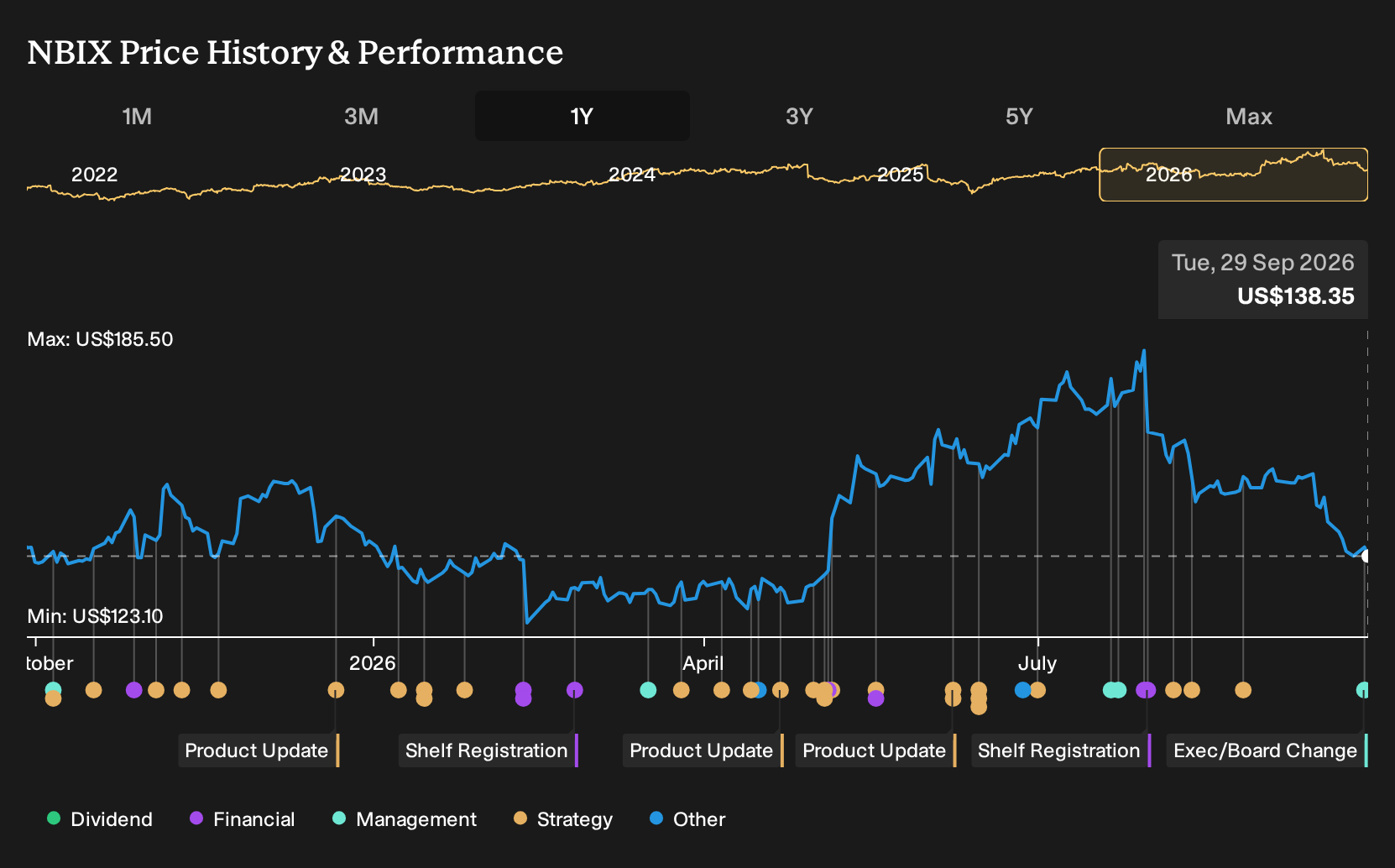
- Neurocrine Biosciences announced that Eiry W. Roberts, M.D., has rejoined the executive team as Chief Medical Officer, replacing Dr. Sanjay Keswani after his departure on September 25, 2026. She is returning to a position she previously held from 2018 to 2025.
- Dr. Roberts brings continuity to Neurocrine Biosciences by resuming oversight of clinical development after guiding INGREZZA indication expansions and the crinecerfont program that supported U.S. approval of CRENESSITY. This experience speaks directly to the firm’s execution risk around late-stage trials and launch support.
- We will examine how Neurocrine Biosciences' investment narrative is affected by this leadership return to the Chief Medical Officer role.
See how Neurocrine Biosciences' leadership shift compares with other late stage-focused biopharma players by reviewing our hand picked list of 35 healthcare AI stocks.
Neurocrine Biosciences Investment Narrative Recap
To own Neurocrine Biosciences, you need to be comfortable with a story built on two marketed neurological products, INGREZZA and CRENESSITY, plus a late stage central nervous system pipeline. The short term focus stays on execution in those franchises and payer dynamics, where Medicare contracting and rising rebate pressure could weigh on pricing and net margins even if prescription volumes hold up.
The biggest operational risk remains concentration in a few key drugs while research and development costs and commercial spend stay elevated. Dr. Roberts returning as Chief Medical Officer appears more like continuity than disruption. As a result, the main near term catalyst remains clinical readouts and uptake trends rather than this leadership change itself.
The most relevant recent development tied to this leadership move is Dr. Roberts' prior role in the crinecerfont program that supported U.S. approval of CRENESSITY. Her return gives investors one clear reference point for how Neurocrine Biosciences has previously run complex endocrine and neurology trials and then transitioned into launch and reimbursement work.
For you as a shareholder, the link to catalysts is straightforward. Future value creation depends on sustaining CRENESSITY adoption with payers already scrutinizing costs, while also pushing late stage programs in major depressive disorder, schizophrenia and movement disorders toward potential approvals. Execution quality around those programs is where Dr. Roberts' track record matters most.
Neurocrine Biosciences' current analyst narrative points to revenues of US$5.2b and earnings of US$1.4b by 2029. This path assumes revenue expansion of 15.6% per year and an earnings increase of roughly US$694.5m from US$705.5m today.
Uncover why Neurocrine Biosciences' fair value indicates a 54% potential upside to its current price that could narrow quickly.
Exploring Other Perspectives
Some of the most optimistic analysts focus on Neurocrine Biosciences using its cash flow to keep adding new franchises through deals like Soleno and VYKAT XR. They were modeling revenue of about US$6.4b and earnings of roughly US$2.4b by 2029. You can compare that to the consensus US$5.2b and US$1.4b, then consider how this CMO change could influence those projections.
Explore 2 other Neurocrine Biosciences fair value estimates, including one that suggests as much as 285% upside from the current price.
Decide For Yourself
Don't just follow the ticker. Dig into the data and build a conviction that's truly your own.
- A great starting point for your Neurocrine Biosciences research is our analysis highlighting 4 key rewards that could impact your investment decision.
- See our latest analysis for Neurocrine Biosciences. The report includes a comprehensive fundamental analysis summarized in a single visual, the Snowflake, making it easy to evaluate Neurocrine Biosciences' overall financial health at a glance.
Looking For More Neurocrine Biosciences Style Ideas?
If the Neurocrine Biosciences story has you thinking about what else might fit your watchlist, broaden the search using targeted stock screens that line up with your goals and risk tolerance.
- For investors who want potential mispricings with quality fundamentals, start by scanning our 32 high quality undervalued stocks, which already includes companies that pass strict balance sheet and cash flow checks.
- If capital preservation comes first for you, focus on resilience by filtering companies through our 32 resilient stocks with low risk scores, designed around lower volatility and cleaner financial profiles.
- When the aim is to spot lesser-known opportunities before they hit the spotlight, work through our 17 high quality undiscovered gems, which pairs strong fundamentals with limited current coverage.
This article by Simply Wall St is general in nature. We provide commentary based on historical data and analyst forecasts only using an unbiased methodology and our articles are not intended to be financial advice. It does not constitute a recommendation to buy or sell any stock, and does not take account of your objectives, or your financial situation. We aim to bring you long-term focused analysis driven by fundamental data. Note that our analysis may not factor in the latest price-sensitive company announcements or qualitative material. Simply Wall St has no position in any stocks mentioned.
Have feedback on this article? Concerned about the content? Get in touch with us directly. Alternatively, email editorial-team@simplywallst.com