
3 U.S. Dividend Stocks Built For Higher Rates
Fed officials are hinting at just one more rate hike, inflation is still sticky and borrowing costs are biting harder on everything from credit cards to corporate debt. That combination is reshaping which dividend payers look sturdy and which feel stretched. For investors who care about income and resilience, this is a moment to pay attention. This article examines three large cap dividend stocks that are exposed to these cross currents.
The stocks highlighted below are just a sample set, and the full quality dividend screen surfaced 12 more large cap income ideas with similarly detailed stories that are not covered here. To identify and analyze your own highest conviction income holdings across sectors, head straight to the U.S. Large-Cap Quality Dividend Stocks screener.
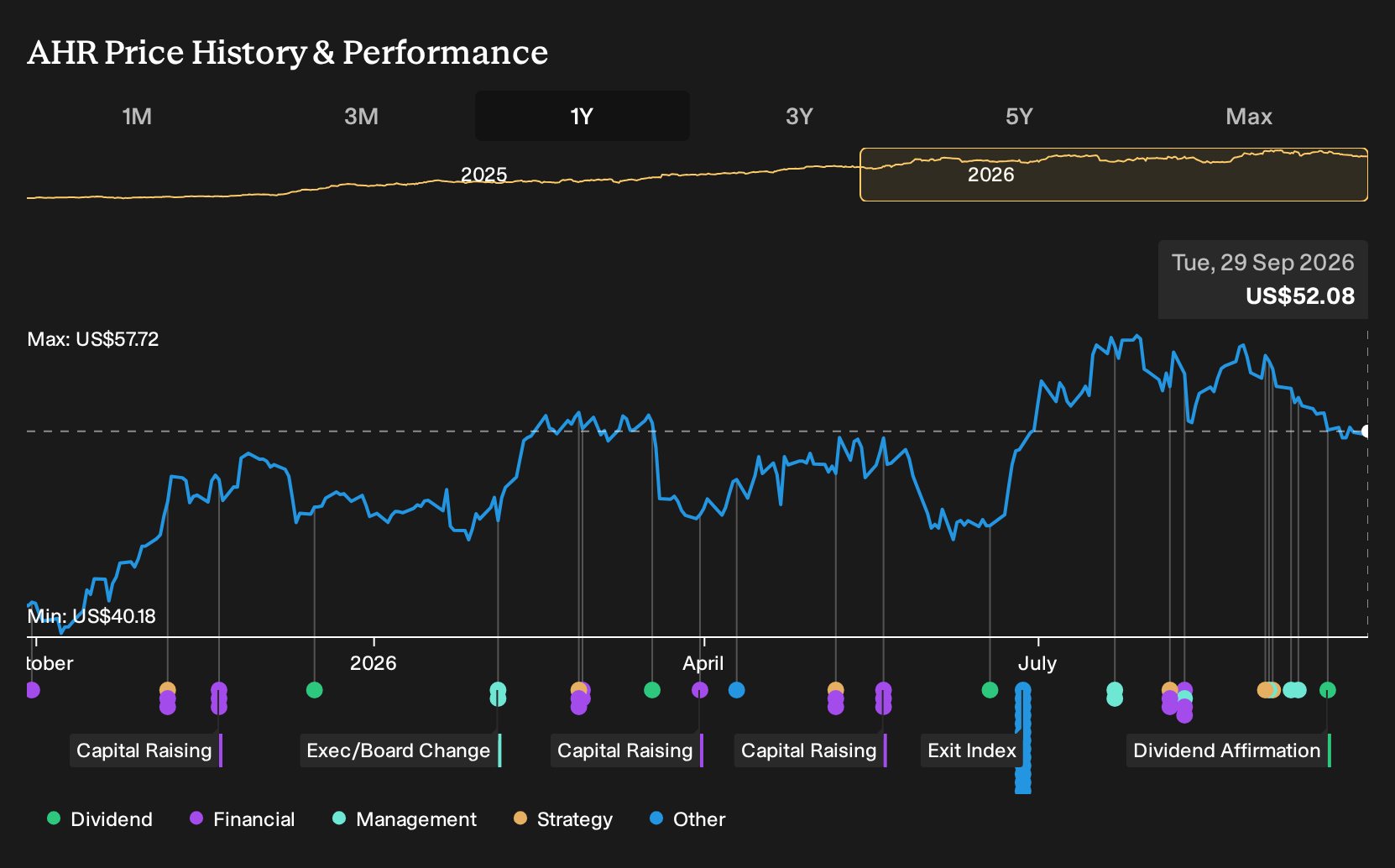
American Healthcare REIT (AHR)
Overview: American Healthcare REIT owns and operates senior housing, skilled nursing, and outpatient medical properties across the U.S. and select international markets, targeting income producing healthcare real estate.
Operations: American Healthcare REIT generates about $1.9b from Integrated Senior Health Campuses, $419 million from Shop, and $122 million from Outpatient Medical properties, with roughly $2.5b of revenue coming from the United States.
Market Cap: $12.1b
Income investors looking for resilient cash flows in a higher for longer rate backdrop may see American Healthcare REIT as a pure play on essential healthcare real estate that supports this quality dividend theme.
"The combination of a rapidly growing 80+ demographic and a multi-year period of low new supply in senior housing and skilled nursing is expected to drive a persistent supply-demand imbalance, fueling both occupancy gains and rent growth across American Healthcare REIT's portfolio."
The real test for American Healthcare REIT will be how one unresolved pressure on its cost of capital interacts with those demand tailwinds.
That cost of capital question is the hinge for the full story, and the full narrative for American Healthcare REIT explains how American Healthcare REIT could address it in a way that supports its income potential.
Curbline Properties (CURB)
Overview: Curbline Properties owns and manages convenience shopping centers in affluent suburban U.S. communities, offering recurring rent streams that fit a quality dividend profile.
Operations: Curbline Properties generates about $224 million in revenue from owning and operating convenience retail properties across the United States.
Market Cap: $3.3b
For the U.S. Large-Cap Quality Dividend Stocks theme, Curbline Properties brings a pure play on everyday shopping trips that can support predictable rent collection and, by extension, a regular payout stream in a higher for longer rate backdrop.
"Scaling into a highly fragmented 950 million square foot convenience center universe, where Curbline currently controls only 4.5 million square feet, supports a long runway of accretive acquisitions that can compound revenue and FFO growth well above the REIT average."
What really matters now is how one quiet constraint on its funding mix shapes the pace and profitability of that whole acquisition engine.
That funding constraint is the real swing factor, and the full narrative for Curbline Properties explains how it could accelerate Curbline Properties' acquisition engine while still managing risk.

Rayonier (RYN)
Overview: Rayonier is a timber and land resources REIT that manages over 4 million U.S. acres for wood products, real estate, and land-based solutions.
Operations: Rayonier generates about $320 million from Southern Timber, $136 million from Pacific Northwest Timber, and $246 million from Real Estate, all in the U.S.
Market Cap: $5.6b
Rayonier brings something different to this quality dividend screen: a portfolio of productive forests and land that can support recurring income and offer some inflation sensitivity as interest rate expectations slowly settle.
"Although Rayonier is pursuing $40 million of annual run rate merger synergies on a 4.1 million acre platform, any shortfall in extracting these efficiencies or slower than expected progress on integration could leave operating costs higher than implied in current models and limit improvement in net margins and earnings."
What happens to Rayonier’s appeal for income focused investors will hinge on how one quiet cost pressure interacts with those timber and land cash flows.
That quiet cost pressure is exactly what the full narrative for Rayonier unpacks, showing how Rayonier could turn merger efficiencies into accelerating, more resilient income potential.

Seeking Fresh Alternatives For Your Watchlist
Fresh ideas move first. Stocks can shift from quiet to breakout while most investors are still catching up, and early momentum often flies past latecomers. Scan the next wave and act now.
- Track cash rich operators before Wall Street crowds in by running the list of solid balance sheet and fundamentals (25 results) for companies built to handle shocks while it still matters.
- Spot strong trend followers rather than late stage hype by zeroing in on 37 profitable AI stocks that aren't just burning cash that pair real earnings with AI momentum under the radar for now.
- Secure yield opportunities that could hold up when rates shift again by filtering for 6 dividend fortresses before everyone is chasing the same high payout stories.
This article by Simply Wall St is general in nature. We provide commentary based on historical data and analyst forecasts only using an unbiased methodology and our articles are not intended to be financial advice. It does not constitute a recommendation to buy or sell any stock, and does not take account of your objectives, or your financial situation. We aim to bring you long-term focused analysis driven by fundamental data. Note that our analysis may not factor in the latest price-sensitive company announcements or qualitative material. Simply Wall St has no position in any stocks mentioned.
Have feedback on this article? Concerned about the content? Get in touch with us directly. Alternatively, email editorial-team@simplywallst.com