
Passenger Link Branch: From September 1 to 27, retail sales of 827,000 vehicles in the national passenger car new energy market fell 20% year on year
The Zhitong Finance App learned that on September 30, the Passenger Link Branch released a car market scan (September 21 to September 27, 2026). From September 1 to 27, the national passenger car new energy market retailed 827,000 vehicles, down 20% from the same period last year, up 2% from the same period last month, and has sold 7.501 million units since this year, down 13% year on year; from September 1 to 27, passenger car manufacturers across the country sold 1.032 million new energy vehicles, down 11% from the same period last month, down 7% from the same period last month, and a total of 10.81 million vehicles have been sold since this year, up 7% year on year.
Penetration rate: From September 1 to 27, the penetration rate of new energy retail sales in the national passenger car market was 65.7%; from September 1 to 27, the penetration rate of new energy wholesale by passenger car manufacturers across the country was 70%.
Production: In the first to three weeks of September, the country produced 330,000 pure fuel light vehicles, down 52% from the same period last year and up 47% from the same period last month; in the first to three weeks of September, overall hybrid and plug-in hybrid production was 265,000 units, down 23% from the same period last year, and 21% higher than the same period last month. (This section of data has not been updated this week)
Passenger cars: From September 1 to 27, the national passenger car market retailed 1.258 million units, down 29% from the same period last year, up 1% from the same period last month. The cumulative retail sales volume since this year was 12.973 million units, down 22% year on year; from September 1 to 27, passenger car manufacturers sold 1.474 million vehicles, down 30% from September last year, down 12% from the same period last month. Since this year, 18.657 million vehicles have been sold, down 7% year on year.
Retail sales trend in the national passenger car market in September 2026
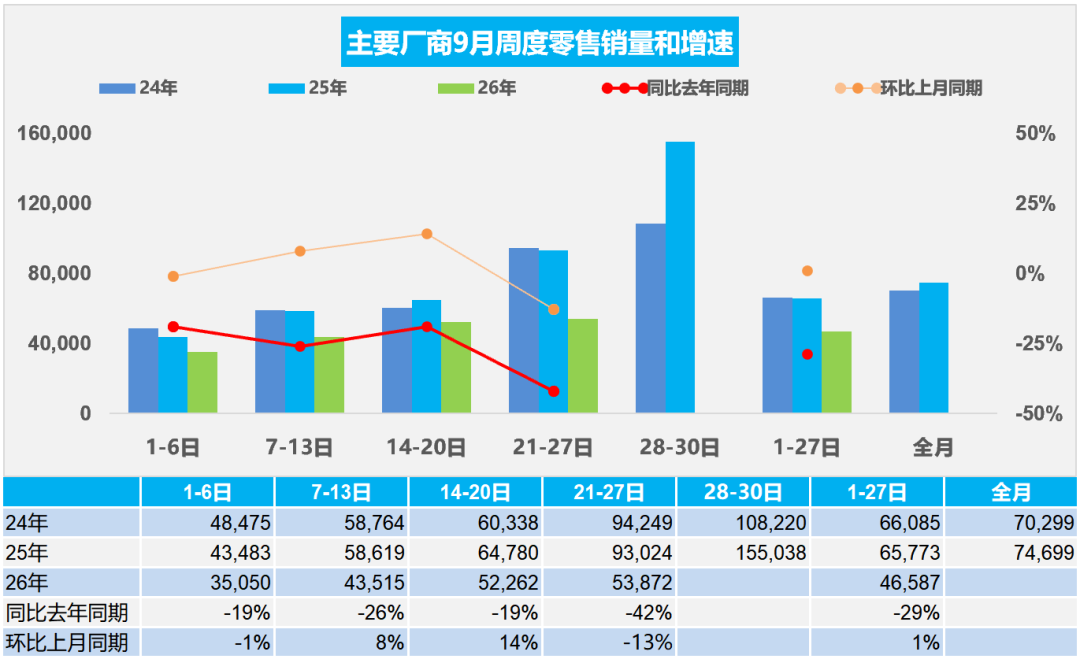
In the first week of September, the national passenger car market sold an average of 35,000 vehicles per day, down 19% from the same period in September last year, and down 1% from the same period last month.
In the second week of September, the national passenger car market sold 44,000 vehicles per day, down 26% from the same period in September last year, and up 8% from the same period last month.
In the third week of September, the national passenger car market sold an average of 52,000 vehicles per day, down 19% from the same period in September last year, and up 14% from the same period last month.
In the fourth week of September, the national passenger car market sold an average of 54,000 vehicles per day, down 42% from the same period last September and 13% from the same period last month.
From September 1 to 27, the national passenger car market retailed 1.258 million vehicles, down 29% from the same period last year and up 1% from the same period last month; the cumulative retail sales since this year was 12.973 million units, a decrease of 22% year on year.
In September, the market entered the traditional “gold nine silver ten” peak consumption season, and terminal passenger traffic is expected to continue to pick up. At the macro level, the manufacturing PMI rebounded month-on-month and the CPI was stable in August. The economy showed operating characteristics of “marginal recovery in demand and stabilization at a low level of total volume”, providing bottom support for the recovery of the car market. However, September faced a high base in the same period last year — the rush to buy in September 2025 before subsidies were stopped in some regions drove retail sales to a record peak in that month, and the effects of the high base will further inhibit the recovery in September this year. This week is the Mid-Autumn Festival holiday. The impact of the wrong peak on retail sales is significant. It is normal for retail sales to drop 42% year over year.
In September, the passenger car market entered the traditional peak sales season. Local consumer promotion policies and car companies' promotional activities continued, which helped release consumer demand. New products launched in the early stages continued to rise, and new cars brought increased popularity to support market performance. In previous years, the “Golden Nine” was generally on the rise. When the first purchase and exchange were released together, both fuel and new energy sources could be increased; this year was a stock game. This year, it was a stock game. This year, the increase was mainly concentrated on new energy sources, and there seemed to be no new demand for fuel vehicles.
Since the end of July, the cumulative increase in gasoline during the year has exceeded 830 yuan/ton, and the appeal of new electric vehicles is becoming stronger, and the willingness to consume fuel vehicles continues to be suppressed. Prices of upstream raw materials have declined somewhat. Coupled with the gradual deepening of the “anti-internal volume” consensus in the industry, upstream profits have skyrocketed; price pressure is transmitted from upstream to the vehicle end, and the upstream and downstream conflicts in the industry are becoming more and more acute. Although inventory is low, the pressure on dealers to operate continues to increase.
Wholesale sales trend of national passenger car manufacturers in September 2026
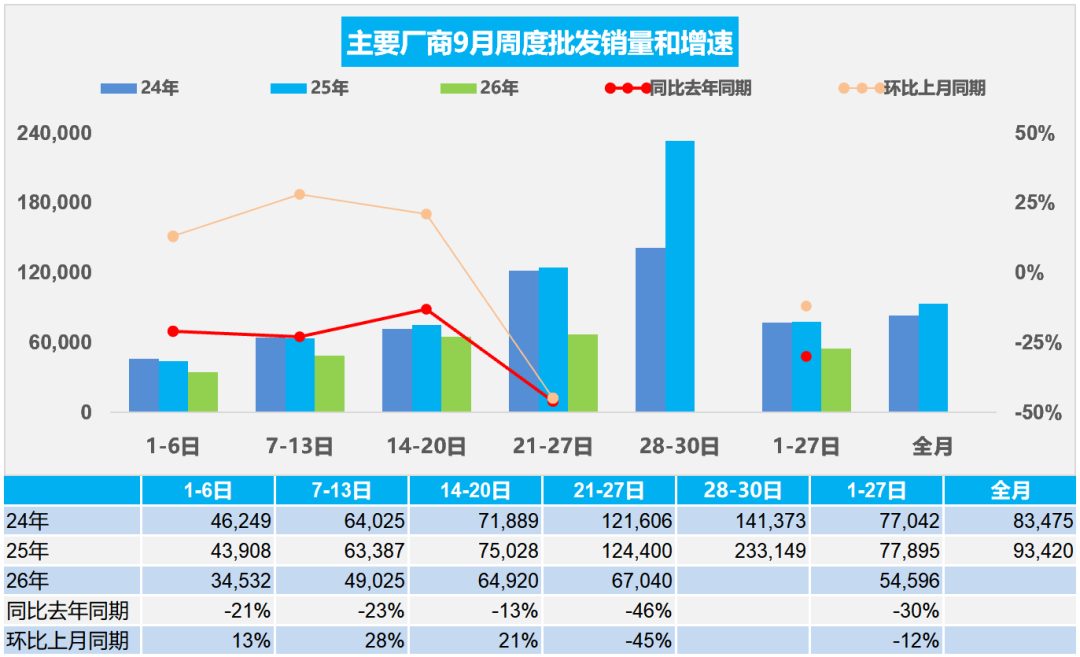
In the first week of September, passenger car manufacturers across the country sold an average of 35,000 vehicles per day, down 21% from the same period in September last year, and up 13% from the same period last month.
In the second week of September, passenger car manufacturers across the country sold 49,000 vehicles per day, down 23% from the same period in September last year, and up 28% from the same period last month.
In the third week of September, passenger car manufacturers across the country sold an average of 65,000 vehicles per day, down 13% from the same period in September last year, and up 21% from the same period last month.
In the fourth week of September, passenger car manufacturers across the country sold 67,000 vehicles per day, a decrease of 46% compared to the same period in September last year, and a decrease of 45% compared to the same period last month.
From September 1 to 27, passenger car manufacturers across the country wholesale 1.474 million vehicles, down 30% from the same period last year, down 12% from the same period last month; a total of 18.657 million passenger cars have been sold since this year, down 7% from the same period last year.
In previous years, the “Golden Nine Silver Ten” fuel vehicles were able to get the cake. Demand for fuel trucks under high fuel prices this year will be further compressed. Due to the continued sharp decline in fuel vehicle retail sales, fuel vehicle domestic demand production fell 52% in the first three weeks of September. As a result, manufacturer sales were generally sluggish, and wholesale fuel vehicle manufacturers fell 53% in the first four weeks. Most NEV brands currently lack popular models, but manufacturers also need a stable production pace. As a huge industrial chain system, it is impossible to simply schedule production according to orders; they also need to consider production and sales targets. Most manufacturer sales and direct order sales have been converted to target sales, and sales targets for some models must be achieved without a backlog of orders. As a result, direct retail sales by manufacturers improved slightly in the first three weeks, and the penetration rate of new energy sources was abnormally high. This week is the Mid-Autumn Festival holiday. The wrong peak during the holiday season had a big impact on production and sales. It is normal for manufacturers to drop 46% year-on-year in sales.
September New Energy Product and Technology Route Tracking
From January to September 2026, there were 22,760 models in the NEV duty-free catalogue. Of these, there were 355 new models in September, which is at a high level compared to the same period in the past three years. The February-September catalogue resources were similar in volume compared to the same period in 2025. There are many new passenger cars, few subsidies, and a sluggish market; the market is good for new trucks with few subsidies and high subsidies. 355 new models were added to the duty-free catalogue in September, a sharp drop from 652 in August. By category: There are only 65 passenger cars, and the number of pure electric, plug-in, and range extension declarations has been reduced simultaneously; there are only 7 models of buses, which have cooled down significantly. Special vehicles were the main force for the month, with a total of 283 models, including 266 pure electric vehicles, accounting for more than 70% of the total number of models in that month. The model declaration structure in September was clearly divided. The pace of passenger car and bus declarations for new cars slowed down, and special vehicles were still the core support for the purchase tax exemption catalogue.
In September, 16 models were added to the electric model exchange catalogue, which was the same as the August 16 model. By category, only 1 pure electric model of passenger car was declared, and sales continued to be sluggish; 15 special vehicles contributed, all of which were pure electric models, and were the absolute main force in this month's electricity exchange catalogue.
The average battery life of pure electric passenger cars reached 561 km in September, continuing to increase from 544 km in August; the total range of 500 km or more accounted for 87%. The average weight of pure electric models in September 2026 was 2007 kg, far higher than the same period in previous years, and the battery capacity of new cars remained high. The average weight of a hybrid vehicle in the narrow sense is 2223 kg, which is relatively heavy.
New medium and large products above 5 meters were reported intensively, and the extended range racetrack was outstanding. Major range extended-range models such as the Xiaomi Pengcheng N90, the Wenjie M9T/M8EV, the Xiangjie S9T, the Qijing GX7, the Aika V27, and the Dongfeng Warrior X70 were showcased. On the pure electric side, flagship models such as Tensei N8/N9, Ideal i9, Xiaopeng G9L, and Weipai V9X were declared. The battery capacity generally exceeded 100 kWh, and battery life moved towards 700 km+ or even 900 km+. Larger models generally weigh more than 2.5 tons. Extended range pure electric battery life continues to rise, and plug-in hybrid models have also been upgraded to longer pure electric battery life. The trend of high-end is obvious.