
High interest rates loom over European real estate stock strategists: excessive pessimism or a dramatic reversal
The Zhitong Finance App learned that as interest rates continue to rise, the market is increasingly pessimistic about European real estate stocks. Some strategists believe this has created conditions for a dramatic reversal in real estate stocks.
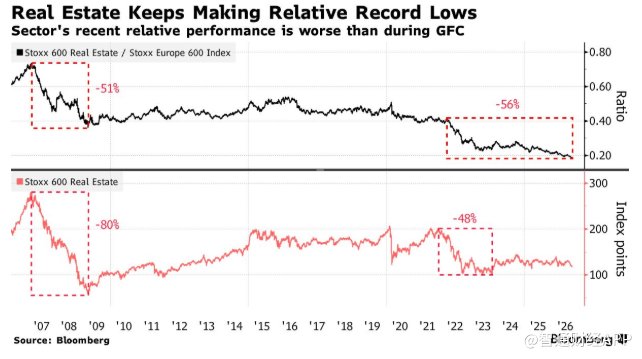
The European Stoxx 600 real estate index fell about 7% in 2026 and is expected to outperform the market for the third year in a row. Although the sector has remained range-bound during this period, the gap with the Stoxx 600 Index has surpassed the level during the global financial crisis.
The European real estate sector outperformed the market by a large margin
Pessimism prevails, interest rate expectations shift from falling to rising
J.P. Morgan strategist Mislav Matejka and his team said, “Interest rate expectations are shifting from interest rate cuts to possible interest rate hikes, exacerbating the plight of real estate investment because higher borrowing costs and a tighter financial environment put pressure on asset values and investor sentiment. The real estate sector is highly linked to bonds, and is often viewed as a bond substitute, vulnerable to rising bond yields.”
The pessimism has been going on for some time and intensified during the summer. According to the Bank of America's September fund manager survey, European real estate is one of the largest underfunded sectors, and 36% of net investor holdings are below the allowable benchmark level. This is the highest rate in at least two years, almost three times that of July.
This sector is highly correlated with bonds, and it is not without reason that it has been left out in the cold. Major central banks are tightening monetary policies due to inflation. As long as oil prices remain high and the economy remains resilient, there is no reason for policymakers to change policy direction. Currently, the swap market expects the ECB to raise interest rates three more times before the end of June next year, while the Bank of England will raise interest rates four times before the end of July next year.
Interest rate prospects are like throwing coins; the reversal is likely to be drastic
However, aggressive interest rate pricing, which is driving up bond yields, could also be quickly reversed. Since the outbreak of the war in Iran, oil prices have been a major driver of bond and stock trends. Although little progress has been made in peace negotiations, any breakthrough could completely change the situation. Because of this, interest rate prospects are as difficult to predict as throwing a coin, and when market sentiment is so pessimistic, once the direction changes abruptly, the reversal may be drastic.
The sector's performance has been sluggish for a long time, and some institutions are beginning to think that pessimism has been excessive. The strategists at Deutsche Bank and Bank of America both gave real estate an “plus” rating. Overfalling prices may also provide support, and the sector's absolute and relative valuations are far below the historical average.
European real estate sector valuations fall below historical average
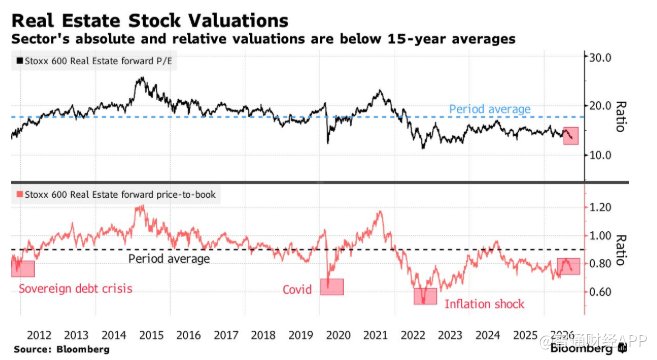
For Bank of America, part of the reason they are bullish on real estate is how a “higher and longer” interest rate environment will affect the economy and risk assets.
The Bank of America strategist team led by Sebastian Redler said, “In view of the recent poor performance of the real estate market, we forecast that the relative price of real estate will rise by about 15% in the next few months based on German Treasury yields and the Purchasing Managers' Index (PMI). Considering the local nature of real estate, when the Eurozone PMI is stronger than the global PMI, the performance of real estate will often outperform yield expectations.”
Regional performance is divided: Germany is at its peak, and Britain ushered in policy catalysis
Real estate stock performance is clearly divided regionally, and the impact of local policies is also varied. In Berlin, for example, an aggressive proposal to seize large housing packages is back on the agenda, posing an additional threat to the sector. German real estate stocks are already one of the worst performers in the European real estate index.
By contrast, British homebuilders have just had a breather. The Labor government is willing to resume the “Home Buying Assistance” program, which is certainly a strong shot for the housing construction industry, which had previously been sluggish — mortgage approvals just hit a 32-month low this week. The strong reaction of the market to this news fully reflects the reversal effect that policy changes can trigger.
“UK real estate stocks have previously been seriously undervalued. Now they have a catalyst,” said Clive Biggles, co-manager of JO Hambro Capital Management Ltd. UK Equity Income Fund. “The government's new equity loan program is expected to revive new construction activities, unlock the potential for profitable growth, and reshape the future of the industry. We believe this could be a winning strategy for the UK stock market and active investors.”
Still, the UK's ongoing risks may keep investors cautious in the short term. UK Treasury yields have been high for many years, which is driving up refinancing costs, and many households are expected to face higher mortgage interest rates in the next two years. Meanwhile, Goldman Sachs Group analysts pointed out that construction cost inflation continues to exceed price growth, putting pressure on profit margins.