
Top 3 EV Stocks To Watch In September 2026
Long term government bond yields are sitting at levels last seen before the global financial crisis, which is forcing many investors to rethink how they balance risk, income, and growth. When the cost of capital rises, capital tends to get choosier, and businesses built around clear, long term shifts in how people move and power their lives can draw fresh attention. This article breaks down three US listed electric vehicle related stocks from our screener that aim to tap into that transition.
The stocks discussed below are a sample from the broader idea, and the full screen surfaced 13 more EV related businesses with equally compelling stories that are not covered here. To see the wider opportunity set, head straight into the EV Stocks screener to identify, filter, and analyze potential high conviction EV stocks.
Ford Motor (F)
Overview: Ford Motor is a global automaker whose Ford Model e division builds Mustang Mach E, F 150 Lightning, and related EV technologies.
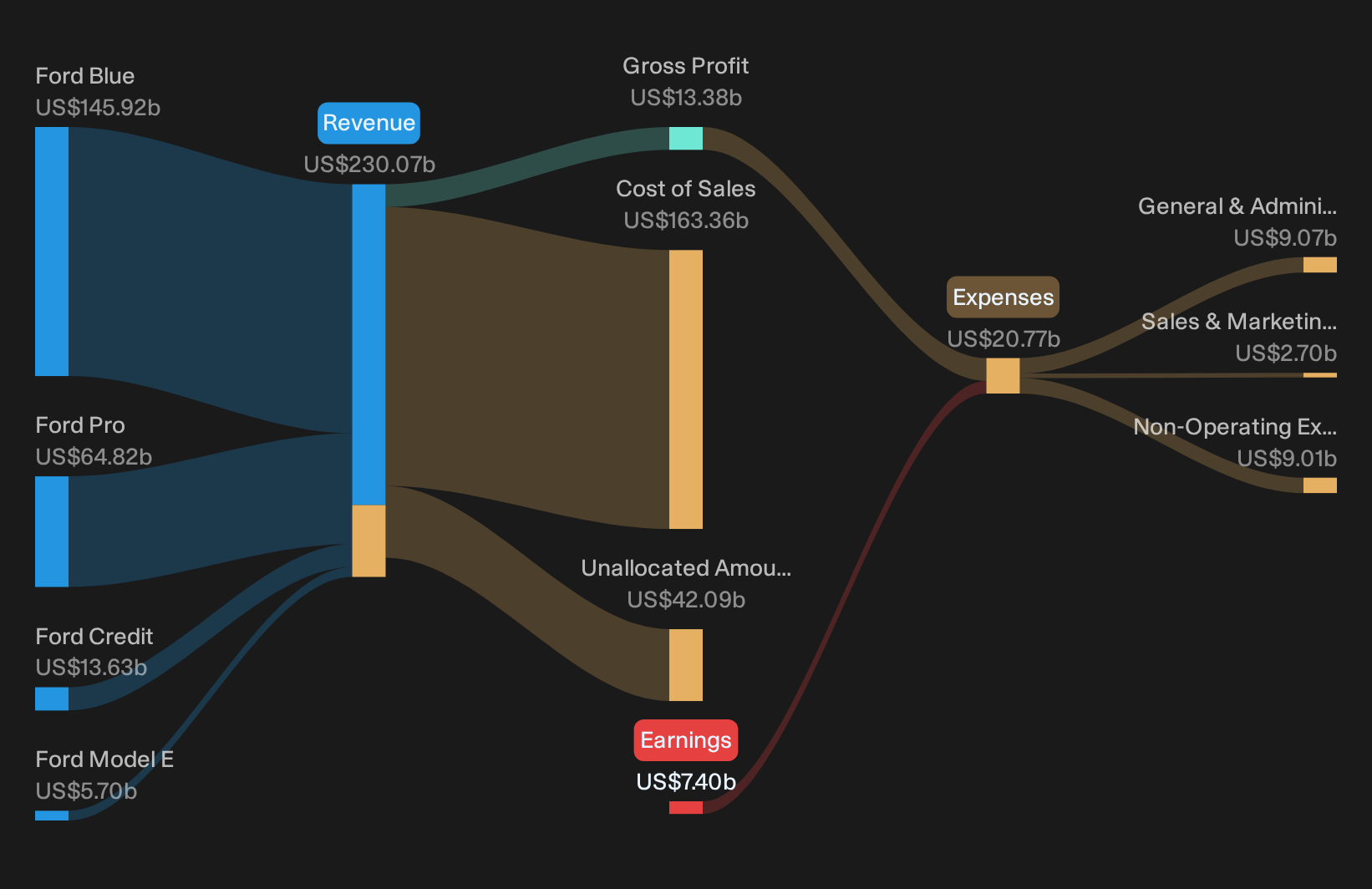
Operations: Ford generates about US$146b from Ford Blue, US$65b from Ford Pro, US$14b from Ford Credit, and US$6b from Ford Model e.
Market Cap: US$49.4b
Ford Motor matters for this EV Stocks screener because its Ford Model e arm ties a century old manufacturer directly into mass market electrification.
"Ford's ongoing transformation of its Ford Pro commercial platform, which emphasizes high-margin, recurring revenues from software, telematics, and aftermarket services, continues to outperform, with paid software subscriptions up 24% year-over-year and aftermarket approaching 20% of Pro EBIT."
What happens to future margins if one less visible piece of this EV and software shift moves faster than the rest of the business?
If that quieter shift in Ford Motor margins is what you are watching, look into the full narrative for Ford Motor to see how the EV story could be decoupling.
Rivian Automotive (RIVN)
Overview: Rivian Automotive designs and manufactures battery electric pickup trucks, SUVs, and commercial delivery vans supported by its own charging and software ecosystem.
Operations: Rivian generates about US$4.0b from Automotive and US$1.9b from Software and Services, tying software closely to its vehicle base.
Market Cap: US$21.7b
Rivian Automotive matters for this EV Stocks screener because it is building the vehicles, charging hardware, and software stack needed for both adventure drivers and commercial fleets to go all electric.
"The R2 platform and enhanced manufacturing efficiency are expected to significantly lower costs and improve Rivian's path toward profitability and market expansion."
The real swing factor is how one less visible shift in the mix between software economics and hardware scale ends up reshaping future margins.
That margin mix is where things could accelerate fastest, and the full narrative for Rivian Automotive lays out how Rivian Automotive’s software, scale and capital needs might interact as the story matures.

Tesla (TSLA)
Overview: Tesla designs and sells electric vehicles, battery packs, and related services worldwide, with its car business driving the EV story.
Operations: Tesla generates about US$90.8b from Automotive and US$12.8b from Energy Generation and Storage, with sales spread across the United States, China, and other international markets.
Market Cap: US$1.39t
Tesla matters for this EV Stocks screener because its mass market electric cars, battery packs, and charging network form a central part of the modern conversation about how quickly drivers may shift away from combustion engines.
"Tesla is pursuing a range of ambitious and, in some cases, speculative opportunities, such as AI leadership, robotaxis, humanoid robotics, and battery storage. While the company has reported progress in energy storage, competition is intensifying in that area as well."
The key issue for investors is how changes in any major assumption about future demand could affect Tesla’s valuation and profitability.
That demand debate is exactly what the full narrative for Tesla unpacks, showing where Tesla’s AI bets, energy storage and vehicle economics could be accelerating or quietly stalling next.

Seeking Fresh Alternatives Beyond EVs?
Markets move fast and early money often sets the tone. Before the next breakout wave gains momentum and the best ideas get caught by the crowd, act now.
- Spot cash generating compounders early by running the 32 high quality undervalued stocks while they are still under the radar for now and before momentum traders pile in.
- Target durable income streams with the 6 dividend fortresses so you can focus on payout strength while prices are still dropping or drifting without much attention.
- Track where AI profits, not just stories, are flying by scanning the 37 profitable AI stocks that aren't just burning cash before enthusiasm chases valuations higher.
This article by Simply Wall St is general in nature. We provide commentary based on historical data and analyst forecasts only using an unbiased methodology and our articles are not intended to be financial advice. It does not constitute a recommendation to buy or sell any stock, and does not take account of your objectives, or your financial situation. We aim to bring you long-term focused analysis driven by fundamental data. Note that our analysis may not factor in the latest price-sensitive company announcements or qualitative material. Simply Wall St has no position in any stocks mentioned.
Have feedback on this article? Concerned about the content? Get in touch with us directly. Alternatively, email editorial-team@simplywallst.com