
Most Investors Overlook Dividends. That's a Costly Mistake.
Key Points
Different companies choose to reward their shareholders in different ways. Some of them simply pass along a portion of their profits as they’re produced.
While growth stocks seemingly offer more net upside than non-growth alternatives, sometimes the math says otherwise.
Investors should examine the entire long-term picture before selecting one stock over another.
I get it: You want to own stakes in companies with what seem like the most exciting growth stories. It feels good. It feels right.
However, as veteran investors can attest, things don't always pan out the way it seems they should. Conversely, although past performance is no guarantee of future results, plenty of boring companies' history is a pretty good indication of what the future likely holds. That's particularly true of dividend-paying outfits when the underlying business never really changes.
Missed Nvidia in 2009? This Rare Signal Is Flashing Again. In 2009, a "Double Down" signal flashed for a little-known chipmaker called Nvidia. For the first time in years, that same "Total Conviction" signal is flashing for a company 1/100th the size of Nvidia. Continue »
I've been in and around the stock market for long enough to know that far too many investors are underestimating the positive impact that dividends can make on their portfolio.
What's a dividend?
Simply put, a dividend is a discretionary cash payment made by a publicly traded company to its shareholders. They are neither required nor guaranteed, which is how and why some names like Amazon and Berkshire Hathaway don't dish them out at all. They can be paid just once, or only occasionally, although in most cases they're paid on a reliable, recurring basis. That's the case with beverage giant Coca-Cola (NYSE: KO), which has paid a dividend every calendar quarter like clockwork for decades now. And they can change, usually getting bigger (typically in step with earnings growth), although when a company's profits are under enough pressure, it might instead cut its payout.
Perhaps more than anything, though -- assuming you're collecting these payments in cash rather than reinvesting in more shares of the ticker paying them -- once a dividend is paid, the cash is yours to keep to do with what you please.
However often they're paid and however big they are, they're part of the total net return that investors achieve by owning a particular stock.
Not insignificant
They can make up a surprisingly significant portion of a stock's total net return, too. Using the S&P 500 (SNPINDEX: ^GSPC) as an example, a $10,000 investment made in the index 10 years ago would be worth $35,570 today, plus any cash dividends you might have pocketed during this time frame. Had you reinvested these dividend payments into the S&P 500 as you received them, however, your initial $10,000 investment would be worth measurably more, at $42,310.
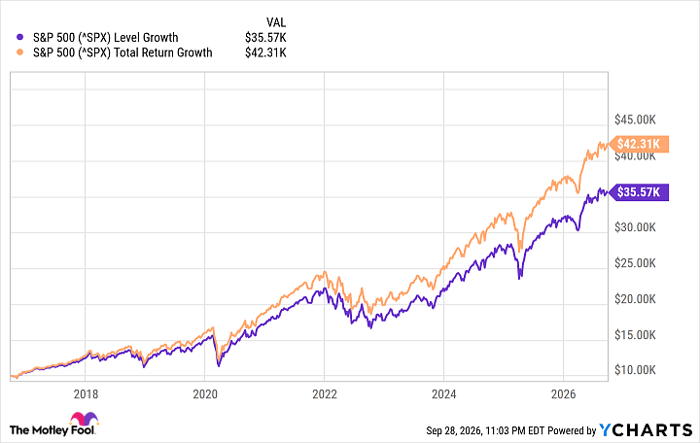
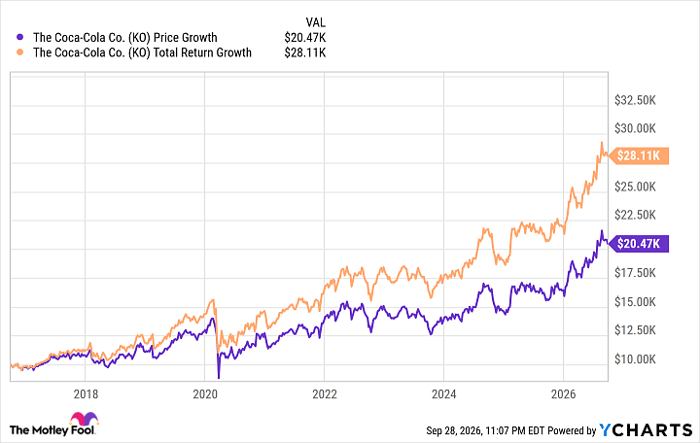
And that's a relatively muted example. The index is made top-heavy by a bunch of technology names that aren't exactly known for generating dividend income. With a stock like the aforementioned beverage behemoth Coca-Cola that boasts a higher yield (by dishing out more generous dividend payments), investors who reinvested their dividends performed considerably better than those who didn't.
Slow and steady wins the race
Surprised? I'd be a little surprised if you weren't, especially if you're a relatively new investor. Growth stocks are -- by definition -- expected to outgrow tickers of companies that aren't built for high growth.
The key here is the cumulative effect of steady cash dividend payments reinvested over time. While this approach admittedly gets a slow start, the cumulative compounding of these cash payments leads to exponential growth, as you accumulate more shares of the very same stock that's paying (usually growing) dividends.
And this dynamic changes how investors should see certain stocks. As it turns out, many of the seemingly boring ones aren't so boring even if their dividend yields aren't particularly thrilling right now.
Take industrial equipment and supply company Illinois Tool Works (NYSE: ITW) as an example. Newcomers will be plugging into a so-so forward-looking yield of 2.5%. However, the underlying dividend payment has grown so quickly over the course of the past 10 years that a $10,000 investment in the stock would have returned $29,170 with dividends reinvested, versus just $23,000 without.
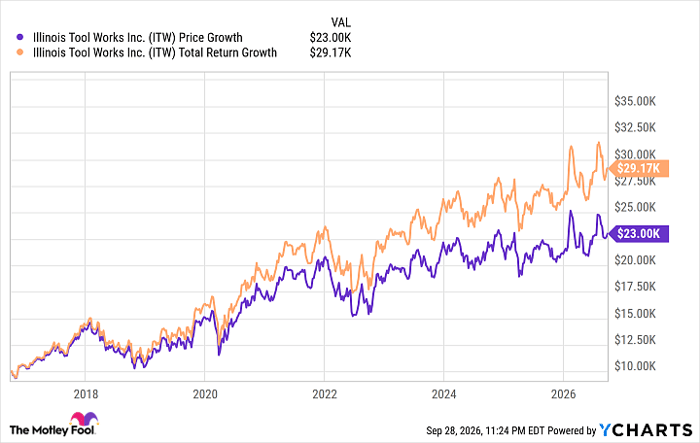
I know this is only a handful of examples, and, admittedly, some of the better ones. Not all dividend payers produce these sorts of net returns, although a handful fare even better.
My bigger point is: Don't assume that only growth stocks are capable of producing strong returns. Although they might do so in a different way, when it's consistent and consistently growing, dividend income can also drive growth-like returns. And most dividend-paying stocks are certainly less nerve-racking to buy and hold than plenty of growth stocks. Too many growth stocks never end up achieving any net growth at all.
James Brumley has positions in Coca-Cola. The Motley Fool has positions in and recommends Amazon and Berkshire Hathaway. The Motley Fool recommends Illinois Tool Works. The Motley Fool has a disclosure policy.