
Is Salesforce (CRM) Reasonable After Security Flaws And Service Outages?
Salesforce has seen its share price fall back in recent months, and that pullback has sharpened the question of whether the current US$225.31 level is still supported by what the company earns. With mixed headlines around security, product integrations and reliability, the stock now asks investors to judge how much of its earnings story is already reflected in the price.
- Over the past 5 years the stock has declined 15.5%, which puts the focus squarely on whether today's valuation is still grounded in its earnings power rather than past share-price swings.
- Recent security fixes around the SalesBleed vulnerabilities, fresh AI integrations like Navatar's deal engine and service outages during Dreamforce all feed into expectations about Salesforce's ability to sustain demand and protect margins over time, which can influence how much investors are willing to pay for each dollar of profit.
- There is a second opinion on Salesforce worth weighing. See what analysts think Salesforce's shares could be worth.
For investors, the debate is whether Salesforce's current share price is justified by its earnings when viewed against the Fair Ratio benchmark.
If you want to test this same earnings driven valuation question beyond Salesforce, it can help to scan a wider field of 32 high quality undervalued stocks.
Is Salesforce Still Cheap on Earnings?
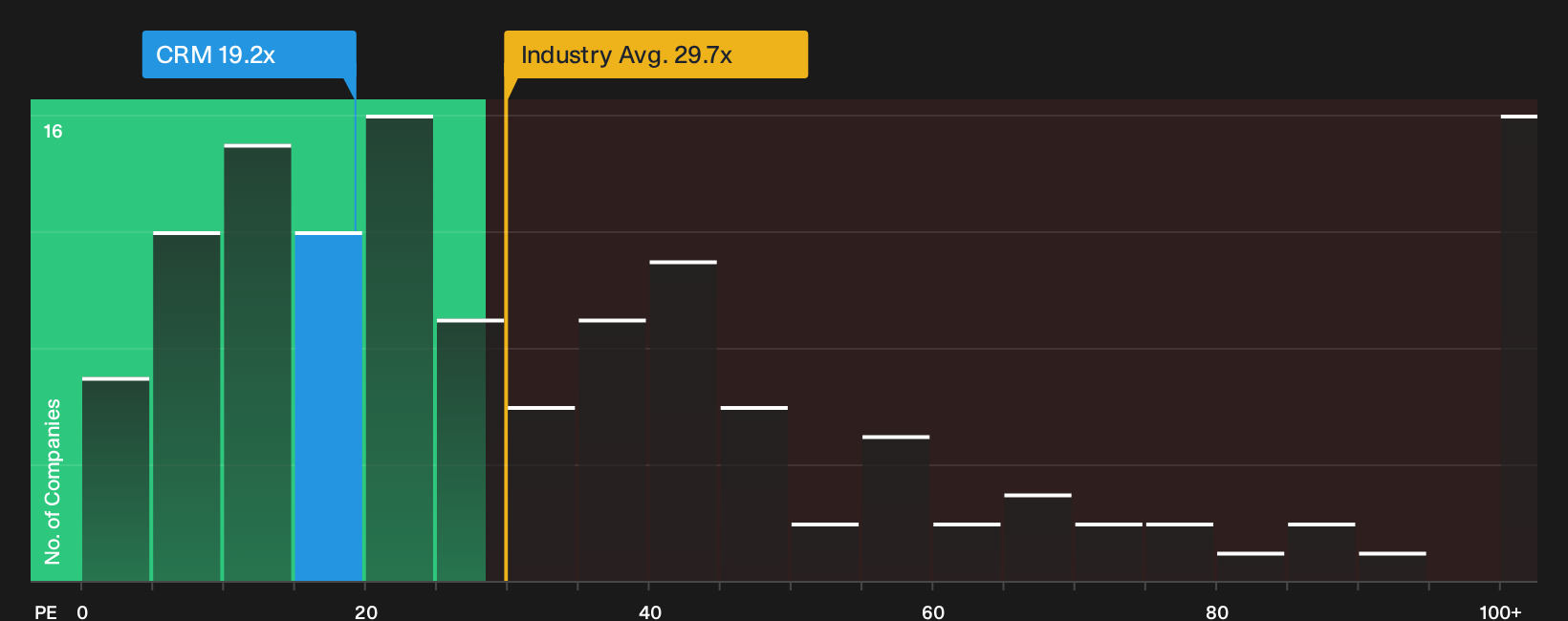
The P/E lens fits Salesforce because earnings remain a key anchor for how investors weigh its cloud and AI bets. At roughly 19.2x earnings, Salesforce trades below the wider Software industry on about 29.7x and sits well under the peer group near 41.7x. The Fair Ratio benchmark, which reflects what investors might usually pay for a business with Salesforce's mix of growth profile, profitability, size and risks, sits above the current market multiple. As a result, the stock screens as undervalued on this measure.
Despite the recent SalesBleed security issues and service outages during Dreamforce putting operational execution under scrutiny, the current P/E still prices Salesforce at a discount to both sector and peer norms. That gap suggests the market is asking for a margin of safety around future execution rather than paying in line with comparable software stocks. Explore the numbers behind Salesforce's P/E valuation.
The Salesforce Narrative: What Would Justify Today's Price?
Simply Wall St Narratives for Salesforce pick up where the valuation puzzle leaves off by spelling out which expectations for growth, margins and earnings would need to play out for the stock to be worth materially more or less than its current price. Each storyline ties its number to a specific view on how Salesforce's growth profile, profitability and risk mix evolve, giving you a reference point you can revisit as fresh information comes through.
Community views on Salesforce split between investors who see meaningful upside from AI and workflow adoption and those who think risks around competition and regulation justify a lower bar.
Bull case: 18% undervalued
"Salesforce's ongoing integration of AI and agent-based automation (Agentforce, Data Cloud) into its product suite is driving rapid adoption, evidenced by 40% of new agentic bookings coming from existing customers expanding usage..."
Discover why this Narrative puts Salesforce at 18% undervalued.
Bear case: 41% overvalued
"Regulatory tightening on data privacy worldwide threatens Salesforce's ability to leverage and monetize customer data across its agentic enterprise platforms, forcing increased compliance investments and potentially stifling adoption of key offerings..."
Explore why this Narrative puts Salesforce at 41% overvalued.
The price tag on Salesforce is only part of the decision
Valuation is just one lens for Salesforce, and Simply Wall St's broader checks have flagged specific cautionary signals that deserve a closer look before you rely on the numbers alone. Take a closer look at 3 warning signs before settling on a valuation.
This article by Simply Wall St is general in nature. We provide commentary based on historical data and analyst forecasts only using an unbiased methodology and our articles are not intended to be financial advice. It does not constitute a recommendation to buy or sell any stock, and does not take account of your objectives, or your financial situation. We aim to bring you long-term focused analysis driven by fundamental data. Note that our analysis may not factor in the latest price-sensitive company announcements or qualitative material. Simply Wall St has no position in any stocks mentioned.
Have feedback on this article? Concerned about the content? Get in touch with us directly. Alternatively, email editorial-team@simplywallst.com