
BYD (SEHK:1211) Stock May Be Overvalued As Global Expansion Talks Continue
BYD shares have fallen sharply over the past year, which puts fresh focus on whether today’s valuation can still be explained by the company’s earnings power. With the stock recently closing at HK$75.60, investors are asking if the current P/E-based pricing lines up with what the business is actually generating.
- The share price has fallen 31.1% over the past year. The key issue is whether that drop now better reflects what BYD earns or if the market is still out of step with its profit base.
- Recent discussions around global expansion in electric vehicles and batteries, including cooperation on overseas service ecosystems and manufacturing equipment, may support expectations for future earnings and cash flow, which matter directly for how its P/E ratio is interpreted today.
- Your read on BYD is one view; the desks covering it have another. See what analysts think BYD's shares could be worth.
The stock’s next move may depend on whether BYD’s current price can be justified by its earnings when compared with the Fair Ratio benchmark.
To compare BYD with other companies through the same earnings and valuation lens, a focused stock screen is a useful second step in your research using 196 high quality undervalued stocks.
Has BYD Run Too Far on Earnings?
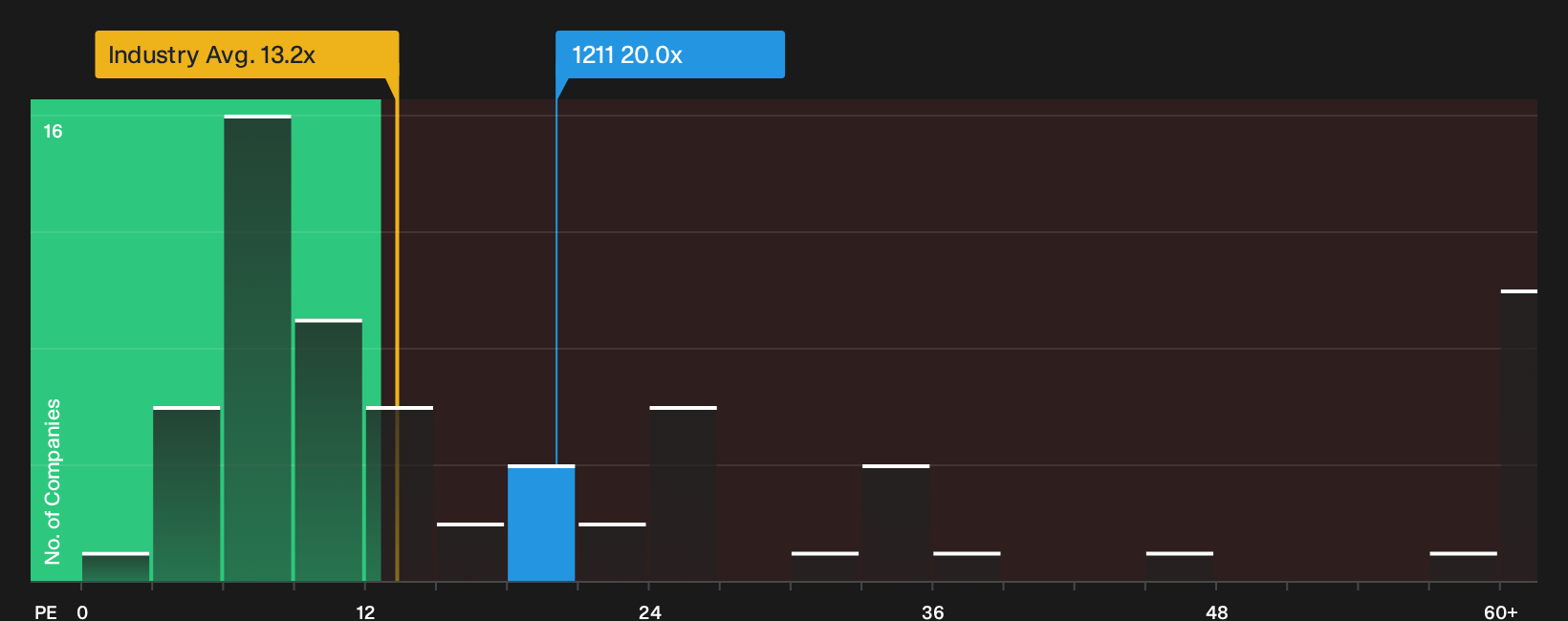
The P/E ratio is a useful starting point for BYD because earnings remain a core reference for how the market prices its mix of vehicles and batteries. At around 20.0x earnings, the stock trades very close to the peer average of 20.4x and above the wider Auto sector on roughly 13.2x. That puts BYD on a richer earnings tag than many industry players, even though the headline multiple does not look extreme relative to direct peers.
The Fair Ratio, which adjusts the benchmark P/E for BYD’s growth profile, margins, size and risk, sits below the current market multiple. As a result, the shares screen as overvalued on this model. Recent headlines around cooperation on overseas service ecosystems and battery manufacturing equipment expansion feed into a constructive story. However, the valuation already prices the business at a premium to the sector and above what this tailored yardstick suggests would be a more grounded earnings multiple. Explore the numbers behind BYD's P/E valuation.
The BYD Narrative: What Would Justify Today's Price?
Simply Wall St Narratives for BYD focus on the current valuation puzzle and the assumptions that need to hold for BYD's share price to be worth materially more or less than it is today, by spelling out how different paths for growth, profitability and earnings could connect to that outcome on the Community page. Rather than relying on a single P/E or one model result, each scenario lays out its own drivers so you can compare those inputs with future reported numbers as they arrive.
One of the top community narratives on BYD: 50% undervalued
"BYD is no longer just competing on price, they are competing on intelligence and longevity, while Tesla grapples with hardware fragmentation…"
Discover why this Narrative puts BYD at 50% undervalued.
One more BYD check that belongs beside the current P/E story
Price ratios show what you are paying for BYD today, but a separate lens comes from where professional forecasts see earnings and cash flows a few years from now. You can compare those directly with the current tag. Explore where analysts expect BYD to be in a few years.
This article by Simply Wall St is general in nature. We provide commentary based on historical data and analyst forecasts only using an unbiased methodology and our articles are not intended to be financial advice. It does not constitute a recommendation to buy or sell any stock, and does not take account of your objectives, or your financial situation. We aim to bring you long-term focused analysis driven by fundamental data. Note that our analysis may not factor in the latest price-sensitive company announcements or qualitative material. Simply Wall St has no position in any stocks mentioned.
Have feedback on this article? Concerned about the content? Get in touch with us directly. Alternatively, email editorial-team@simplywallst.com