China Index Research Institute: The real estate market bottoming trend is expected to continue
The Zhitong Finance App learned that the China Index Research Institute said that looking ahead to the fourth quarter, the real estate market bottoming trend is expected to continue. Looking at the medium term, the impact of the August 28 New Deal by lengthening the capital occupation cycle and changing the land acquisition and investment behavior of housing enterprises will gradually become apparent starting in 2027. The peak land supply performance at the end of the year and the implementation of local rules are an important observation window. In the long run, the accelerated improvement of the basic system of the industry is conducive to optimizing the market supply structure and promoting the smooth transformation of the industry. In the short term, some companies tend to accelerate evidence collection and enter the sales stage to shorten the capital occupation cycle, compounding the 9.29 mortgage interest rate discount policy and the low base effect of the previous year, which is expected to drive the decline in sales of housing enterprises to further narrow.
Performance: The decline in sales of 100 real estate companies in January-September was the same as in January-August
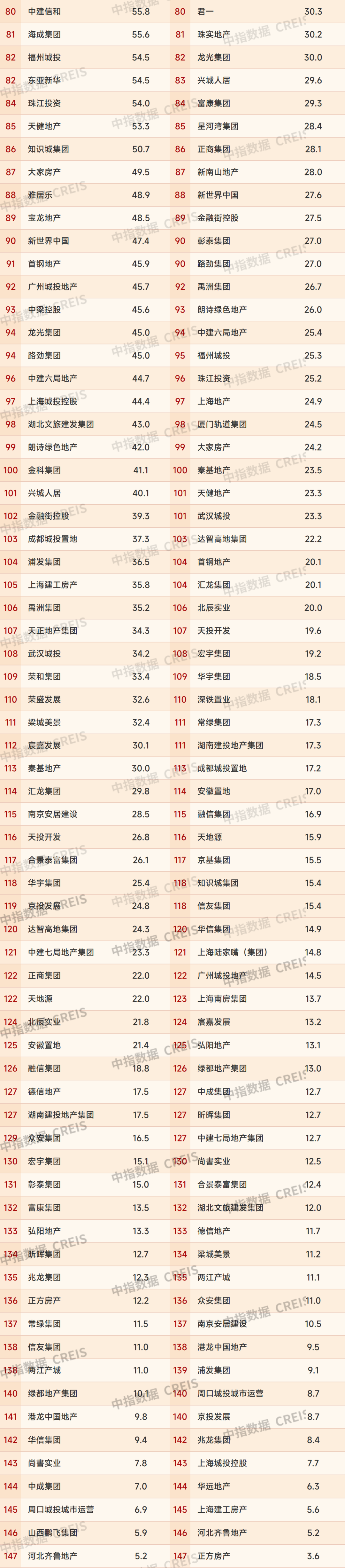
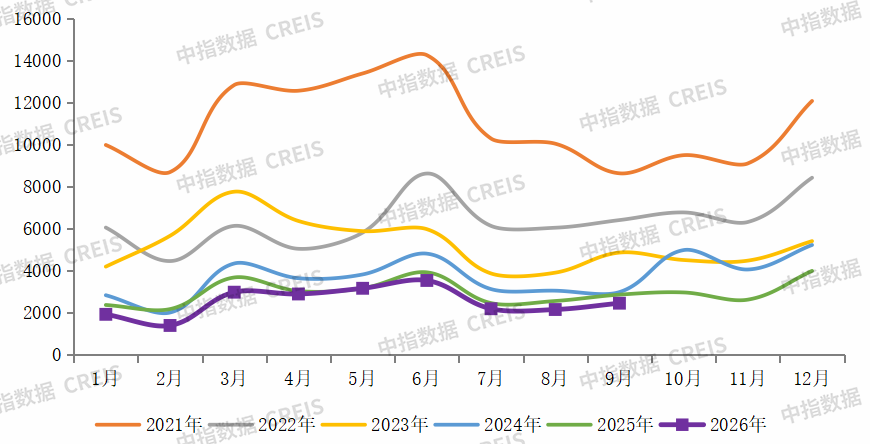
From January to September 2026, the total sales of 100 housing enterprises was 2259.72 billion yuan, the same year-on-year decline as in January-August. The property market is still in an off-season situation. Only core cities still have market support, driven by the entry of high-quality projects into the market, and the decline in sales performance of key housing enterprises has increased slightly. The trading sales of 100 housing enterprises were 1785,15 billion yuan, and equity sales were 1568.97 billion yuan. Looking at specific companies, sales of companies such as Zhonghai Real Estate, China Resources Land, and Beijing Urban Construction increased year-on-year in January-September. These housing enterprises have seized the structural opportunity of “good house+good city” and used accurate supply and product power to transform the market differentiation into sales performance. At the same time, in an environment where delivery anxiety has not been resolved and demand is highly fragmented, the state-owned asset background brings low financing costs, guarantee delivery certainty, and home purchase reliability, and outstanding project premium capacity and elimination capacity, making it easier for housing enterprises to seize structural demand.
Figure: Average cumulative full-caliber sales volume and growth rate of 100 real estate companies from January 2022 to September 2026
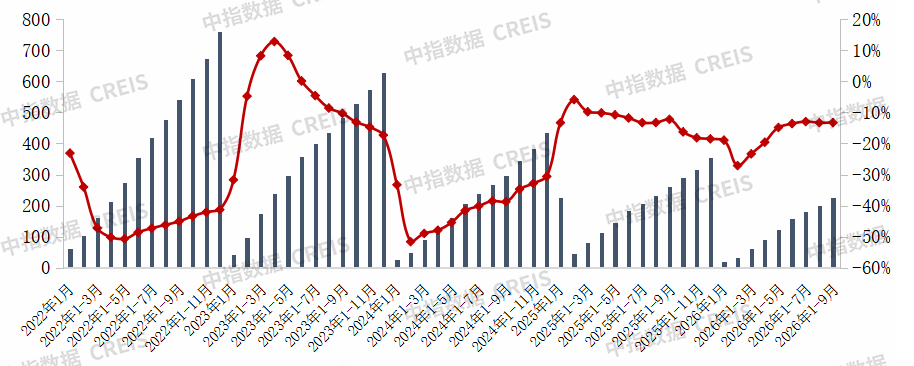
Figure: Monthly sales of 100 real estate companies from January 2021 to September 2026 (unit: 100 million yuan)
Explanation: Sales used in the analysis in this article, if not specified, all refer to full-caliber sales
Data source: Middle Index Data CREIS
Number of factions: The industry has experienced a deep reshuffle, and the signals for housing enterprises to shift to high-quality development are becoming more and more clear
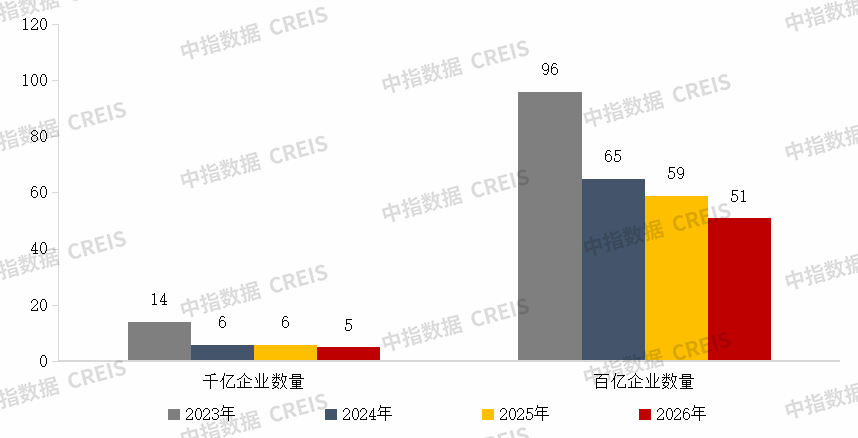
From January to September 2026, there were 5 100 billion housing enterprises, a decrease of 1 compared to the same period last year; there were 51 10 billion housing enterprises, a decrease of 8 compared to the same period. Judging from the changes in the sales camp of housing enterprises from 2023 to January to September 2026, the number of housing enterprises in the 100 billion and 10 billion echelons showed a continuous contraction trend, and the overall sales echelon of housing enterprises sank, reflecting that the era of large-scale expansion of the industry has come to an end. The decline in the number of 100 billion housing enterprises from January to September 2024 to 2026 has clearly slowed down, and the market position of leading housing enterprises has stabilized. Over the past few years, the industry has experienced a deep reshuffle and liquidation, and the signs that housing enterprises are shifting from large-scale expansion to high-quality and steady management are becoming more and more clear.
Figure: Number of 100 billion and 10 billion housing enterprises from 2023 to 2026 and January-September
Popular projects: Driven by demand-side policies in core cities, multiple projects take advantage of location and product strength to achieve popularity
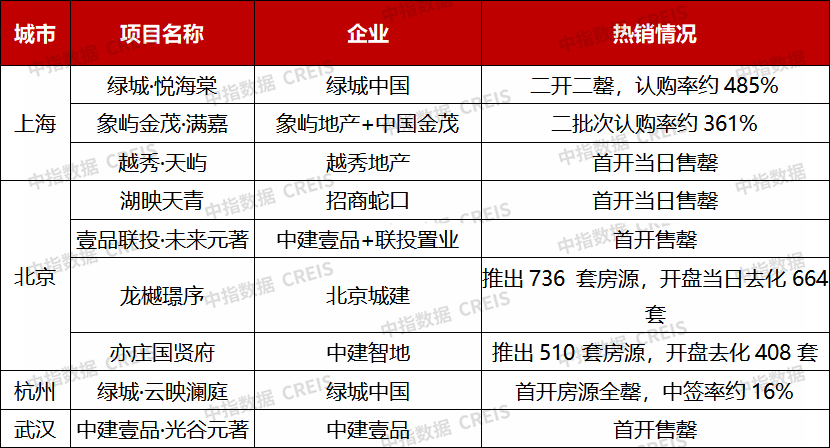
Driven by demand-side support policies for core cities at the end of August, some projects in key cities such as Shanghai, Beijing, Chengdu, Hangzhou, and Wuhan achieved popularity due to location and product strength. Popular projects mostly benefited from the following factors: First, the concentrated explosion of the policy window period. Core cities such as Beijing, Shanghai, Hangzhou, and Chengdu centrally introduced new property market policies at the end of August, boosting market confidence, and September ushered in a wave of demand release. Second, the value of core locations is evident. Most of the popular projects are located in urban core or high-potential sectors, and there is strong industrial and population agglomeration support. At the same time, new projects have been scarce in recent years, and the scarcity of land has enhanced the value of the project. Third, the product strength is outstanding. The best-selling projects are newly regulated products, and the housing rate is high. Many projects use raised board designs to reconstruct three-dimensional community spaces, improve the living experience, and form differentiated selling points such as the Sheng Garden Clubhouse, Song style garden, and technological housing systems. Fourth, brand credit and delivery certainty have significantly enhanced buyers' confidence. Central state-owned enterprise endorsements, early clubhouse delivery, and mature community operations have effectively hedged market concerns about delivery risks.
Table: Status of some recent best-selling properties
Data source: Comprehensive compilation by the China Index Research Institute
Outlook: The 9.29 mortgage interest rate discount policy will strongly support the release of demand and is expected to drive housing companies' sales decline to narrow
In terms of policy, the central government continues to set the tone for “stabilizing the real estate market.” At the National Standing Committee meeting on September 28, it was once again emphasized introducing policies and measures to stabilize the real estate market and promote employment income growth, indicating that stabilizing the real estate market is an important part of stabilizing the macroeconomy, and short-term policies will continue to be strengthened. On September 29, the Ministry of Finance, together with the People's Bank of China and the General Administration of Financial Supervision, issued a document stating that for the first time, the central financial administration gave interest rates on personal housing loans, targeting limited financial capital to real self-occupation needs without affecting loan contract interest rates or reducing bank net interest spreads, directly reducing the actual capital cost of eligible first-time homebuyers by about 1 percentage point, effectively reducing the pressure on buyers of monthly payments.
The reform of the real estate system is in place, and every effort is being made to push forward the implementation of the three basic systems. On August 28, various departments such as the Ministry of Housing and Construction, the Ministry of Natural Resources, and the General Administration of Financial Supervision issued a “1+2+5” policy document to comprehensively restructure basic systems such as real estate development, financing, and sales, and accelerate the construction of a new model for real estate development. On September 18, the Ministry of Housing and Construction made it clear at a press conference that real estate has undergone “two transformations”. One is that the relationship between supply and demand in the real estate market has changed significantly, and the other is that real estate has entered an era of stock. From the perspective of the new model of real estate development, the Ministry of Housing and Construction clarified the meaning of “1234” for the first time. “1” firmly grasps the foundation for people to settle down; “2” is to improve the two systems of security and market; “3” is the three systems of project company system, host bank system, and existing housing sales system; and “4” promotes the linkage of the four elements of “human real estate money.” At the same time, the Ministry of Housing and Construction emphasized that it will “make every effort to promote the implementation of the three basic real estate systems.” The current policy leaves some room for local city-specific policies, and the exact implementation rules are yet to be clarified. Cities such as Beijing, Shanghai, and Guangzhou explore existing home sales and raise the pre-sale threshold. On September 24, Beijing took the lead in implementing rules, clarifying that projects that acquired land before 8.28 but did not obtain a work permit are implemented in principle according to the new pre-sale policy. At the same time, certain flexible space has been set for each district, and certain transition period arrangements have been set. It is proposed that if each district government ensures that it can be completed and delivered on time, it can be pre-sold according to the original pre-sale conditions before the end of 2027, but the mortgage loan conditions will be implemented in accordance with the new policy, making it clear that the deposit is generally not more than 1% of the total housing price, and clarifying that for projects announced after 8/28, land payments can be made in less than 30 days 50% of the total price, paid within 2 years, not counting interest. Shanghai quickly followed up and introduced implementation rules on September 28. The general framework is basically the same as Beijing. The pre-sale management of land that has been announced for sale has been made more detailed and clear. The deposit collection ratio is no more than 3% of the total purchase price. It is clear that work regulations can be applied for based on land concession contracts, which helps speed up the construction progress of the project. Guangzhou is highly aligned with Beijing and Shanghai in key aspects such as pre-sale thresholds, on-going project transition and pre-sale fund supervision, mortgage loan timing, and host banking system. At the same time, it also shows clear local differentiated arrangements in terms of deposit limits, capital cancellation conditions, land supply and supporting support policies.
In terms of new housing, according to preliminary statistics from the China Index, in the first three quarters of 2026, the transaction area of newly built commercial housing in 100 key cities decreased by about 10% year-on-year. Specifically, sales fell 21% year on year in the first quarter, and the decline was quite obvious; as the base declined in the second quarter, compounded by continuous optimization of demand-side policies in core cities, overall transactions remained stable, and the year-on-year decline narrowed to 3%. Entering the third quarter, the sales area of new homes in key traditional off-season cities in July-August declined month-on-month, with year-on-year declines of 1% and 6%, respectively. In September, the year-on-year decline continued. According to preliminary statistics from the Central Index, the sales area of newly built homes in key cities fell by about 7% year on year in September, and overall fell by about 5% year on year in the third quarter.
In terms of the land market, the land market continued to be characterized by “shrinking volume and improving quality” in the third quarter, and the scale of transactions continued to shrink. In August, high-total land plots in core cities led to a marked increase in concession funds, and declined again year on year in September. According to data from the China Index, in the third quarter (ending September 27), residential land concessions in 300 cities fell 4.6% year on year, driven by high quality land transactions in hot cities such as Beijing, Shanghai, Hangzhou, and Shenzhen in August. The decline was significantly narrower than in the second quarter, and the transaction area still fell 24.3% year on year. Looking at September alone, land market transactions declined due to the combined effects of a slowdown in the pace of land supply and the trend towards prudent pricing by housing enterprises after the August 28 New Deal. From September 1 to 27, 300 cities planned to build a residential land area of 29.82 million square meters, with land concessions of 115.5 billion yuan, a year-on-year decrease of 37.4% and 29.0%, respectively. The average premium rate for residential land in 300 cities declined overall in the third quarter. From September 1 to 27, it was 6.0%, down 1.4 percentage points from August. Most cities mainly traded at reserve prices and low premium prices.