
Here’s What to Expect From MSCI’s Next Earnings Report
New York-based MSCI Inc. (MSCI) has built its business around helping investors make sense of increasingly complex financial markets. With a market capitalization of about $39.5 billion, the company provides indexes, research, data, and portfolio analytics that help clients evaluate investments, manage risk, and identify opportunities across global markets. Its offerings are used throughout the investment process, from assessing portfolio performance to understanding potential risks and returns.
MSCI serves a broad customer base that includes asset managers and owners, private-market investors, hedge funds, wealth managers, banks, insurers, and corporations. By bringing together market data, analytics, and technology, the company provides a common framework that allows financial-market participants to compare investments and make more informed decisions across regions and asset classes.
The leading provider of investment decision-support tools and indices is expected to announce its fiscal third quarter 2026 financial results on Tuesday, Oct. 20, at 11:00 a.m. Eastern Time.
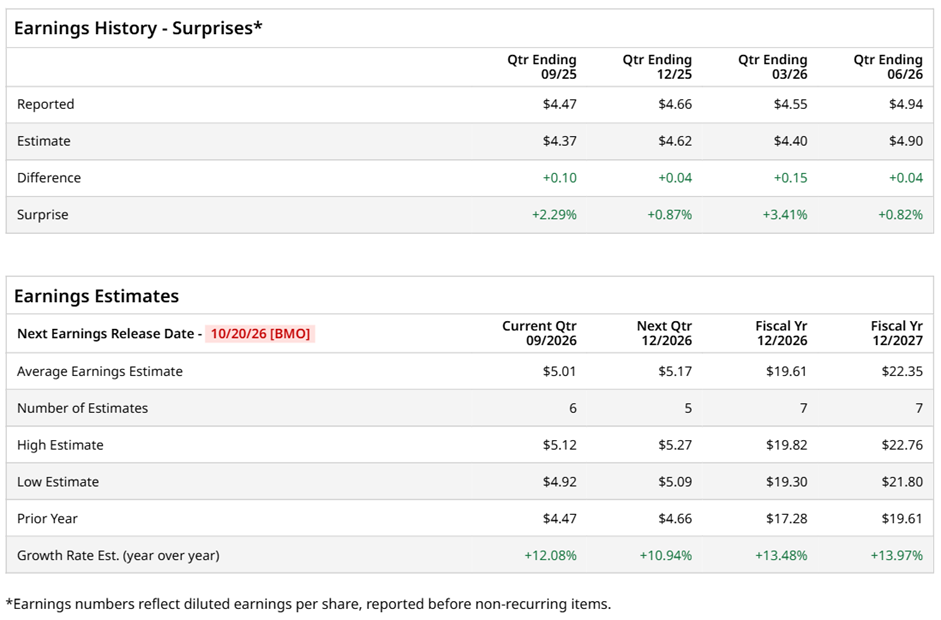
Ahead of the event, analysts expect MSCI to report a profit of $5.01 per share on a diluted basis, up 12.1% from $4.47 per share in the year-ago quarter. The company has consistently surpassed Wall Street’s EPS estimates in each of the past four quarterly reports.
The longer-term expectations are also pointing higher. For fiscal 2026, analysts expect MSCI’s EPS to be $19.61, up 13.5% from $17.28 in fiscal 2025. Its EPS is projected to climb 14% year over year to $22.35 in fiscal 2027.
The stock, however, has not kept pace with those earnings expectations. MSCI’s shares have slipped 5.1% over the past 52 weeks, while the S&P 500 Index ($SPX) has climbed 15.2%. The financial sector has also held up better, with the State Street Financial Select Sector SPDR ETF (XLF) down only marginally over the same period.
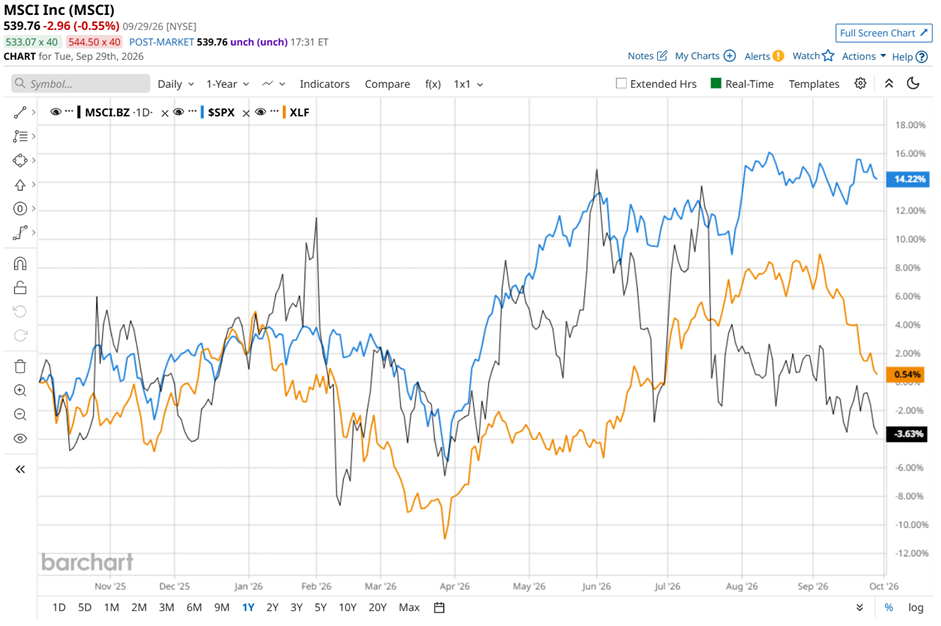
One of the biggest setbacks for MSCI came in July, when the stock took a sharp 10.1% hit after the company raised its 2026 operating expense forecast to $1.54 billion to $1.58 billion. The higher spending reflected acquisition costs, larger employee incentives, and increased investment, but investors quickly shifted their focus to what that could mean for margins and profits. Operating expenses had already climbed 9.2% to $379.5 million, while interest expense jumped nearly 48% as debt levels increased.
The bigger picture was not all negative. MSCI’s Q2 adjusted EPS of $4.94 matched Wall Street expectations, while index asset-based fees jumped 26.6% to $233.1 million.
Analysts are upbeat on MSCI, with the stock carrying an overall “Strong Buy” rating. Of the 19 analysts covering the company, 14 recommend a “Strong Buy,” while two rate it a “Moderate Buy,” two have a “Hold” rating, and one recommends a “Strong Sell.” The average price target stands at $690.55, implying about 27.9% upside potential from current levels.
On the date of publication, Sristi Suman Jayaswal did not have (either directly or indirectly) positions in any of the securities mentioned in this article. All information and data in this article is solely for informational purposes. For more information please view the Barchart Disclosure Policy here.