
Ministry of Civil Affairs: Helping Yinfa's economy accelerate development and vigorously promote the construction of smart home, community and institutional care scenarios
The Zhitong Finance App learned that on September 30, the Ministry of Civil Affairs issued the “15th Five-Year Plan” for the Development of Civil Affairs. Among them, it was mentioned to help the Yinfa economy accelerate development. Enrich the supply of products and services and application scenarios. Accelerate scientific and technological innovation for the elderly. Select and update the promotion catalogue of geriatric products (rehabilitation aids). Promote the development and popularization of age-appropriate products. Promote the integrated development of various business formats such as old-age care, medical care, education, and cultural tourism. Promote the cultivation of residential care destinations. Vigorously promote the construction of smart home, community and institutional care scenarios. Play the role of an information platform for old-age services to achieve functions such as health file management, service reservations, and emergency calls. Develop an “Electronic Map of Elderly Care Services.”
The plan also suggests that by 2030, party building in civil affairs departments at all levels will be comprehensively strengthened, the policy system, service guarantee system, supervision and management system, and social participation system will be further improved and perfected, the level of work in aging and old-age services, social assistance, social welfare, social affairs, and social governance will be further improved, and solid steps will be taken in the high-quality development of civil affairs undertakings.
The original text is as follows:
The “15th Five-Year Plan” for the development of civil affairs
In order to clarify the goals and tasks for the development of civil affairs during the “15th Five-Year Plan” period, this plan was formulated based on the “Outline of the 15th Five-Year Plan for National Economic and Social Development of the People's Republic of China”.
Chapter 1: Promoting Chinese-style modernization and writing a new chapter in the development of civil affairs
Section I Development Situation
During the “14th Five-Year Plan” period, the civil administration system adhered to Xi Jinping's ideology of socialism with Chinese characteristics in the new era, earnestly implemented the decisions and arrangements of the Party Central Committee, carried out its duties with due diligence, and made new progress in various tasks, which strongly served the overall work of the Party and the country.
The “15th Five-Year Plan” period is a critical period for basically achieving socialist modernization, consolidating the foundation and making comprehensive efforts. General Secretary Xi Jinping made a series of important remarks on civil affairs work, profoundly clarifying a series of directional, fundamental, global, and strategic issues relating to the long-term development of civil affairs, pointing out the way forward and providing fundamental guidelines for the reform and development of civil affairs undertakings. The Party Central Committee and the State Council have made important strategic plans for reform and development in various fields of civil affairs. The new round of scientific and technological revolution has provided favorable conditions for civil affairs work to enrich working methods, expand application scenarios, and improve service quality. China's population development has further shown the trend characteristics of declining birthrate, aging population, and diversification of regional population growth and decline. The growing needs of the people to live a better life have put forward new requirements for civil affairs work.
Section II General Requirements
Guiding ideology: During the “15th Five-Year Plan” period, the development of civil affairs should adhere to Xi Jinping's ideology of socialism with Chinese characteristics in the new era, comprehensively implement the spirit of the 20th National Congress and the 20th Plenary Session of the Party, promote high-quality development as the theme, better serve the socialist modernization drive with Chinese characteristics as the main line, aim to meet people's needs for a better life, be driven by comprehensive deepening reforms, highlight systemic, holistic and collaborative nature, and strengthen inclusive, basic, and underpinned people's livelihood construction with Chinese modernization.
Basic principles: Adhere to the overall leadership of the Party and firmly grasp the correct political direction. Adhere to people's livelihood as the greatest, so that development results can benefit all people more and more fairly. Adhere to the basic underpinning of inclusiveness, and steadily promote the expansion of civil affairs services from specific targets to all residents. Insist on doing our best to do what we can to promote healthy interaction between people's livelihood improvement and economic development. Insist on comprehensively deepening civil affairs reforms to stimulate new momentum for development. Adhere to integrated development and security, and ensure high-quality development with a high level of security.
Section III Development Goals
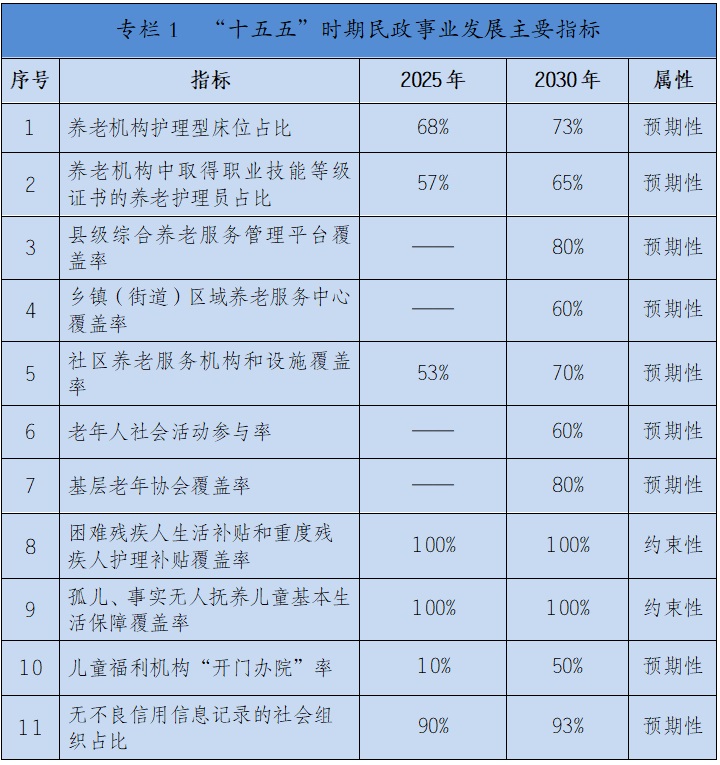
By 2030, party building in civil affairs departments at all levels will be comprehensively strengthened, the policy system, service guarantee system, supervision and management system, and social participation system will be further improved and perfected, the level of work in aging and old-age services, social assistance, social welfare, social affairs, and social governance will be further improved, and solid steps will be taken in the high-quality development of civil affairs undertakings.
Chapter II: Actively Responding to Population Aging and Promoting Collaborative Development of Aging Undertakings and Industries
Section I: Further Implementing the National Strategy to Respond Actively to Population Ageing
Promote aging work in an integrated manner. Improve implementation mechanisms and strengthen strategic coordination, policy coordination and resource sharing. Improve systems such as statistical monitoring and data release for the aging industry and the banking economy. The sixth national sample survey on the living conditions of the elderly in urban and rural areas was carried out.
Deepen education on national conditions. Promote population aging and education on national conditions into institutions, schools, communities, enterprises, etc. Improve mechanisms for the development, review and evaluation of educational content for the aging population and national conditions. Implement the “Internet +” national education project for an aging population and promote the construction of a learning resource bank.
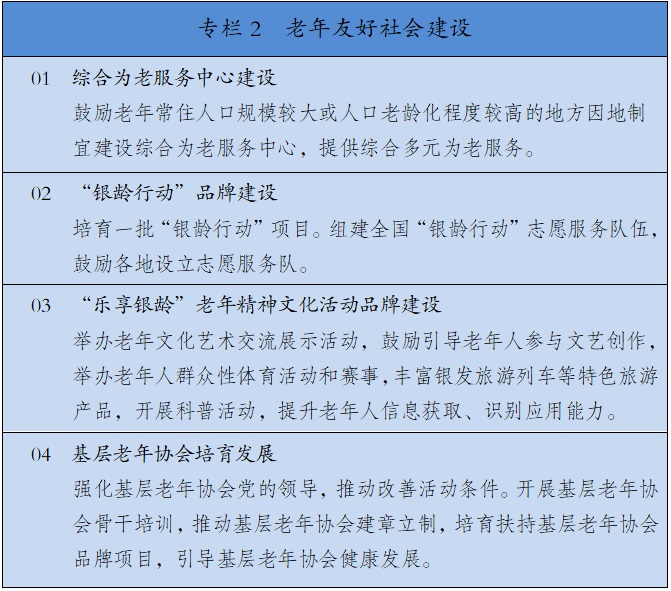
Expanding social participation. Improve policies and regulations for the social participation of the elderly, and promote the elimination of unreasonable regulations that prevent the elderly from continuing to play their role. Improve the volunteer service system for the elderly, and improve mechanisms such as recruitment management, incentives and restrictions. Actively develop human resources for the elderly, carry out family development capacity training, and improve skills in intergenerational care and nursing care.
Strengthen the protection of rights and interests. Improve working mechanisms for early warning, prevention, detection and reporting, resolution and disposal of risks involving the elderly. Coordinate and promote the crackdown and rectification of illegal and criminal acts such as false publicity, illegal fund-raising, and pension fraud in the field involving the elderly. Publish typical cases of protecting the rights and interests of the elderly, carry out publicity and education on legal popularization and fraud prevention for the elderly, and promote intentional guardianship of the elderly.
Build an age-friendly environment. Encourage all regions to implement preferential treatment programs for the elderly, and support the implementation of programs where the elderly enjoy the same preferential treatment as those in their domicile domicile. Comprehensively promote the construction of age-friendly communities and continue to carry out the “Smart Help for the Elderly” campaign. Strengthen the inheritance and innovation of filial piety and respect for the elderly culture, and carry out the national “Respect for the Aged Month” campaign and the selection of national activities to respect the elderly, love the elderly and help the elderly.
Strengthen theoretical research on aging and international exchanges and cooperation. Promote relevant universities, research institutes, etc. to carry out research to respond positively to population aging, and strengthen collaborative innovation in aging policy research. Improve bilateral and multilateral exchange mechanisms in the field of aging, build a brand for international conferences on aging issues, and actively participate in global governance of aging issues.
Section II Improving the Old-Age Service System Suitable for China's National Conditions
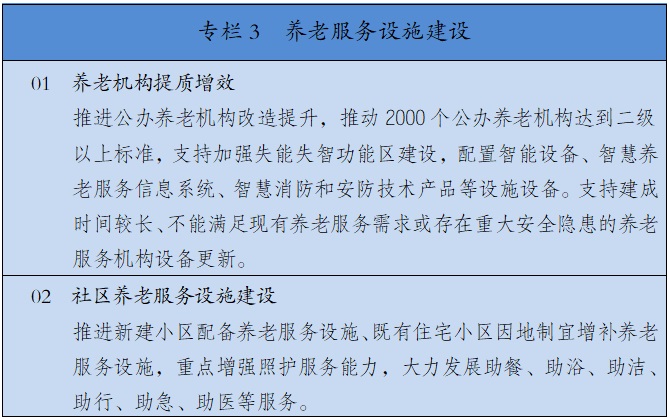
Build a three-level old-age service network. Build an urban and rural three-level old-age service network supported by a county-level comprehensive old-age service management platform, township (street) regional old-age service centers, and village (community) old-age service sites to enhance and expand service functions. Strengthen technical guidance and talent training for county-level comprehensive old-age service management platforms, and strengthen coordination of county-level old-age service resources. Improve the radiation capacity of regional old-age service centers, and promote the connection between supply and demand and the adaptation of resources. Relying on village (community) old-age service facility sites to collect and refer service requests in a timely manner, home-based or community nursing services can be provided nearby. Establish and improve evaluation and supervision mechanisms. Implement the county pension service improvement plan project.
Improve the supply pattern of old-age services. Strengthen basic old-age services, expand the scale of inclusive old-age services, optimize the supply pattern of home-based, community-based, institutional professional support, and medical care, and promote the expansion, quality and efficiency of old-age services. Develop a smart home nursing bed care model and carry out age-appropriate transformation for elderly families. Strengthen care and assistance for the elderly living alone and empty nesters, and normalize visits and care services for the elderly. Develop embedded community pension services and cultivate specialized, chain and branded community pension service institutions. Promote integration of medical care and strengthen integrated care services. Actively develop rural old-age services and implement mutual assistance for the elderly according to local conditions. Strengthen the service capacity building of pension institutions, and implement underwriting guarantee type, inclusive support type, and complete market classification reforms for pension institutions according to local conditions in accordance with regulations. Improve and perfect the price formation mechanism for old-age services. Strengthen care services for the disabled and mentally disabled elderly, guide pension institutions to actively accept disabled and mentally disabled elderly people, and explore “elderly parents+disabled children” families to stay in pension institutions or other care institutions together. Develop geriatric education in conjunction with the three-level old-age service network.
Strengthen the guarantee of elements of old-age services. Strengthen the link between long-term care insurance and the old-age service system. Explore the establishment of cross-departmental coordination mechanisms to promote interdepartmental information sharing and mutual recognition of evaluation results across the country. Relevant benefits are paid to eligible elderly people. Strengthen the construction of an old-age service talent team and establish a professional qualification system for old-age service workers.
Strengthen comprehensive supervision of old-age services. Implement the main responsibility for safety management of old-age service institutions, establish and improve supervision mechanisms with coordination and cooperation among various departments, and consolidate the responsibilities of territorial governments. Strengthen the full cycle management of admission, operation, and withdrawal of pension institutions. Establish a cross-departmental normalized joint inspection mechanism, and implement a “one list” of inspection items for pension institutions. Improve the credit supervision system for old-age services. Improve emergency response mechanisms. Strengthen the standardization of old-age services. Promote the sinking of the power to supervise and enforce old-age services.
Section III: Helping the Yinfa Economy Accelerate Development
Guide and nurture business entities. Improve the policy system for the aging industry. Promote the improvement of current support policies and promote the rational flow of factors of production in the industry. Establish an industry incubation mechanism, promote the cultivation of leading enterprises and “specialized, special and new” enterprises, and strengthen brand strategy promotion.
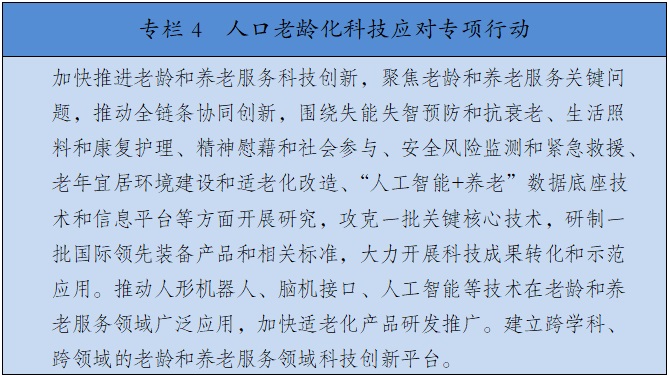
Enrich the supply of products and services and application scenarios. Accelerate scientific and technological innovation for the elderly. Select and update the promotion catalogue of geriatric products (rehabilitation aids). Promote the development and popularization of age-appropriate products. Promote the integrated development of various business formats such as old-age care, medical care, education, and cultural tourism. Promote the cultivation of residential care destinations. Vigorously promote the construction of smart home, community and institutional care scenarios. Play the role of an information platform for old-age services to achieve functions such as health file management, service reservations, and emergency calls. Develop an “Electronic Map of Elderly Care Services.”
Optimize and improve the consumption environment. Encourage the construction of shopping malls, supermarkets for the elderly and online sales platforms that integrate the display, experience, and sale of elderly products, and encourage the development of elderly product display, rental and sales areas in pension institutions, civic centers, and large supermarkets. Encourage e-commerce platforms and retailers to set up banking consumer zones. Launch the “Old-Age Service Consumption Season” campaign to activate the potential consumption needs of the elderly. Encourage all regions to organize high-level promotion activities on the theme of the aging industry in compliance and build a platform for supply and demand. Promote the formulation and improvement of relevant national standards, and establish certification systems for silver hair products and services.
Chapter III: Securing the Bottom Line of People's Livelihood and Improving the Social Assistance System
Section I Improving the Hierarchical Classification of Social Assistance Systems
Construct a gradient rescue pattern. Comprehensively identify marginal households under subsistence allowances and families with rigid spending difficulties, and promote the implementation of relevant special aid policies for medical care, education, housing, employment, etc. Accelerate the formation of a gradient rescue pattern with hierarchical management according to the degree of difficulty and classification of aid according to rescue needs. Improve policies and measures to promote employment assistance and financial support for social assistance recipients.
Comprehensively improve the quality and efficiency of rescue. Implement regulations such as the gradual decline of subsistence allowances, employment cost deductions, and “single person insurance.” Improve the aid and support system for special hardship cases, and optimize the “three no” certification conditions and relief measures for special hardship cases. Establish a filing system for subsistence insurance standards, and standardize dynamic adjustment mechanisms for basic living assistance standards such as subsistence allowances linked to per capita consumption expenditure. Implement a linkage mechanism linking social assistance and security standards to price increases. Fully implement “small-amount quick relief” for urgent matters, and play the role of emergency response, transition, connecting and supplementing temporary assistance. Promote the transformation and upgrading of rescue management services for evacuees who have no means to live, improve regional integrated working mechanisms, and promote rescue management agencies in prefecture-level cities to play the role of regional rescue centers.
Improve long-term supervision mechanisms. Continue to carry out comprehensive management of social assistance, improve the mechanism for supervising aid funds, and strictly implement systems such as filing records for close relatives of social assistance managers and filing credit cards on behalf of them. Strengthen the work of letters and petitions in the field of social assistance, and clear channels for reporting claims such as social assistance service hotlines at all levels. Establish and improve due diligence exemption mechanisms.
Section II: Strengthening Dynamic Monitoring and Rescue Assistance
Strengthen dynamic monitoring of social assistance. Strengthen the application of low-income population dynamic monitoring information platforms, integrate management service systems, verification systems, dynamic monitoring systems, and “emergency emergency” information docking service systems, and improve the database of social assistance recipients. Improve mechanisms for checking household financial status, and promote nationwide networking of information checking information systems.
Establish and improve a closed-loop operation mechanism. Establish a working mechanism for civil affairs departments to accurately identify aid targets, and various functional departments to collaborate on rescue and support, establish a closed-loop operation mechanism with hierarchical management, dynamic monitoring, promotion as needed, classified rescue, and feedback on results, forming a “closed-loop rescue chain for one household (person)”.
Section III: Optimizing Social Assistance Services
Actively develop service-type social assistance. It mainly targets social assistance recipients such as special hardship cases in need, minimum subsistence allowance recipients, family members on the margins of minimum subsistence allowance, family members with rigid spending difficulties, etc., to meet their basic service needs that are difficult to obtain on their own, and to promote the transformation of social assistance from a single material aid to a “material+service” comprehensive aid model. Provincial civil affairs departments should prepare a guidance list for service social assistance in their administrative regions, establish and improve a needs assessment index system, and promote the gradual formation of a relatively uniform service social assistance list within the region. Municipal and county civil affairs departments should draw up service social assistance lists in their administrative regions based on actual situations such as the financial affordability of the region and the specific needs of people in need, and clarify service categories, service content, target scope, service standards, funding sources, etc. Service-type social assistance programs should be set up within the means to avoid repeated support with material social assistance. Make full use of existing resources to rationally determine funding channels for service-type social assistance; in principle, no additional financial burden will be added. Strengthen applications such as big data and artificial intelligence, and improve the “one-door acceptance and collaborative processing” mechanism and active discovery mechanism for social assistance. Establish and improve the participation mechanism for multiple actors, strengthen the effective link between government aid and charitable support, encourage charitable organizations to set up rescue and help public welfare projects, and guide social forces to participate in social assistance in a broad and orderly manner.
Chapter IV: Actively Adapting to the Needs of the Masses and Raising the Level of Social Welfare
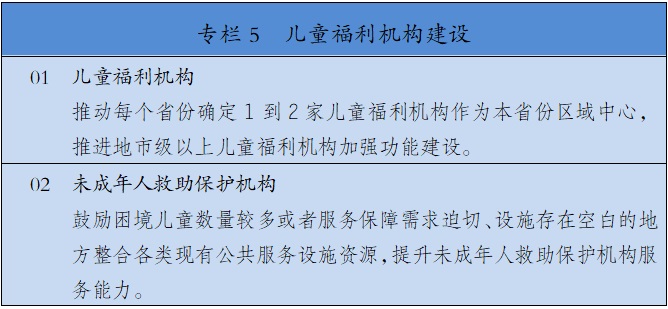
Section 1. Raising the level of child welfare protection
Construct a child welfare work pattern with multiple guarantees. Promote the improvement of basic livelihood security, medical rehabilitation services, basic public education services, mental health care services, personal safety protection, legal guardianship responsibilities, etc. for children in distress, improve and standardize work such as guardianship assessment, adoption registration management, etc., strengthen care services for autistic children, establish a “material+service” diversified security pattern, and promote standardization. Strengthen accurate protection for orphans and factual unsupported children, improve methods and support policies for the identification of factual unsupported children, and improve mechanisms for dynamic adjustment of basic livelihood security standards for orphans and factual unsupported children. Improve mechanisms to protect the rights and interests of migrant children and left-behind children, update the list of care services in a timely manner, and promote the enjoyment of basic public services by migrant children in their places of permanent residence. Promote the identification and assessment of the mental health status of children in distress.
Strengthen the grassroots foundation for child welfare work. Establish a comprehensive service system with national regional centers as the lead, provincial regional centers as the backbone, and city and county child welfare institutions as supplements. Promote the quality and efficiency of the services of child welfare institutions and juvenile rescue and protection agencies. Strengthen the construction of a team of township (street) child supervisors and village (community) child supervisors. Strengthen detailed care services for children in distress by relying on places such as township (street) unprotected stations and village (community) child care services.
Section II Improving the Social Security System and Care Service System for People with Disabilities
Improve the provision of welfare systems for people with disabilities. Improve living allowances for people with disabilities in need, nursing allowance systems for severely disabled persons, and mechanisms for dynamic adjustment of subsidy standards. Implement a subsidy data verification mechanism and strengthen supervision of the disbursement of subsidy funds. Improve systems to protect the rights and interests of persons with disabilities, such as promoting centralized employment.
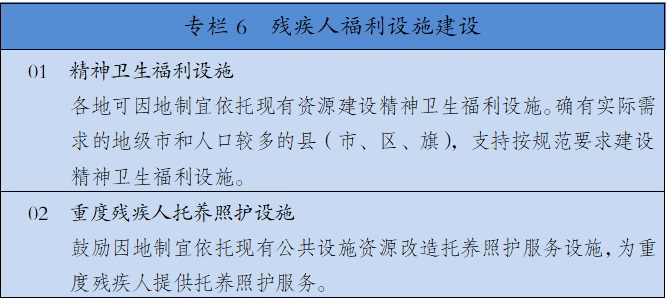
Strengthen nursing and care services for the severely disabled. Accelerate the construction of a nursing service system for the severely disabled, rely on existing resources to carry out the construction of nursing care service facilities according to local conditions, strengthen the link between nursing and care services for the severely disabled, and improve the policies and measures for capable pension institutions to accommodate people with severe disabilities.
Develop mental health welfare services and community rehabilitation services for mental disorders. Improve the mental health welfare service system to effectively meet the life care, rehabilitation, medical and other service needs of patients with mental disorders among special hardship cases. Promote the construction of a rehabilitation service system for communities with mental disabilities, and promote the “Integrative Action for Integrating Well-being” to improve quality and efficiency.
Section III Enhancing the Service Capabilities of Rehabilitation Aids to Support the Elderly and the Disabled
Promote the optimization and upgrading of the rehabilitation aid industry. Play the role of an inter-ministerial joint conference on the rehabilitation aid industry, improve industry supervision policies, and effectively standardize rehabilitation aid products and services. Promote the establishment of a national rehabilitation aid industry contact point system. Consolidate and expand the results of the national comprehensive innovation pilot and the community rental service pilot. Implement the normalized revision mechanism of the “China Catalogue of Rehabilitation Aids” to improve the information service capabilities of national rehabilitation aid products and the entire industry chain. Promote the upgrading of traditional functional compensatory rehabilitation aids, encourage the integrated application of cutting-edge technologies such as artificial intelligence, intelligent sensing, 3D printing, and brain-computer interfaces in the field of rehabilitation aids, and promote the development of products in the direction of high-end, intelligent and personalized products.
Strengthen the promotion and application of rehabilitation aids. Formulate policies for the promotion and application of rehabilitation aids. Encourage places in a position to do so to build comprehensive rehabilitation aid service platforms based on existing resources according to local conditions to provide “one-stop” services such as evaluation, configuration, rental and sale of rehabilitation aid products for groups with rehabilitation needs. Strengthen the construction of a team of professionals related to rehabilitation aids. Implement relevant preferential tax policies, and coordinate research to promote the inclusion of eligible basic therapeutic rehabilitation aids in the scope of basic medical insurance payments in accordance with procedures. Standardize and strengthen the construction of a service subsidy system for basic assistive devices for the disabled, promote centralized procurement of rehabilitation aids in an orderly manner, and effectively improve the configuration and service level of rehabilitation aids for the disabled.
Chapter V focuses on implementing practical aspects of people's livelihood and optimizing social affairs management services
Section 1 Optimizing Marriage Management Services
Improve and enhance matrimony management services. Enact and revise regulations on marriage registration, registration of marriage for border residents, and file management for Chinese citizens, both men and women who are not mainland residents, to improve the quality and efficiency of “nationwide” marriage registration. Strengthen the supervision and management of marriage agency agencies. Deepen cross-strait marriage and family exchanges and cooperation.
Improve the marriage and family counseling service system. Promote the revision of national professional standards for marriage and family counselors, and actively promote the classification of skilled vocational personnel. Optimize marriage and family counseling services, and encourage all regions to strengthen comprehensive marriage and family service guidance work and service system construction.
Deepen the reform of marriage customs. Cultivate a new culture of marriage and childbearing, and promote a positive view of marriage and childbearing. Promote the establishment of a long-term mechanism to control bad marriage customs, such as expensive bride prices and big arrangements, and formulate advocating standards or regulations in the field of marriage customs in conjunction with actual practice. Promote innovation in the “marriage service+” model.
Section II Strengthening Funeral Management Services
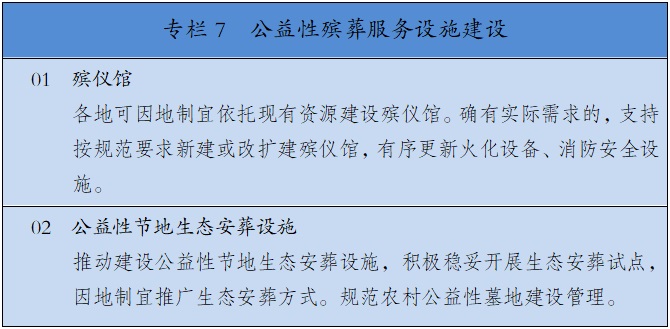
Establish and improve a basic funeral service system. Formulate and implement a list of basic projects for national funeral services. Each region can add basic projects according to local conditions. Basic funeral service projects that meet the conditions, such as transportation, storage, cremation, and storage of ashes, will gradually be included in the scope of basic national public services. Each region reasonably determines the list of non-basic projects, and strictly manages the charges for the projects included in the list in accordance with the law. Services such as transportation, storage, and cremation of dead bodies shall be provided by funeral service agencies organized by the government. Fully implement the welfare funeral policy and deepen the “deal with the aftermath once” reform. Scientifically plan and lay out funeral service facilities to gradually match the supply of public welfare burial facilities with the basic funeral service needs of urban and rural residents.
Raise the level of legal governance of funerals. Improve the funeral policy system, promote local legislation in the field of funeral, and promote the development of standardized management of funeral services. Establish a comprehensive cross-departmental supervision mechanism in the funeral field, strengthen law enforcement capacity building in the funeral field, and strengthen source management and full-process supervision. Steadily push forward funeral reform, establish and improve ecological burial rewards and supplements policies, continue to promote funeral customs and customs, give full play to the exemplary leading role of Party members and cadres and the role of village regulations and residents' conventions, strengthen life culture education, and promote the establishment of a new culture of civilized and frugal burial.
Chapter 6 focuses on high-quality service development, strengthening and innovating social governance
Section I Strengthening the Cultivation and Management of Social Organizations
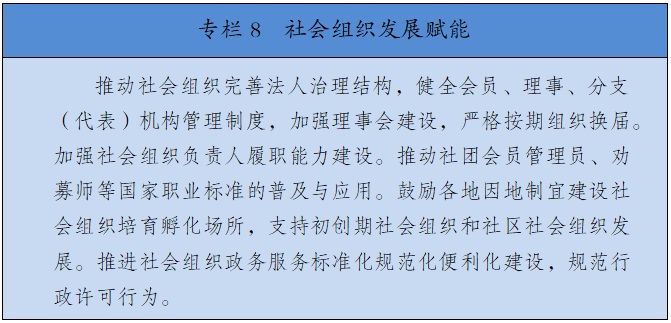
Strengthen the management of social organizations. Adhere to party building leadership, improve social organization management system reform, international social organization cultivation and management policy design, implement industry associations and chambers of commerce legislation and administrative regulations revisions for social organization registration management, and improve rules and regulations for branch (representative) agencies, credit information management, evaluation and commendation, and festival exhibition forums. Improve the deregistration system and clear exit channels. Improve the management system for science and technology associations, and promote the reform of the science and technology society management system and mechanism. Improve the comprehensive supervision system and mechanism of social organizations, and deepen the standardization of social organizations. Innovate in-fact and post-event supervision methods, and rely on technical models such as big data and artificial intelligence to intelligently analyze and warn risks of abnormal activities of social organizations. Improve the information disclosure system and continuously enhance the credibility of social organizations. Improve law enforcement mechanisms, enhance law enforcement capabilities, and step up the investigation and punishment of illegal acts. Regularize the crackdown on illegal social organizations.
Improve the system for cultivating and developing social organizations. Focusing on serving the country's major strategies, it focuses on cultivating and developing social organizations in strategic emerging industries and future industries. Encourage the establishment of international science and technology organizations in China, and support social forces to establish science and technology social organizations. Support the establishment of social organizations to serve the development of urban agglomerations such as Beijing-Tianjin-Hebei, Yangtze River Delta, Guangdong, Hong Kong and Macao to help coordinate regional development. Strengthen the talent team building for social organizations, and promote the formulation of relevant national professional standards and the evaluation of professional standards. Improve the social organization evaluation system and expand the application of evaluation results. Strengthen the construction of a social organization case base and knowledge base, and cultivate a team of experts in the field of social organization. Promote social forces to fund and support the development of social organizations, and encourage financial institutions to increase their support for eligible social organizations. Guide social organizations to participate in social services and promote the decline in resources, strength, and services.
Section II Promoting and Regulating the Development of Philanthropy
Improve the system for the development of philanthropy. Improve the management system and accreditation procedures for charitable organizations in accordance with law. Improve the charitable trust system and broaden the distribution channels of wealth to philanthropy in an orderly manner. Improve community philanthropy development policies and innovate community charity models. Establish and improve a system of charitable standards. Promote the establishment of a charitable information statistics system. Explore the working mechanisms of charity to help the development of civil affairs and people's livelihood undertakings.
Improve mechanisms to support development. Deeply publicize laws and regulations such as the Charity Law, and widely carry out “China Charity Day” themed activities to promote charitable culture into institutions, enterprises, villages, communities, and families, and create a positive social atmosphere. Improve the charity commendation system, carry out charity award selection and commendation activities at all levels in accordance with the law and regulations, and increase recognition and praise for acts of charity. Implement preferential tax policies for charitable purposes. Guide and support willing and capable businesses, social organizations, and individuals to participate in charitable causes.
Improve standardized management mechanisms. Work with the Party's working agencies and business units to promote charitable organizations to achieve full coverage of the Party's organization and the Party's work. Improve comprehensive charity supervision mechanisms, and promote civil affairs departments, business units, and industry management departments to effectively perform their duties. Strengthen guidance and supervision of public fundraising, internet charity, charitable trusts, etc. Implement the “Sunshine Charity” project, improve the evaluation and management of charitable organizations, promote the standardization of charitable organizations, and enhance the credibility of charitable organizations. Establish a pre-term training system for heads of charitable organizations and a training system for employees on regulations and policies. Strengthen self-discipline in the philanthropic industry.
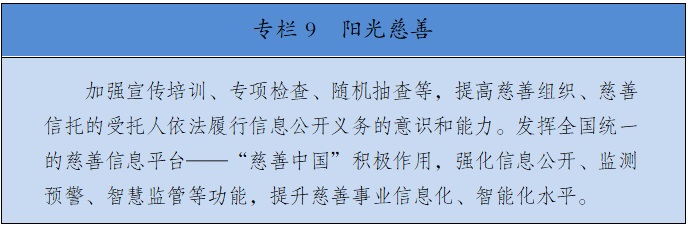
Section III Improving the Distribution and Sales of Welfare Lottery Tickets and Community Chest Management
Strengthen research and development reserves for game products. Promote the integration of new channels, multiple business formats, and multiple scenarios, and promote the standardization of traditional channels. Build the “Sunshine Fucai” brand and deepen the building of credibility. Strengthen the management of responsible lottery tickets throughout the chain and guide healthy lottery purchases. Unify technical systems and build a digital intelligence platform. Standardize consignment sales practices and strengthen supervision and inspection. Strengthen the management of the allocation and use of the Community Chest by civil affairs departments, accelerate the promotion of full coverage of Community Chest funding project signs, and improve the management system for the whole process. Standardize the use of funds and strengthen information disclosure and audit supervision.
Section 4 Optimizing the allocation of geographical names resources for zoning
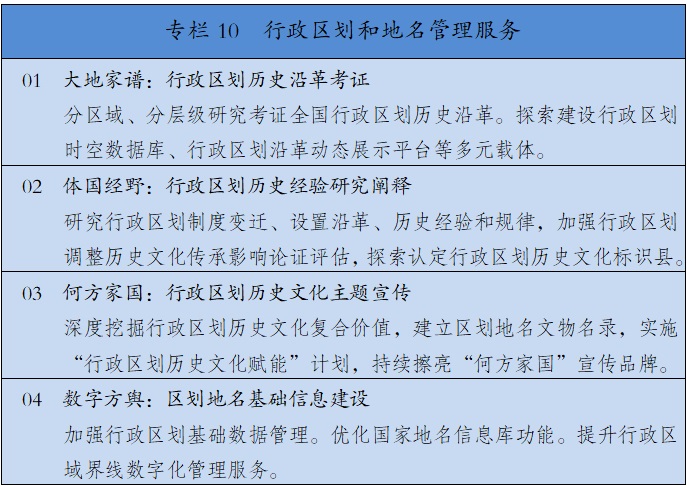
Strengthen overall coordination and planning guidance in administrative divisions. Fully implement the Party Central Committee's centralized and unified leadership of administrative division work, and improve mechanisms for joint review, policy support, implementation supervision, monitoring and evaluation of administrative division adjustment departments. Strengthen strategic research and planning leadership. Strengthen the historical and cultural heritage and protection of administrative divisions, highlight the role of administrative divisions as a symbol of Chinese civilization carrying the country's history, national memory, and cultural accumulation, and consolidate the historical and cultural foundation for maintaining the overall stability of administrative divisions. Strengthen capacity building for administrative regional boundary management, and improve the administrative regional boundary management service system.
Improve the effectiveness of geographical names management services. Strengthen the supervision of geographical name naming and renaming, improve and improve the geographical names management regulations, policy system system, implement the filing and announcement system, and step up efforts to revise the standard system. Improve the geographical names cultural heritage list system and deepen the protection and inheritance of geographical names culture. Strengthen capacity building for geographical names public services, promote the “Famous Village Campaign” to improve quality and efficiency, and increase the coverage rate of urban and rural geographical name labeling. Promote the construction of geographical names cultural brands and help the development of the industry. Promote standardization of translations of foreign geographical names. Actively participate in the United Nations standardization of geographical names.
Strengthen the integration of geographical names data resources for zoning. Strengthen comprehensive services for administrative divisions, administrative regional boundaries, and geographical names information, strengthen data resource catalogue construction, and strengthen data collection, collection, update and maintenance. Establish a hierarchical classification management system, improve data co-construction and sharing mechanisms, and strengthen safe operation.
Chapter 7: Strengthening Plan Implementation Guarantees to Form Strong Synergies for Plan Implementation
Section I: Uphold and Strengthen the Party's Overall Leadership
Deeply study and implement Xi Jinping's ideology of socialism with Chinese characteristics in the new era, and use the Party's innovative theories to unify ideas, unify will, and unify actions. Adhere to and strengthen the overall leadership of the Party, persevere in promoting comprehensive and strict government of the Party, and provide strong political guarantees for achieving the goals and tasks of the plan. Fully implement the Party's strategy for governing Tibet and the strategy for governing the border, and do a solid job of the civil administration department to aid Tibet and Jiang.
Section II Strengthening Policy Coordination and Guarantee
Improve the civil administration regulation system, strengthen civil administration law enforcement capacity building, and promote strict performance of duties in accordance with the law. Coordinate the development of national standards, industry standards, local standards, and group standards in the field of civil affairs, and strengthen the implementation and supervision of standards. Focus on the “efficient completion of one thing” reform, improve management service information platforms in the field of civil affairs, promote “cross-provincial co-operation”, “full network operation”, and active service, and strengthen intelligent and penetrating supervision.
Section III Improving Planning and Implementation Mechanisms
Clarify the division of target tasks, draw up a list of major engineering projects, and promote the implementation of planned tasks by classification. Carry out dynamic monitoring, mid-term evaluation and summary evaluation of the implementation of the plan, improve and strengthen policy initiatives for the implementation of the plan in a timely manner, and ensure the full implementation of the planning tasks.
This article was selected from the “Ministry of Civil Affairs” official website, Zhitong Finance Editor: Feng Qiuyi.