
How Accounting Restatements Will Impact Nidec Stock Investors
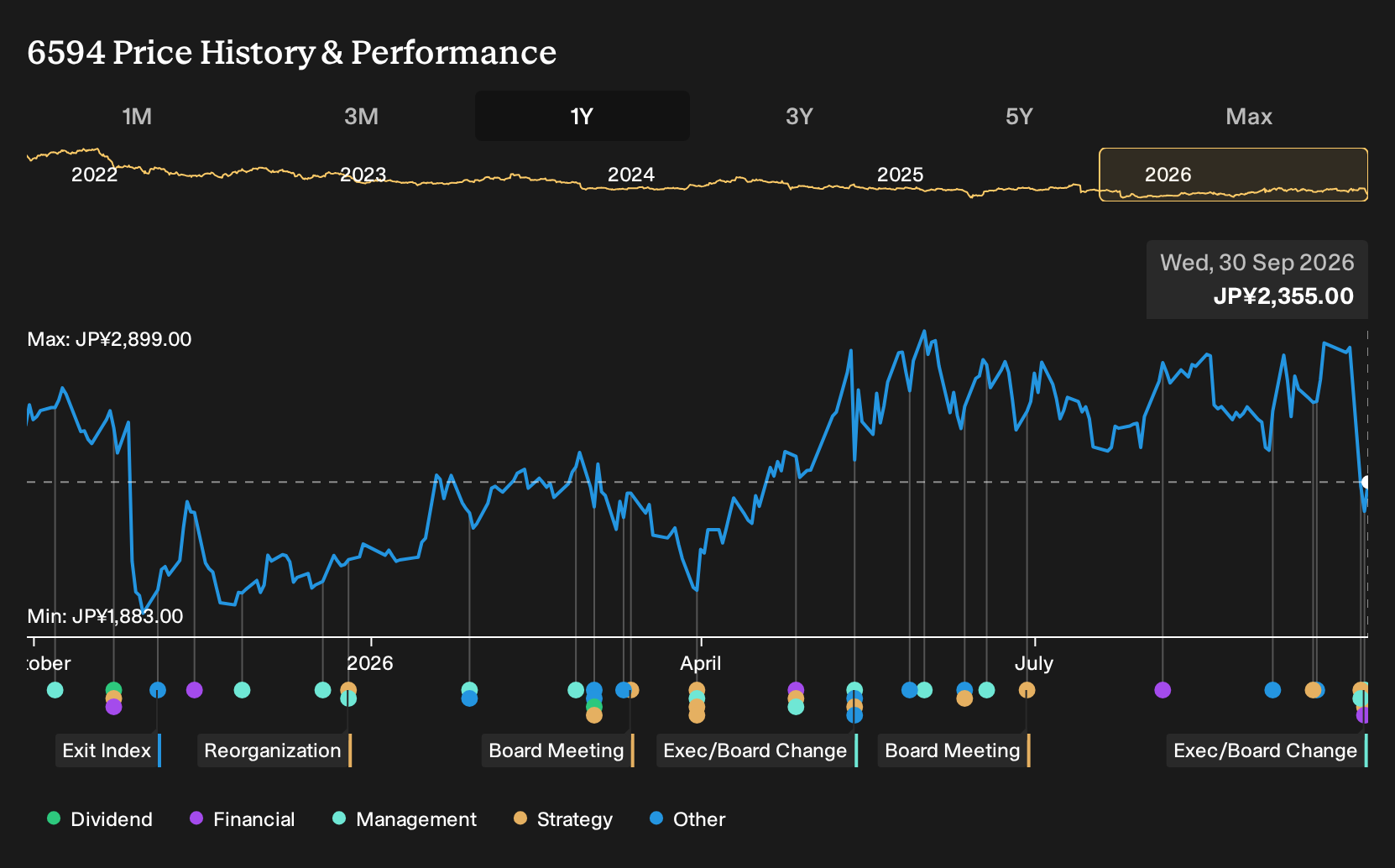
- Nidec disclosed past accounting irregularities, restated earlier financials, recorded extraordinary items and announced the delayed release of its March 2026 results, alongside CEO and president resignations on 29 September 2026.
- The board elevated long-serving executive Michio Kaida and expanded compliance leadership, while also reorganizing supply chain and software functions to tighten controls and refocus operations.
- This article examines how Nidec's investment narrative is affected by the accounting restatements and leadership reshuffle around financial reporting.
Balance the Nidec headlines by scanning a hand picked 21 resilient stocks with low risk scores designed to help keep accounting surprises and governance shocks to a minimum.
Nidec Investment Narrative Recap
Nidec still asks you to believe in a fairly simple story. A global motor heavyweight trying to refocus on higher value areas like data center cooling, EV traction systems, and more efficient industrial equipment, while cleaning up old problem areas and tightening cost control. The immediate swing factor now is execution. Management needs to keep large restructuring efforts on track without letting accounting issues distract key operational teams.
The biggest near term risk has shifted further toward governance and internal controls. Accounting restatements, a 1 trillion yen impairment and delayed filings sit right next to heavy exposure to cyclical data center and auto demand. If the new governance structure stabilizes reporting and keeps regulators, customers, and suppliers confident, the underlying demand themes can still matter. If trust erodes further, even good end markets may not rescue the story.
The resignation of CEO and president Mitsuya Kishida on 29 September 2026, and the appointment of long time executive Michio Kaida to both roles, is the most relevant recent announcement. It goes straight to the question you are probably asking: who is actually accountable for cleaning up Nidec now that past conduct around financial reporting has been called out as not appropriate on some occasions.
Investors will likely focus on whether Kaida and the refreshed leadership, including the elevated chief compliance officer and the new Global Supply Chain Management Division, can reduce the risk of further accounting corrections and one off losses. That is central to how the cost cutting program, supply chain revamp, and possible divestment of Nidec Components translate into more predictable cash generation from AI, EV, and automation demand.
Nidec Earnings Assumptions After Governance Shock
The analyst story around Nidec has not disappeared just because governance risk is now front and center. It now sits alongside it. Forecasts still lean on a picture of steady expansion rather than a sharp rebound, with consensus modeling revenue growth of 3.7% a year over the next three years and a lift in profit margins from 4.6% today to 8.2% by around 2029. That framework assumes the business can work through restructuring, higher compliance scrutiny, and restated numbers without losing the projects that underpin the longer term plan.
On earnings, the current anchor point is ¥120.1b. Analysts on average see that rising to ¥238.0b by around 2029, with the more optimistic end of the range at ¥274.3b. The implied shift is large in yen terms, so any further accounting corrections, impairments, or fines would matter because they affect both the starting level of earnings and investor confidence in the journey to those forecasts. A higher margin profile and a cleaner product mix only make sense if the governance fixes are credible enough that these profit targets still feel usable as reference points.
The equity story that analysts build off those figures also relies on specific valuation math. To back their price targets, models assume Nidec trades on a P/E of 15.8x on the ¥238.0b of earnings in 2029, compared with 21.6x today and slightly above the current JP Electrical sector multiple of 15.7x. Earnings per share of ¥211.35, flat share count expectations over the next few years, and a discount rate around 8.2% round out the picture. An investor scanning this setup is not just weighing multiples. You are effectively asking whether a company that has just admitted to accounting missteps can still credibly support a premium to its domestic peer group on numbers that depend heavily on cleaner execution and stricter oversight.
Nidec's narrative projects ¥2,917.1b revenue and ¥238.0b earnings by 2029. This assumes 3.7% yearly revenue growth and roughly ¥118b earnings increase from ¥120.1b today.
Uncover why Nidec's fair value indicates a 10% potential upside to its current price that could narrow quickly.
Exploring Other Perspectives
One alternate angle on Nidec focuses on valuation risk. The most cautious analysts already treated the shares as expensive before this governance shock, using a lower P/E of 11.0x and a price target of ¥1,800 on around ¥2,872.9b revenue and ¥240.9b earnings by 2029. That is a much tougher story. Use it as a prompt to compare several viewpoints and ask how these forecasts might shift after the CEO change and accounting restatements.
Explore 3 other Nidec fair value estimates, including one that suggests as much as 100% downside from the current price!
Decide For Yourself
Disagree with existing narratives? Extraordinary investment returns rarely come from following the herd, so consider your own analysis.
- A great starting point for your Nidec research is our analysis highlighting 3 key rewards and 1 important warning sign that could impact your investment decision.
- See our latest analysis for Nidec. The report includes a comprehensive fundamental analysis summarized in a single visual, the Snowflake, making it easy to evaluate Nidec's overall financial health at a glance.
Looking for more Nidec investment ideas?
If this Nidec story has you rethinking risk, income, and upside, it can help to widen the lens and compare it with other listed businesses using the Simply Wall St Screener.
- If capital preservation ranks high on your list, start with a set of companies that screen well on stability and risk by reviewing the 21 resilient stocks with low risk scores.
- For investors hunting for value opportunities with quality fundamentals, scan the 76 high quality undiscovered gems and see which stocks merit a closer look.
- If balance sheet strength matters most to you, focus on businesses with cleaner finances and resilient funding profiles using the list of solid balance sheet and fundamentals (22 results).
This article by Simply Wall St is general in nature. We provide commentary based on historical data and analyst forecasts only using an unbiased methodology and our articles are not intended to be financial advice. It does not constitute a recommendation to buy or sell any stock, and does not take account of your objectives, or your financial situation. We aim to bring you long-term focused analysis driven by fundamental data. Note that our analysis may not factor in the latest price-sensitive company announcements or qualitative material. Simply Wall St has no position in any stocks mentioned.
Have feedback on this article? Concerned about the content? Get in touch with us directly. Alternatively, email editorial-team@simplywallst.com