
How to Play Tesla Stock Ahead of Its Hotly Anticipated Roadster Reveal
Tesla (TSLA) investors have a key event to watch as the company prepares to unveil its highly anticipated next-generation Roadster, almost a decade after first showing off the electric sports car. Tesla initially scheduled the reveal for Oct. 1 but has since postponed the event to Oct. 15, citing weather concerns. The Roadster has remained one of Tesla’s most closely watched projects since its November 2017 debut, when the company promised a performance-focused EV capable of going from 0 to 60 mph in 1.9 seconds, exceeding 250 mph at top speed, and delivering up to 620 miles of range.
This latest reveal is expected to provide investors with a closer look at Tesla’s new design and performance ambitions, including the much-discussed possibility of SpaceX (SPCX)-developed cold-gas thrusters. Elon Musk has previously described cold-gas thrusters as a way to enhance the Roadster’s acceleration, braking, and cornering and potentially enable limited hovering demonstrations, though several of these capabilities remain to be confirmed for the production vehicle.
With the highly anticipated reveal now just weeks away, investors are focusing on Tesla’s ability to turn years of ambitious promises into a production-ready vehicle. Here’s what investors should know about TSLA stock ahead of the Roadster reveal.
About Tesla Stock
Tesla is an automotive and clean energy company headquartered in Austin, Texas. Tesla designs, manufactures, and sells electric vehicles (EVs), alongside energy storage solutions such as Powerwall and Megapack, solar products like solar panels and Solar Roof, and related services.
Over the years, Tesla has expanded globally with a network of production facilities, showrooms, service centers, and Supercharger stations and has increasingly emphasized advanced software and autonomous capabilities as part of its long-term strategy. Tesla is one of the world’s most valuable companies, with a current market cap of $1.4 trillion.
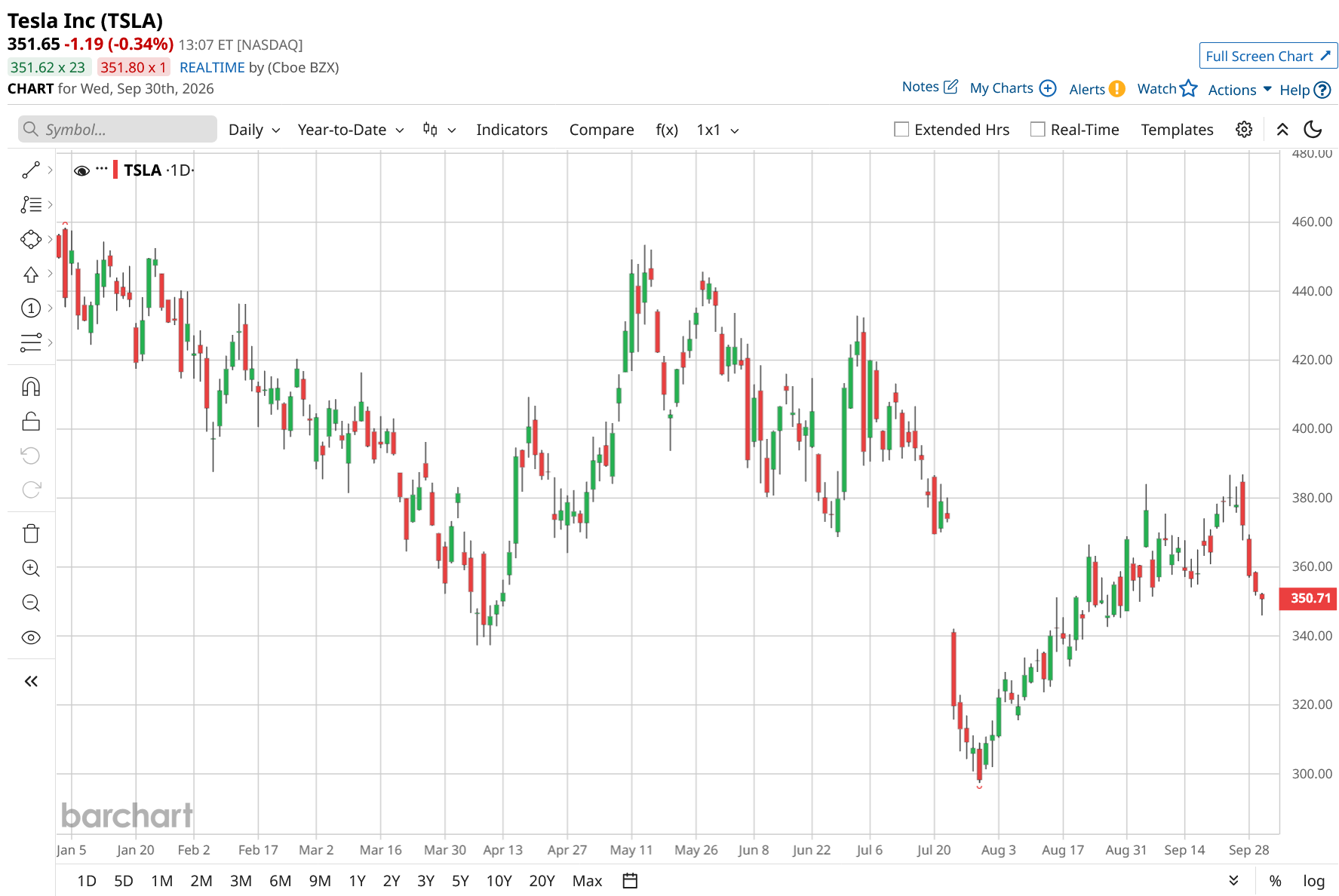
However, Tesla stock has come under renewed pressure, with shares down 8% over the past five days, while the stock has declined 21% over the past 52 weeks and 22% year-to-date (YTD). It is currently about 30% below its 52-week high of $498.83, reached last year, underscoring the stock’s significant retreat.
The recent weakness has been driven in part by growing concerns over Tesla’s vehicle sales outlook. Wall Street firms have been cutting their third-quarter delivery estimates amid softer registration data in the U.S. and China.
JPMorgan, for example, recently reduced its Q3 delivery forecast and lowered its price target, citing weaker vehicle registrations in both markets. JPMorgan now expects Q3 delivery of about 482,000 vehicles, compared to the previous 516,000, due to weaker sales trends in the U.S. and China. August registrations fell nearly 13% in China and 4% in the U.S., while Wall Street estimates remain wide-ranging, with Goldman Sachs at 435,000 and Barclays at 475,000 deliveries. Tesla is scheduled to release its Q3 delivery figures on Oct. 2.
The selling pressure also intensified after the aforementioned postponement of the Roadster reveal.
In terms of price-to-earnings (P/E) ratio, TSLA stands at 424.46, well above the industry average. Furthermore, the stock is at 15.50 times sales, which is also a premium compared to its peers.
Mixed Financial Performance
Tesla’s second-quarter results, released on July 22, showed strong top-line growth and vehicle deliveries, but profitability remained under pressure as the company stepped up investments in AI, autonomy, and next-generation products.
The company’s revenue climbed 26% year-over-year (YoY) to $28.2 billion, helped by higher vehicle deliveries, growth in Services and Other, and stronger Energy Generation and Storage revenue. Automotive revenue increased 23% to $20.5 billion, Energy Generation and Storage revenue rose 13% to $3.1 billion, and Services and Other revenue surged 50% to $4.6 billion.
Tesla’s vehicle business posted record quarterly deliveries as the company delivered 480,126 vehicles, up 25% YoY, while production increased 10% to 451,758 vehicles. Model 3/Y deliveries jumped 25% to 467,762, while deliveries of other models rose 19% to 12,364. Energy storage deployments also increased 41% YoY to 13.5 GWh. Meanwhile, active FSD subscriptions reached 1.48 million, up 56% from a year earlier.
The stronger sales volumes, however, did not translate into higher operating profits. Gross profit rose 23% to $4.8 billion, but total gross margin declined to 16.8% from 17.2% a year earlier. Its operating expenses jumped 47% to $4.4 billion. As a result, operating income plunged 57% to $398 million, while operating margin fell to 1.4% from 4.1%. Adjusted EBITDA declined 4% to $3.3 billion, with the adjusted EBITDA margin dropping to 11.6% from 15.1%.
At the bottom line, non-GAAP net income fell 17% to $1.2 billion, while adjusted EPS dropped 18% to $0.33. Tesla’s results reflected the rising cost of its push into AI and other R&D initiatives, along with lower regulatory-credit revenue and lower vehicle average selling prices.
Cash flow also reflected Tesla’s aggressive investment cycle. Operating cash flow increased 85% YoY to $4.7 billion, but capital expenditures surged 142% to $5.8 billion. That drove free cash flow to a negative $1.1 billion, compared with positive free cash flow of $146 million a year earlier. Tesla ended the quarter with $43.5 billion in cash, cash equivalents, and short-term investments, up 18%.
Furthermore, management emphasized capacity utilization, product launches, and long-term investments in AI, autonomy, energy, and robotics.
In addition, analysts predict EPS to decline 19.3% YoY for fiscal 2026 but rise 56.8% to $1.38 in fiscal 2027.
What Do Analysts Expect for TSLA Stock?
Most recently, JPMorgan analyst Rajat Gupta maintained a “Neutral” rating on TSLA stock but lowered the price target to $415 from $445. The revision came ahead of Tesla’s Q3 delivery update and reflected weaker-than-expected vehicle sales trends in the U.S. and China.
On Sept. 17, Barclays analyst Dan Levy maintained a “Hold” rating on Tesla with a $370 price target. The call followed Goldman Sachs’ Sept. 16 reiteration of a “Neutral” rating with a $360 target.
On the bullish side, StoneX analyst Mickey Legg maintained a “Buy” rating on Tesla with a $475 price target.
RBC Capital analyst Tom Narayan maintained a “Buy” rating, with a $480 price target, adding to the group of analysts who continue to see significant upside from Tesla’s autonomous-driving strategy and longer-term technology opportunities.
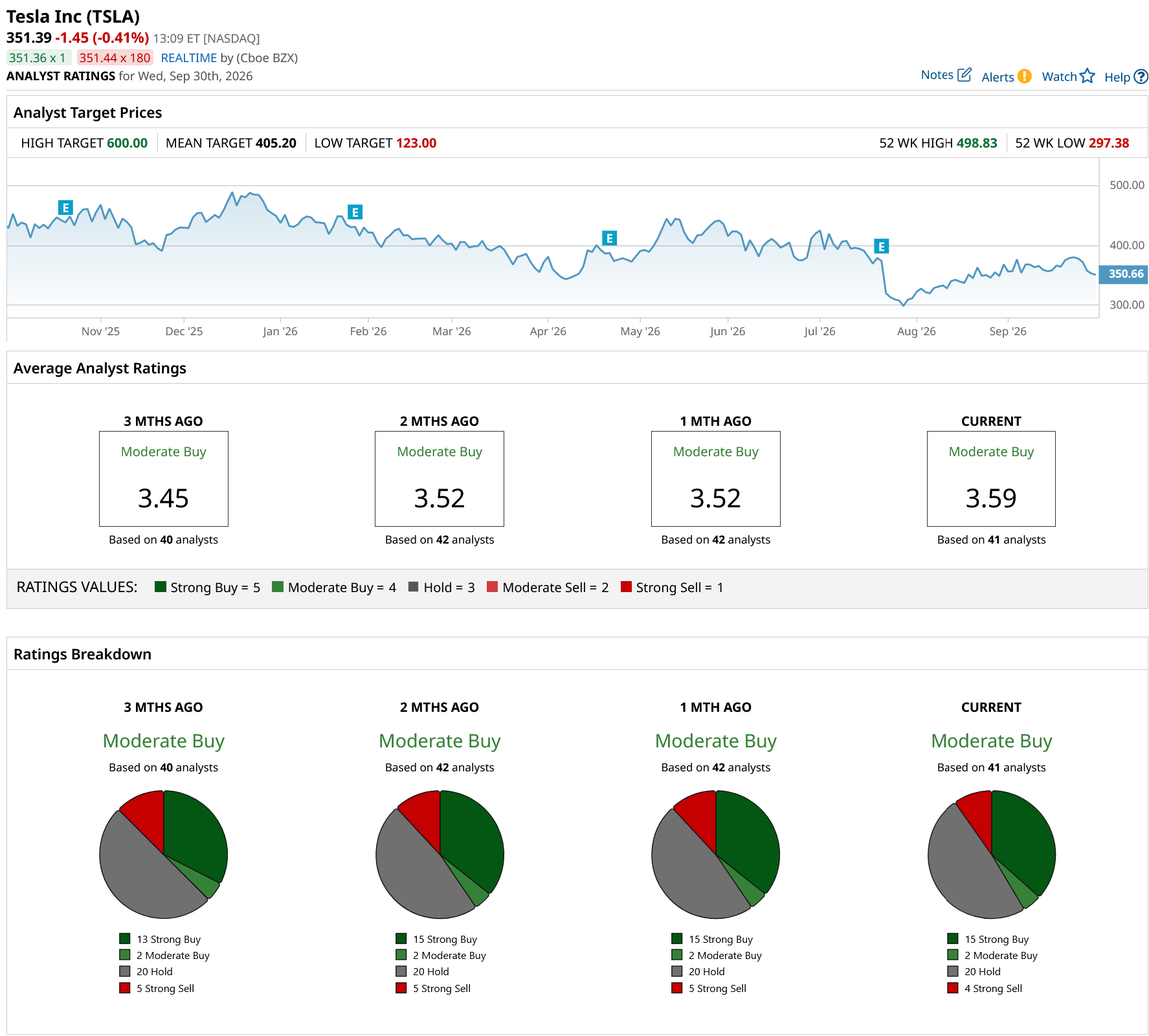
Overall, TSLA stock has a consensus “Moderate Buy” rating, indicating a cautiously bullish stance. Of the 41 analysts covering the stock, 15 advise a “Strong Buy,” two recommend a “Moderate Buy,” 20 analysts are on the sidelines, giving it a “Hold” rating, and four propose a “Strong Sell.”
TSLA’s average analyst price target of $405.20 indicates an upside of 15%, while the Street-high target price of $600 suggests that the stock could rally as much as 71%.
On the date of publication, Subhasree Kar did not have (either directly or indirectly) positions in any of the securities mentioned in this article. All information and data in this article is solely for informational purposes. For more information please view the Barchart Disclosure Policy here.