
The Fed's Preferred Inflation Gauge Declined More Than Expected in August, Yet Bond Yields Aren't Budging. Here's One Reason Why.
Key Points
Longer-term bond yields initially retreated, but had risen, as of this writing.
The way the Personal Consumption Expenditures (PCE) price index is calculated changed, starting in August.
Following the PCE report, the market now sees a lower likelihood of a Fed rate hike in October.
Investors hoping for signs of softening inflation seemingly got what they wanted on Sept. 30 when the Federal Reserve's preferred inflation gauge came in much lighter than expected.
The Personal Consumption Expenditures (PCE)Price Index increased 0.3% seasonally adjusted in August, coming in at 3.4% year over year. Economists had been projecting increases of 0.3% and 3.7%, respectively.
Missed Nvidia in 2009? This Rare Signal Is Flashing Again. In 2009, a "Double Down" signal flashed for a little-known chipmaker called Nvidia. For the first time in years, that same "Total Conviction" signal is flashing for a company 1/100th the size of Nvidia. Continue »
Core PCE, which excludes more volatile energy and food prices, rose 0.2% in August and 3% annually. Economists had been expecting 0.3% and 3.3%, respectively.
While the market initially reacted favorably, the Dow Jones Industrial Average traded more than 140 points lower as of 1:22 p.m. ET. Meanwhile, the yield on the 10-year U.S. Treasury Note and 30-year U.S. Treasury bond both rose to around 5.30% and 5.65%, respectively.
Here's one reason why the seemingly soft inflation report is doing little to temper bond yields right now.

Image source: Getty Images.
PCE calculations changed
One likely reason the lighter-than-expected PCE reading is not being as well received by the market as one might have expected is that the Bureau of Economic Analysis (BEA) recently changed how it calculates the PCE.
Specifically, beginning with the August reading, BEA changed how it measures spending on portfolio management, legal services, and computer software.
Stephen Brown, chief North America economist for Capital Economics, told Yahoo! Finance that he estimates the changes reduced core inflation by 0.3%. The Kobeissi Letter estimates the changes may have reduced core PCE by 0.2%.
Another reason investors may be looking past the data today is that fuel prices have risen in September, making the August data less useful than normal.
The data is still positive
While the change in the PCE measurement is likely impacting inflation data to the downside, I would think economists would have been aware of the changes and, as such, incorporated them into their estimates.
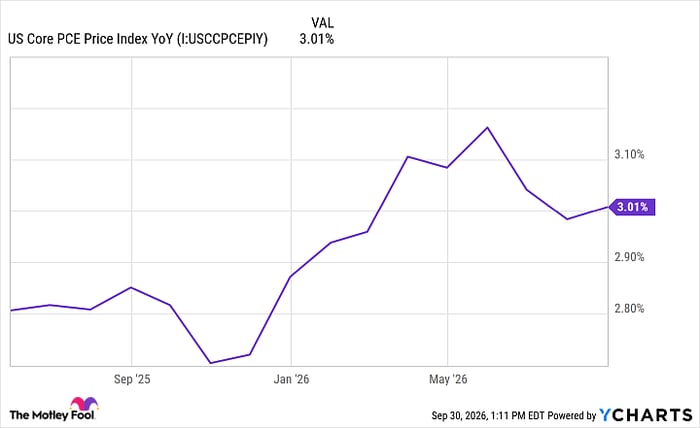
US Core PCE Price Index YoY data by YCharts
"This is good news for investors worried about the recent surge in bond yields, and it bolsters the case for not hiking in October," David Russell, global head of market strategy at TradeStation, said, according to CNBC. "However, it's also relatively old data at this point that doesn't reflect this month's surge in diesel prices."
The market is certainly using the data to shape its outlook for the forward curve, or where it thinks interest rates are going in the future.
Yesterday, there was a 49.1% chance that the Federal Reserve would hold its benchmark overnight lending rate, the federal funds rate, steady at its upcoming October meeting, according to CME Group's FedWatch tool. Today, that number has increased to 60.7%, as of this writing.
FedWatch tracks implied changes in the federal funds rate by examining changes in 30-day federal funds futures prices.
The threat of higher interest rates and the Fed's eventual quarter-point hike earlier in September has seemingly pressured the market, so one might think that a lower likelihood of a rate hike in October would be viewed as bullish by investors.
However, as I mentioned, tensions between the U.S. and Iran have persisted, keeping oil and gas prices elevated and perhaps prompting investors to brace for higher inflation data in September.
The bond market has also been tough to read this year. But ultimately, I view the PCE report today as an overall positive on the inflation front.
Bram Berkowitz has no position in any of the stocks mentioned. The Motley Fool has positions in and recommends CME Group. The Motley Fool has a disclosure policy.