
What The Invesco 37% Gain Still Needed To Prove
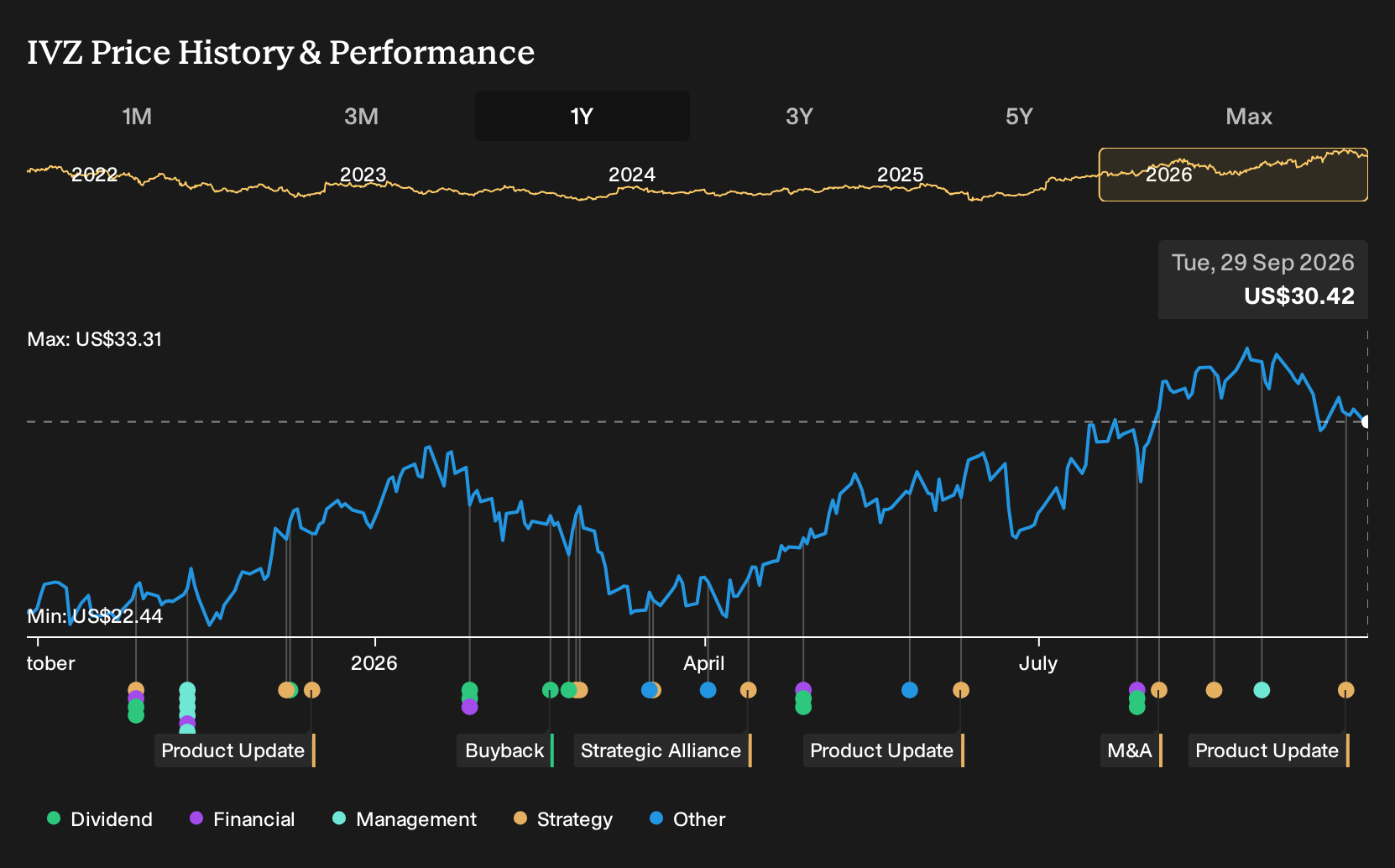
If you only skimmed the headlines about fee cuts, new ETF rivals for QQQ and pressure on real estate funds, Invesco might have looked like a grind rather than a winner. For Invesco shareholders, the return over the past year was 36.8%, including dividends. If you had been deciding in late September 2025 whether to buy or avoid the stock, what did the mix of growth stories and margin concerns really signal about that choice?
The move put Invesco in the middle of this trade. Scan 36 elite gold producer stocks for other companies exposed to it.
The Two Stories Invesco Investors Had To Weigh
The shares cost US$23 at the start of the period, and anyone looking at Invesco then had to decide which story felt more realistic.
The bullish narrative argued that a Fair Value of US$27.61, a price implied by its own assumptions, was reasonable if global aging and passive investing opened new markets. Supporters leaned on the idea that profit margins could climb to 24.0% even while revenue growth declined 6.2% a year.
The bearish view pointed to a Fair Value of US$17.03. This was again just the price level suggested by its model, and that camp focused on the risk that migration from active to low fee passive products would erode fee yields and leave the stock trading on a future P/E of 8.7x.
What The Invesco Evidence Actually Tested
Invesco’s Q2 2026 report showed revenue at US$1,825.6 million and net income at US$345.3 million, with net margin improving from a loss of 0.8% in Q2 2025 to a positive 18.9%. That shift in profitability supported the optimistic margin story more than the cautious one, although fee cuts on the real estate side kept the pressure on yields and cut both ways.
The real swing factor here was not just asset growth, but whether higher assets translated into better economics. For a different manager, you would test the same claim by tracking net margin over several reports and comparing it with any fee changes or mix shifts management highlights.
What Invesco’s Recent Gain Already Prices In
Invesco now trades at US$30.42 after a 36.8% gain over the past year. The selected Narrative’s Fair Value sits above the current price and leans on Invesco’s push into private credit, equal weight ETFs, and tech driven efficiency as the key drivers of that view.
The central test for investors is whether Invesco can keep turning partnerships, product launches, and capital reallocation into sustained margin expansion and resilient net new assets over time.
"Capital reallocation, technological investments, and product innovation position Invesco for sustained margin expansion and greater shareholder returns. Structural industry shifts toward lower-fee passive products, integration challenges, and innovation gaps threaten Invesco's revenue growth, profitability, and long-term competitive position."
One Narrative has put a figure on that disagreement. → See the Narrative with its higher Fair Value, assumptions and all
Looking One Step Beyond Invesco
Invesco depends on where client money actually goes. One major outlet is everyday spending through payment cards and digital wallets.
Each swipe or click rests on a separate infrastructure connecting banks and merchants worldwide. It quietly moves transactions while leaving credit risk to others.
This network earns a small slice on each payment and layers on services like security and analytics. Those extras aim to deepen ties across its ecosystem.
As Invesco pursues fees linked to global commerce, this payment network’s role in daily money movement could matter more than its headline yield implies.
It is written up in full, assumptions and all. → Explore the Narrative that puts this company 33% above its price
This article by Simply Wall St is general in nature. We provide commentary based on historical data and analyst forecasts only using an unbiased methodology and our articles are not intended to be financial advice. It does not constitute a recommendation to buy or sell any stock, and does not take account of your objectives, or your financial situation. We aim to bring you long-term focused analysis driven by fundamental data. Note that our analysis may not factor in the latest price-sensitive company announcements or qualitative material. Simply Wall St has no position in any stocks mentioned.
Have feedback on this article? Concerned about the content? Get in touch with us directly. Alternatively, email editorial-team@simplywallst.com