
Franklin Templeton (BEN) Stock Looks Overvalued Despite Blockchain Growth Hopes
Franklin Templeton has logged a strong share price run in recent years, which now puts a sharper focus on whether the current valuation can be explained by its earnings power. With the stock pulling back over the past month after a big multi year climb, the key issue is how much of the business’s profit potential is already reflected in the price.
- Over the last 3 years, Franklin Templeton has delivered a total return of 58.7%, which raises the question of whether recent gains already reflect what its earnings can reasonably support.
- The group’s push into blockchain based products and crypto infrastructure may support different expectations for fee income, cost efficiency and the timing of future cash flows compared with its traditional asset management model.
- The analysts covering Franklin Templeton have run their own numbers. See what analysts think Franklin Templeton's shares could be worth.
The stock’s next move may depend on whether Franklin Templeton’s current share price is well aligned with what its earnings justify today.
If you want to test the same earnings question that hangs over Franklin Templeton against other stocks, take a look at 32 high quality undervalued stocks.
Is Franklin Templeton Getting Expensive on Earnings?
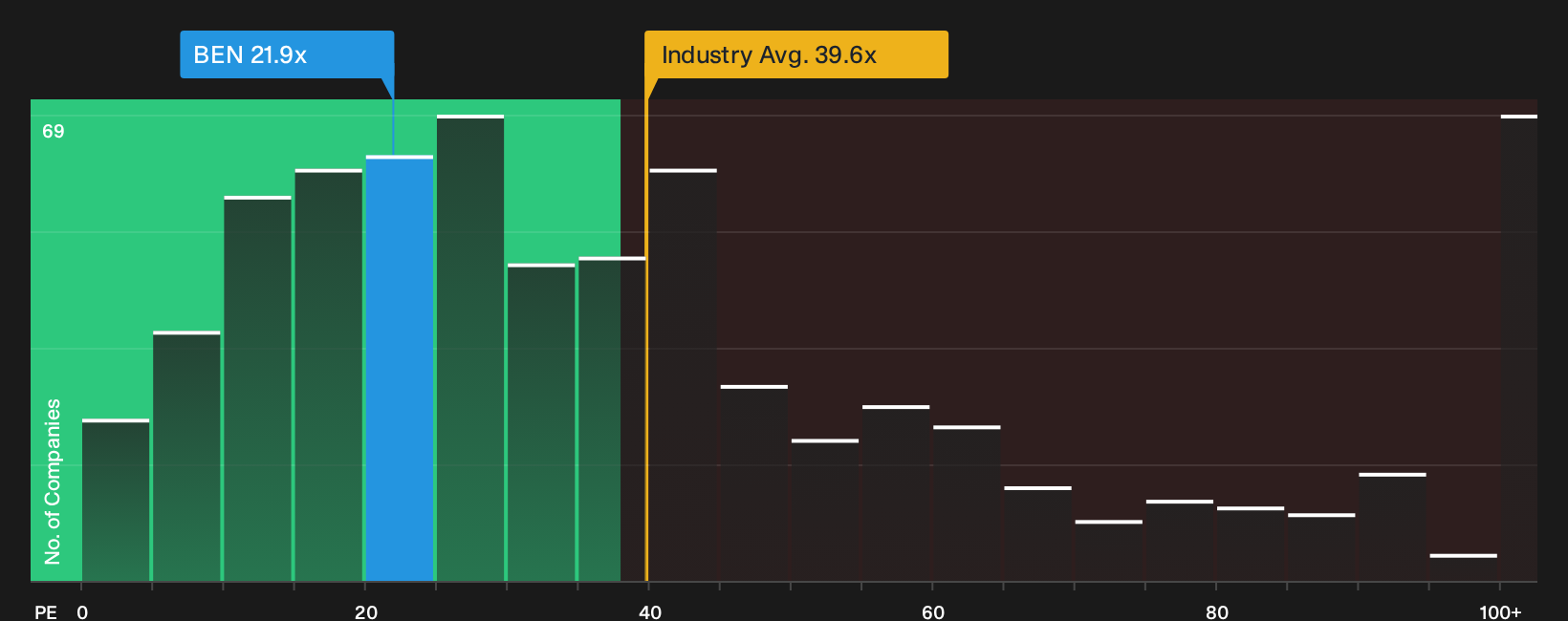
The P/E ratio is a useful yardstick for Franklin Templeton because investors tend to focus on the earnings power of asset managers. Franklin Templeton currently trades on a P/E of 21.5x, which is below the wider Capital Markets industry average of 39.6x and also below the peer group average of 35.8x. For a reader, that points to the market attaching a lower earnings multiple to this stock than to many comparable businesses in the same space.
On a more tailored fair value framework that weighs Franklin Templeton’s profitability profile, scale and risk, the current 21.5x P/E screens as overvalued relative to what that model would typically assign. Because the group has been pushing into blockchain based products and crypto infrastructure, some investors may be willing to pay more for each dollar of earnings despite this signal. The key question is whether the earnings that eventually flow from those projects justify paying a premium to the modelled fair multiple today. Explore the numbers behind Franklin Templeton's P/E valuation.
The Franklin Templeton Narrative: What Would Justify Today's Price?
Franklin Templeton Narratives on Simply Wall St pick up where the valuation question leaves off by explaining which paths for growth, margins and earnings would need to occur for the stock to be worth far more or far less than it is today. Each scenario links its figures to a clear view on how Franklin Templeton's growth potential, profitability and risk profile might change, giving you a reference point you can return to as new information becomes available.
Franklin Templeton investors are currently split between one group that sees more earnings resilience being underpriced and another that worries the P/E already assumes too much.
Bull case: 9% undervalued
"Franklin Resources is aggressively pushing into private assets and alternatives, with $258 billion in alternative AUM and new perpetual vehicles across private credit, secondary private equity, and real estate attracting steady wealth channel inflows..."
Discover why this Narrative puts Franklin Templeton at 9% undervalued.
Bear case: 17% overvalued
"The structural migration toward passive investing and exchange-traded funds has resulted in sustained outflows from traditional actively managed mutual funds, which account for a significant share of Franklin's legacy business..."
Explore why this Narrative puts Franklin Templeton at 17% overvalued.
One more Franklin Templeton factor that deserves your attention
Before you treat Franklin Templeton as a simple earnings story, it is worth checking the areas where our research has raised concerns that sit outside the valuation discussion. Take a closer look at 2 warning signs before settling on a valuation.
This article by Simply Wall St is general in nature. We provide commentary based on historical data and analyst forecasts only using an unbiased methodology and our articles are not intended to be financial advice. It does not constitute a recommendation to buy or sell any stock, and does not take account of your objectives, or your financial situation. We aim to bring you long-term focused analysis driven by fundamental data. Note that our analysis may not factor in the latest price-sensitive company announcements or qualitative material. Simply Wall St has no position in any stocks mentioned.
Have feedback on this article? Concerned about the content? Get in touch with us directly. Alternatively, email editorial-team@simplywallst.com