
What You Could Take From NYK’s 49% Gain To Another Company
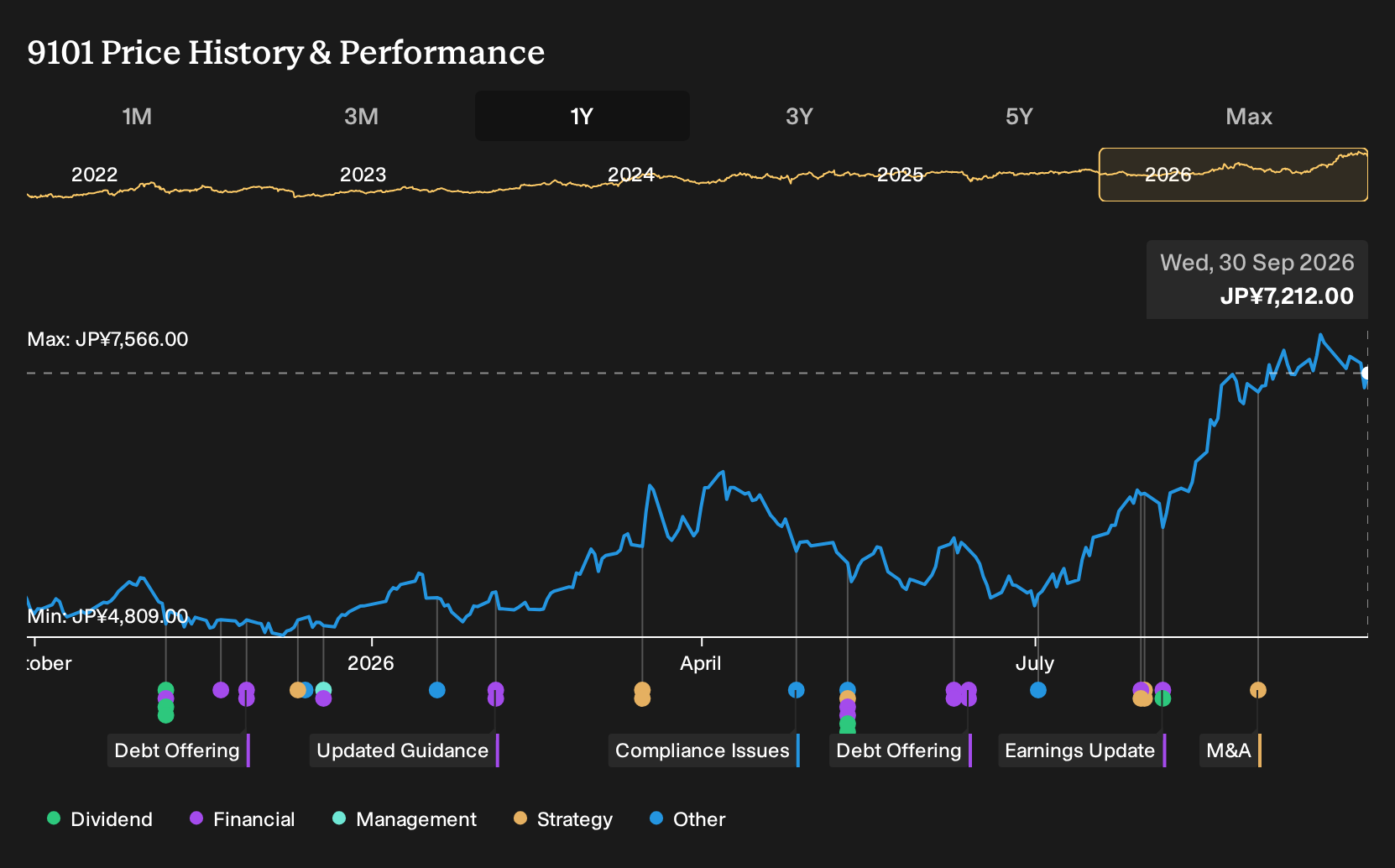
If you were watching Nippon Yusen Kabushiki Kaisha this year, the story did not start with headlines about the Nikkei but with crude futures jumping as Middle East risk pushed charter rates into focus. Investors who held Nippon Yusen Kabushiki Kaisha over the past year are up 49.4%, including dividends. If you were deciding whether to buy back on 2025-09-30, what had to be true about freight demand and geopolitical risk for that outcome to feel reasonable?
Nippon Yusen Kabushiki Kaisha is not the only name tied to this theme. Zero in on 40 power grid technology and infrastructure stocks and compare how each one is priced.
The Argument You Would Have Been Weighing On Nippon Yusen Kabushiki Kaisha
The shares cost ¥5,064 at the start of the period, and anyone looking at Nippon Yusen Kabushiki Kaisha then had to choose between two very different stories about the next few years.
The bullish script pointed to a Fair Value of ¥5,457, a rough guide to what the price could be if revenue drifted 1.9% lower each year, profit margin settled near 9.0%, and the market accepted an 11.0x P/E.
The bearish version leaned on a Fair Value of ¥3,530 and focused on falling freight volumes, decarbonization rules lifting capital costs, and profit margin sliding toward 6.5% as overcapacity and tariffs bit into earnings power.
What The Results Changed For Nippon Yusen Kabushiki Kaisha
Events in the Strait of Hormuz kept geopolitical risk front and center, as Nippon Yusen Kabushiki Kaisha and peers tied future traffic to credible security guarantees. At the same time, Q1 2027 revenue of ¥727,656m and net income of ¥67,109m came in higher than the prior year, with net margin edging up to 9.2%. The evidence cut both ways.
The episode shows how much this kind of thesis hinges on freight profitability, not just volumes or headlines. For any shipper, check whether net margin trends and segment comments around route safety and charter pricing actually line up with the story you are paying for.
What Nippon Yusen Kabushiki Kaisha's Run Has Priced In
After a 49.4% gain over the past year, Nippon Yusen Kabushiki Kaisha now trades at ¥7,212, while this Narrative’s Fair Value sits below the current price.
The argument leans on freight rates easing, air cargo contributions changing after the ANA share exchange, and energy and logistics units facing tougher profit conditions. For today’s price to hold up, an investor must believe earnings can absorb softer freight and energy markets without a material squeeze on net margins.
"Planned share exchange and declining freight rates could challenge revenue levels as premium pricing and profit contributions fall. Geopolitical tensions and an unfavorable market for Energy and Logistics threaten net margins and overall earnings stability."
One Narrative disagrees with today's price. → See where this Narrative says Nippon Yusen Kabushiki Kaisha should trade
Where Nippon Yusen’s Story Echoes
Watching Nippon Yusen, you start thinking about freight risk and pricing power. The same concerns reach into road transport platforms that coordinate global cargo.
One business there runs a digital marketplace matching shippers and carriers. It streamlines booking, pricing and tracking across scattered trucking fleets.
This setup tackles a familiar ocean freight problem. Capacity is fragmented, demand shifts quickly, yet customers still expect predictable service.
If platforms keep tightening those links, freight economics may change again. The question is which participant ultimately keeps more value from each shipment.
It is written up in full, assumptions and all. → Explore the Narrative that puts this company 69% above its price
This article by Simply Wall St is general in nature. We provide commentary based on historical data and analyst forecasts only using an unbiased methodology and our articles are not intended to be financial advice. It does not constitute a recommendation to buy or sell any stock, and does not take account of your objectives, or your financial situation. We aim to bring you long-term focused analysis driven by fundamental data. Note that our analysis may not factor in the latest price-sensitive company announcements or qualitative material. Simply Wall St has no position in any stocks mentioned.
Have feedback on this article? Concerned about the content? Get in touch with us directly. Alternatively, email editorial-team@simplywallst.com