
Is Battery Storage Buildout Altering The Investment Case For DTE Energy (DTE)?
- DTE Energy has filed long term power plans that include 4.5 GW of battery storage, upgrades to existing nuclear assets, and new natural gas plants as it retires coal capacity by 2032 and targets an 84% cut in carbon emissions.
- The integrated resource plan would more than double total capacity to 33 GW and is closely tied to rising electricity demand from large data centers, with future customer bills, grid reliability, and emissions policy all depending on how regulators respond.
- We will examine how DTE Energy's investment narrative changes as regulators consider its coal exit and large battery storage build.
See how DTE Energy's grid build out compares with other utilities racing to meet surging electricity demand in our hand picked 39 power grid technology and infrastructure stocks
DTE Energy Investment Narrative Recap
To own DTE Energy, you need to believe the utility can turn a very large capital plan into steady, regulated earnings while keeping regulators comfortable with customer bills. The new resource plan, with 4.5 GW of battery storage, more gas capacity and a coal exit by 2032, sits in the middle of that story. In the near term, the key catalyst is regulatory approval and the timing of cost recovery for this buildout.
The biggest near-term risk appears to be regulatory and financial. Tougher views on rate affordability, storm reliability or allowed returns could limit how much of this spending goes into rate base and when. Combined with planned annual equity issuance and existing pressure on interest coverage, the balance between growth projects and shareholder dilution remains an open question.
The integrated resource plan filing is the clearest recent milestone for DTE Energy because it links rising data center demand, coal retirements and the proposed new gas plants into a single roadmap. Certificates of Necessity for about 2,100 MW of combined-cycle gas and the 4.5 GW battery build connect directly to the long runway of contracted and potential large load the utility has outlined.
If regulators approve a meaningful portion of this plan, it can support years of regulated capital deployment into generation, storage and the US$11 billion distribution program, all aimed at serving roughly 2.4 GW of contracted data center load plus another 5 to 6 GW in the pipeline. If approval is slower or more restrictive, that could affect how quickly these projects show up in earnings and could sharpen the focus on DTE Energy’s funding mix and dividend coverage.
DTE Energy Consensus Forecasts In Context
DTE Energy's consensus story leans heavily on slow and steady growth rather than outsized bets. Analysts currently assume revenue increases of 2.5% each year over the next three years, paired with profit margins that shift from 8.0% today to 11.8% by 2029. Earnings are expected to move from US$1.3b today to US$2.1b by 2029, a gain of about US$0.8b, which would support the large grid and generation program if those profits materialize within a supportive regulatory setup.
DTE Energy's narrative projects US$17.7b revenue and US$2.1b earnings by 2029. This requires 2.5% yearly revenue growth and about US$0.8b earnings increase from US$1.3b today.
Those analyst estimates also imply a shift in what investors are willing to pay for those profits. The stock currently trades on a P/E of 20.0x, while the consensus view works off a 2029 P/E of 19.4x on the US$2.1b earnings figure and a US$156.36 price target, using a discount rate a little above 7%. That future multiple would sit slightly below the US Integrated Utilities sector average P/E of 20.2x mentioned in the report.
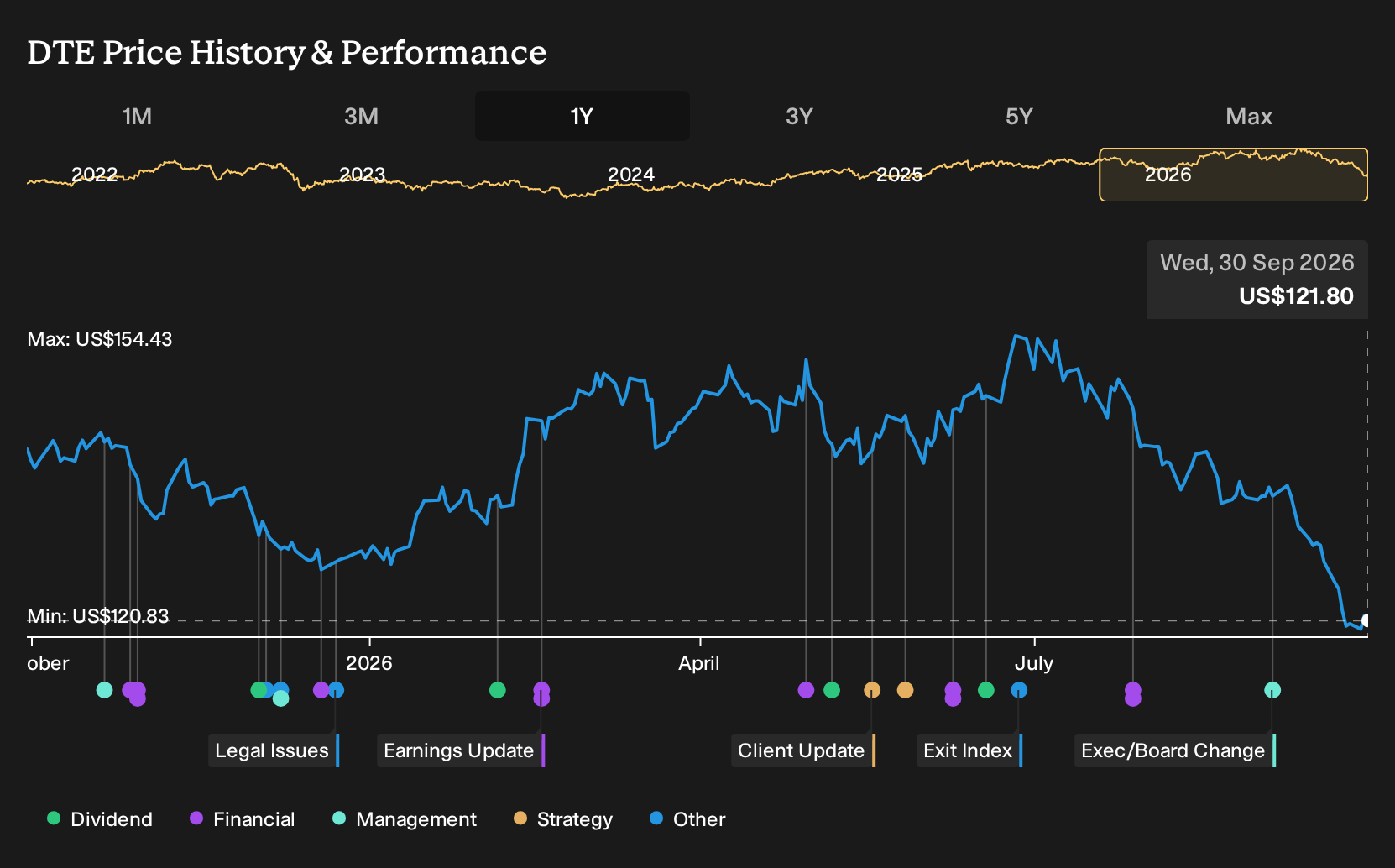
For anyone tracking valuation closely, the core trade off is clear. The current share price of US$126.13 sits below the US$156.36 analyst target, which is 19.3% higher. However, the path to those numbers runs through higher margins, modest revenue growth, and continued approvals for large capital projects. If earnings or the allowed returns on new infrastructure end up below these forecasts, the gap between price and target could narrow without much upside for investors.
That P/E discussion also connects back to balance sheet choices. Analysts expect shares outstanding to grow by about 0.2% per year over the next three years, in line with the plan for US$500m to US$600m of annual equity issuance, while DTE Energy targets an FFO to debt ratio near 15%. More capital deployed into regulated assets can lift total earnings, but regular share issuance can dilute earnings per share, which is what ultimately underpins valuation multiples.
Discover why DTE Energy's fair value indicates a 28% potential upside to its current price, which some investors believe could materialize sooner than expected.
Exploring Other Perspectives
Four fair value views from the Simply Wall St Community span roughly US$106 at the low end to about US$156 at the high end, so some see DTE Energy as close to fully priced, while others model far more upside. When you add storm, regulatory and equity issuance risks, you get sharply different performance expectations. Explore those contrasting viewpoints before forming your own stance.
Explore 3 other DTE Energy fair value estimates, including one that suggests as much as 28% potential upside from the current price.
Decide For Yourself
Disagree with existing narratives? Extraordinary investment outcomes rarely come from following the herd, so consider your own analysis.
- A great starting point for your DTE Energy research is our analysis highlighting 3 key rewards and 2 important warning signs that could impact your investment decision.
- See our latest analysis for DTE Energy. The report includes a comprehensive fundamental analysis summarized in a single visual, the Snowflake, making it easy to evaluate DTE Energy's overall financial health at a glance.
Looking For More Ideas Beyond DTE Energy?
If DTE Energy has sharpened your focus on regulated assets and long term capital plans, it can be useful to widen the lens and compare it with other businesses that share some of the same themes. The Simply Wall St Screener can help you quickly filter for different types of opportunities so you are not relying on a single story or sector.
- For investors who want potential mispricings with stronger fundamentals, start with a focused set of 32 high quality undervalued stocks that pair quality metrics with discounted valuations.
- If capital preservation and lower volatility matter more to you than chasing every upswing, narrow your search to 31 resilient stocks with low risk scores that score well on resilience.
- When you are hunting for under the radar ideas with cleaner balance sheets and solid metrics, cast a wider net across 19 high quality undiscovered gems that many investors may not yet be watching.
This article by Simply Wall St is general in nature. We provide commentary based on historical data and analyst forecasts only using an unbiased methodology and our articles are not intended to be financial advice. It does not constitute a recommendation to buy or sell any stock, and does not take account of your objectives, or your financial situation. We aim to bring you long-term focused analysis driven by fundamental data. Note that our analysis may not factor in the latest price-sensitive company announcements or qualitative material. Simply Wall St has no position in any stocks mentioned.
Have feedback on this article? Concerned about the content? Get in touch with us directly. Alternatively, email editorial-team@simplywallst.com