
Cui Dongshu: The regional pattern of domestic automobile production is rapidly reshaping the Changjiao square to become an absolute core growth pole
The Zhitong Finance App learned that Cui Dongshu, Secretary General of the Passenger Transport Association, issued an article stating that in 2015-2026, the domestic automobile production structure continued to be restructured, and that the transformation of new energy sources further amplified regional production differentiation. The core is that production in various regions has declined over time; it is not a simple increase or decrease in production capacity. In terms of total volume, the country's automobile production rebounded after cyclical fluctuations. Total production fell slightly by 3% year-on-year in January-August 2026. The growth engine was mainly driven by new energy sources.
At the regional level, the share of production in the Yangtze River Delta (Yangtze River Delta) continues to rise. The share of traditional automobile production increased from 20.8% in 2015 to 36.5% in August 2026; the share of new energy production reached 43%, and the penetration rate of new energy sources was 72% in August. The production growth rate led the country and became the core growth sector for automobile production. Production in the central sector has been rising steadily, with Anhui contributing the biggest increase. In August, new energy production rose to the top position in the country in a single month. Production of traditional vehicles in the Pearl River Delta has shrunk, and production of new energy sources remains resilient. Production in established automobile production areas declined markedly: traditional automobile production in Beijing-Tianjin-Sanhe, Cheng-Chongqing, and Northeast China weakened year-on-year, with the biggest drop in Northeast China; the production base of new energy production was low. The penetration rate of new energy sources was only 17% in August, and the transformation at the production level was weak.
By province, new energy production in Anhui, Zhejiang, and Shanghai has grown rapidly, and the ranking has moved sharply forward; major traditional automobile provinces with historically high production, such as Shaanxi, Jilin, and Shandong, have continued to decline. There is a huge gap in the penetration rate of new energy sources in the provinces. Zhejiang and Shanghai are close to 80%, and Jilin is only 10%. Overall, domestic automobile and new energy vehicle production continues to be concentrated in the Yangtze River Delta, production at traditional bases is shrinking, and the regional pattern of automobile production across the country is being reshaped at an accelerated pace.
1. The concept of a long square and the overall characteristics of automobile production
The conventional geographical concept “Yangtze River Delta” refers only to Jiangsu, Zhejiang and Shanghai. In order to match the actual cluster pattern of the domestic automobile industry, I combined the four provinces and cities of Shanghai, Jiangsu, Zhejiang, and Anhui and named the “Yangtze River Delta” automobile industry cluster, which is different from the traditional geographical Yangtze River Delta caliber.
Core logic: Vehicle and new energy production capacity has exploded in recent years in Hefei and Wuhu, Anhui. Projects such as NIO, BYD, Volkswagen Anhui, and Chery have been launched to form a complete collaborative industrial chain with Jiangsu, Zhejiang and Shanghai. Vehicles, parts, and power batteries are highly linked, and can no longer be separated and counted separately.
Anhui has become the largest domestic automobile production province, and is deeply tied to Jiangsu, Zhejiang, and Shanghai. The “Yangtze Square” has become the core observation unit for investigating the transfer of domestic new energy production capacity and regional competition. If Anhui is placed in central China, it will not reflect the changes in industrial agglomeration in East China.
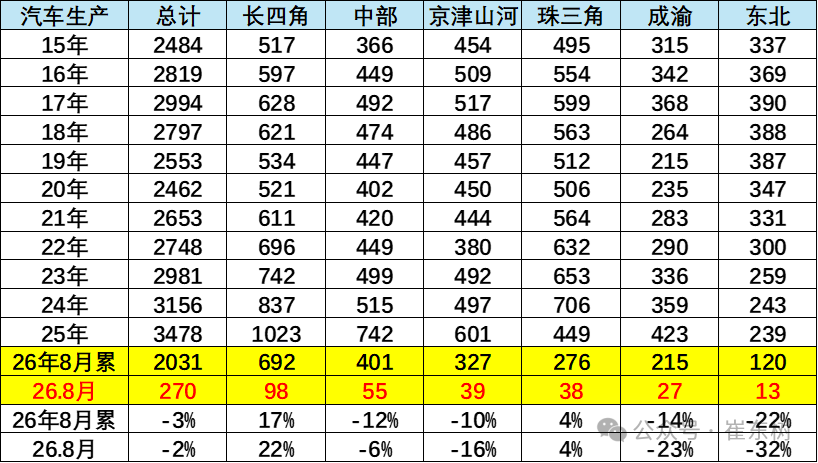
From January to August 2026, domestic automobile production fell slightly by 3% year on year, with significant regional differentiation. Changsijiao excelled, with a cumulative production volume of 6.92 million units, an increase of 17% over the previous year. The monthly growth rate in August was 22%, which is the core growth pole. The Pearl River Delta is showing a slight increase of 4%, which is quite resilient. The central region, Beijing-Tianjin mountains and rivers, Chengyu, and Northeast China all experienced negative growth. The Northeast was under the greatest pressure, with a cumulative decline of 22%, with a monthly decline of 32% in August. The industry is further concentrated in the Yangtze River Delta cluster, production capacity of old traditional bases has shrunk significantly, and the regional automobile manufacturing pattern continues to be restructured.
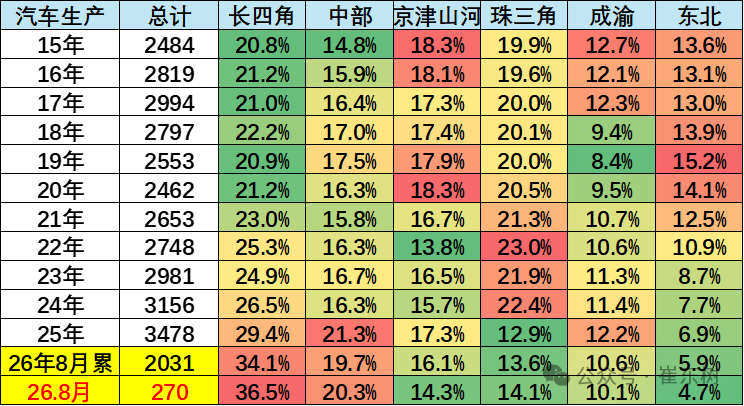
Judging from the share of automobile production, the trend of industrial agglomeration is extremely strong. The share of Changjiao continued to rise, reaching 34.1% from January to August 2026, and further rising to 36.5% in August. It already accounts for more than one-third of domestic automobile production and is the absolute core. The share of central China rose steadily to nearly 20%, making it the second largest sector. The share of the Pearl River Delta fell from around 22% in the previous period to 13%-14%, and the share of production capacity shrank markedly. The share of mountains and rivers in Beijing, Tianjin, and Chengdu and Chongqing declined slightly. Northeast China continued to decline, only 5.9%, down to 4.7% in August. Domestic automobile production capacity is being concentrated at an accelerated pace in the Yangtze River Delta and Central China, the weight of established automobile bases continues to decline, and the industrial landscape is being reshaped.
2. Characteristics of automobile production by province
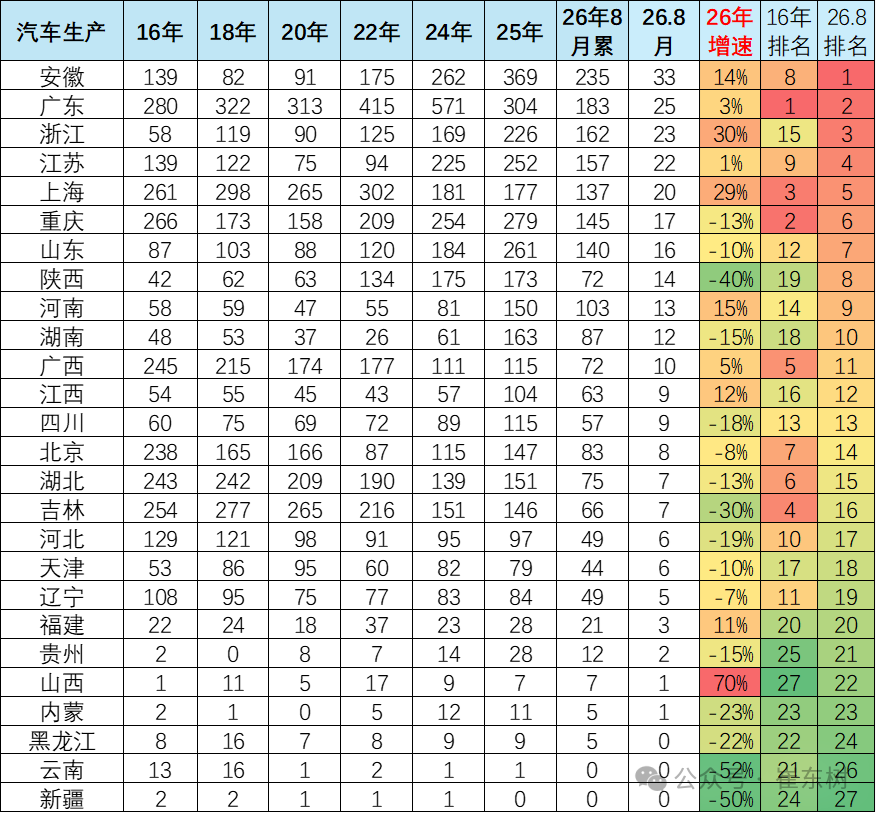
The pattern of automobile production by province was drastically restructured. Anhui's production peaked in August, with an annual growth rate of 14%, the biggest dark horse; Zhejiang and Shanghai showed impressive growth rates (30% and 29%), and the three provinces and one city of the Yangtze River Delta strengthened across the board. Guangdong still ranked first in terms of volume in the early stages, but production declined markedly from the previous high. Major traditional automobile provinces are under pressure. Jilin and Shaanxi declined sharply (-30%, -40%), while Hubei, Chongqing, and Hunan all experienced negative growth. The production capacity of old industrial bases continues to shrink, central Anhui has risen strongly, production has exploded driven by new energy sources in Zhejiang and Shanghai, the industry has moved from traditional bases to the Yangtze River Delta New Energy Cluster, and there has been a major reshuffle in provincial rankings.
3. Overall characteristics of NEV production
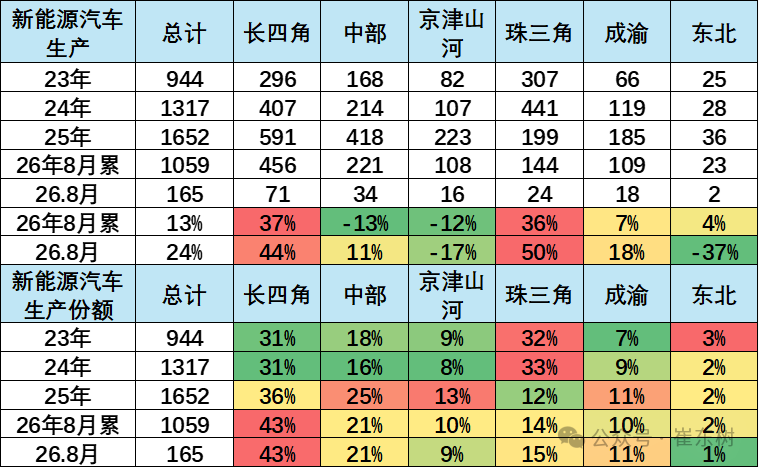
Domestic production of new energy vehicles continues to grow, but regional differentiation is severe. Total production increased 13% year-on-year in January-August 2026, with the Yangsijiao leading the way, with a cumulative growth rate of 37%, 44% in August, and its share jumped to 43%, making it the core carrying area for new energy sources. The Pearl River Delta has outstanding resilience, with a monthly growth rate of 50% in August.
The cumulative production of mountains and rivers in central Beijing and Tianjin increased negatively, and was only slightly restored in August. The volume of new energy sources in Northeast China is extremely small. In August, it fell sharply by 37% in a single month, and the transformation pressure was huge. New energy production capacity continues to be concentrated in the Yangtze River Delta, parts of the Pearl River Delta are strengthening, the transformation process of traditional bases is fragmenting, and the restructuring of the industrial pattern is accelerating.
4. Overall characteristics of NEV production by province
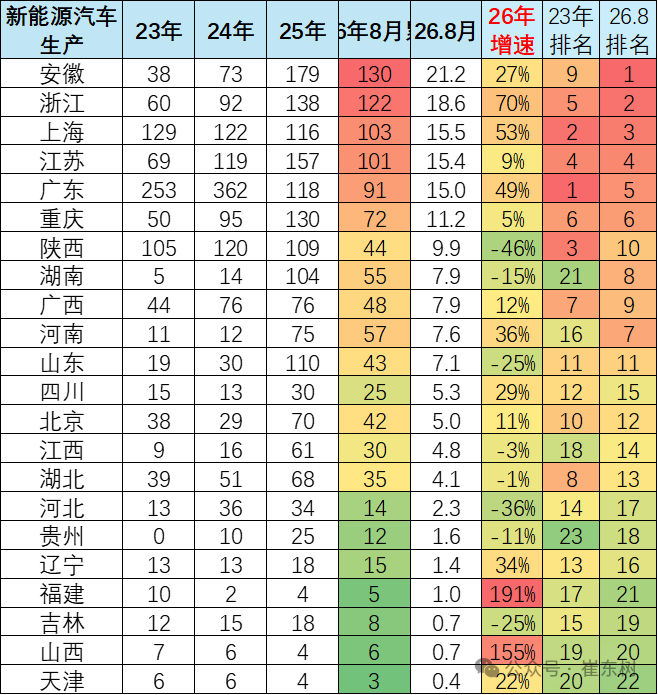
The production capacity pattern of NEV provinces has been deeply restructured. In August, Anhui climbed to the top, Zhejiang second, followed by Shanghai and Jiangsu, with the four provinces and cities of the Yangtze River Delta leading the way. The growth rate in Zhejiang reached 70%, Shanghai 53%, and Guangdong 49%, with strong growth momentum.
Although Guangdong's cumulative production is still high, the monthly ranking declined. Shaanxi, Shandong, Hebei, Jilin and other places experienced significant negative growth, and the transformation of traditional bases was under pressure. Fujian and Shanxi achieved explosive growth, which is a rapid breakthrough under a small base. New energy production capacity continues to gather in the Yangtze River Delta. Anhui has become the core incremental engine. New energy production capacity growth in established automobile provinces is weak, and the provincial rankings have been drastically reshuffled.
5. Changes in automobile production in provinces and regions
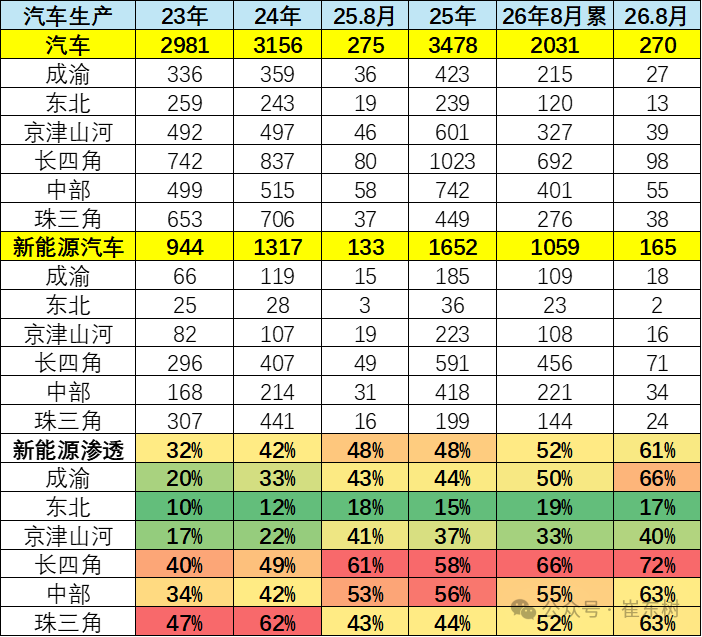
The penetration rate of new energy sources in the domestic automobile industry continued to rise. The overall penetration rate in August reached 61% in a single month, with significant regional differences. The penetration rate of the Yangtze River is far ahead, reaching 72% in August, leading the country in the transformation of new energy sources; central China, Pearl River Delta, Chengdu and Chongqing all surpassed 60%. The penetration rate of mountains and rivers in Beijing, Tianjin, and Northeast China is low. Northeast China is only 17%, and shortcomings in transformation are prominent. Changsijiao's new energy production is rapidly expanding, compounding the increase in traditional vehicles to form an industrial highland.
Traditional automobile production in Northeast China is shrinking, new energy production capacity is insufficient, and the penetration rate is slowly increasing. The industry shows a pattern where the strong are getting stronger, and the gap in the progress of regional new energy transformation continues to widen.
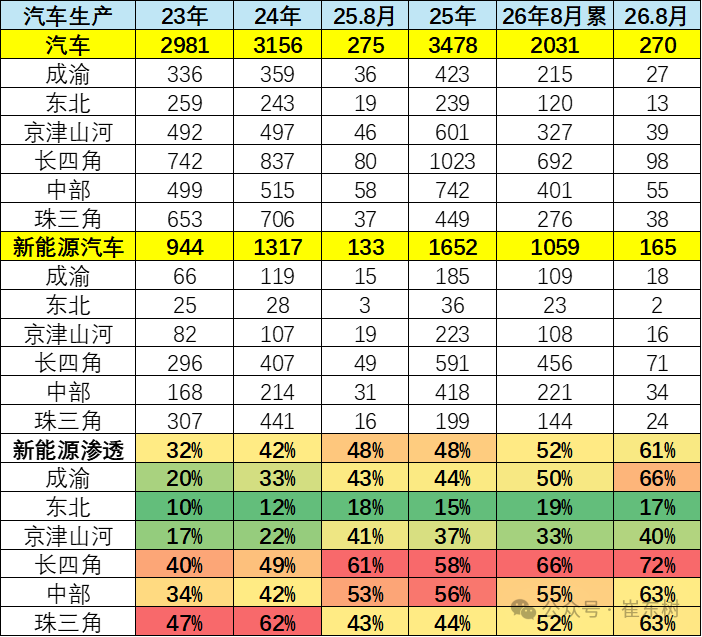
The penetration rate of new energy vehicles in various provinces is clearly divided, and the country's monthly penetration rate in August reached 61%. Zhejiang and Shanghai lead the way, with a penetration rate close to 80% in August; Guizhou, Shanxi, and Guangxi are also in high positions, with Guizhou's monthly penetration rate as high as 94%. The penetration rate in major production areas such as Anhui, Jiangsu, Guangdong, Chongqing, and Shaanxi is over 60%. The penetration rate of major traditional automobile provinces such as Jilin, Hebei, and Shandong is low. Jilin is only 10%, and the transformation pressure is outstanding. The Yangtze River Delta provinces generally have high penetration rates, and both high production capacity and penetration rates of new energy sources. The penetration rate of some small-production provinces is inflated, the transformation of established bases is lagging behind, and the new energy transformation gap between provinces continues to widen.