
Is Smoke Free Growth Altering The Investment Case For Philip Morris Stock?
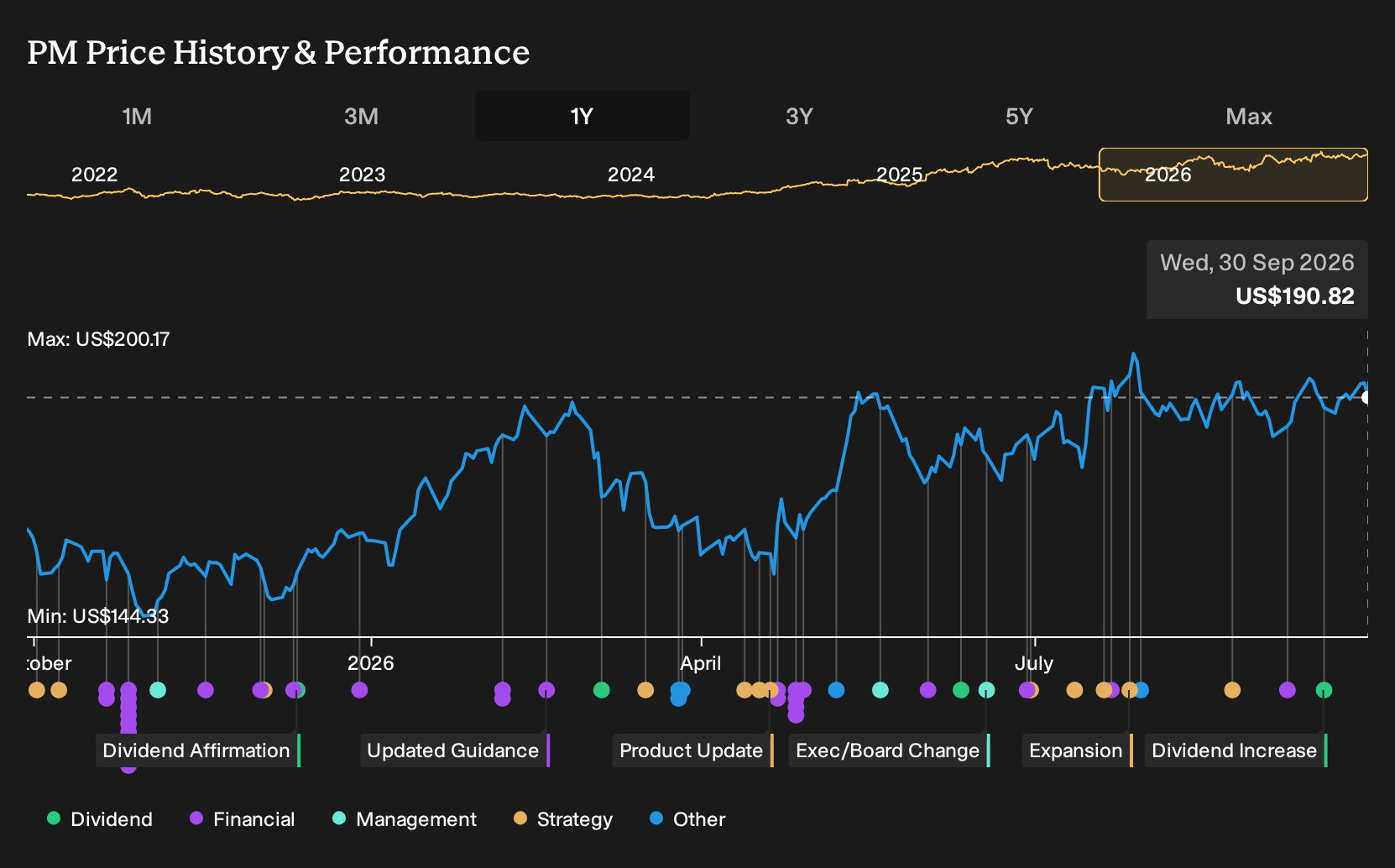
- Philip Morris International has raised its regular quarterly dividend by 8.8% to US$1.60 per share, annualized at US$6.40, while smoke free products now contribute 42% of net revenue and the firm prepares to present its transformation story at the American Growth Summit in Washington, D.C.
- The combination of a higher cash return and a larger smoke free revenue mix suggests Philip Morris International is leaning harder on reduced risk products while still signalling confidence in its ability to fund those payouts.
- We will look at how Philip Morris International's investment narrative is shaped by the 8.8% dividend lift tied to smoke free progress.
Scan how Philip Morris International’s dividend move and smoke free pivot compare with other consumer staples by reviewing the hand picked 7 dividend fortresses.
Philip Morris International Investment Narrative Recap
To own Philip Morris International you need to be comfortable with a tobacco group that is still funded by combustible cash flows, while trying to tilt harder into smoke free products with higher reported gross margins. The key short term swing factor is whether IQOS, ZYN and other reduced risk offerings keep gaining share fast enough to balance cigarette volume pressure and heavier U.S. spend.
The biggest operational risk is that marketing and launch costs for U.S. smoke free expansion drag on margins just as cigarette volumes face structural decline. The recent dividend lift and smoke free revenue mix update are important signals but do not on their own change that core risk reward equation.
The most relevant recent announcement for this story is Philip Morris International presenting at the American Growth Summit on September 29, 2026. Investor focus is likely to sit on how management frames the reduced risk portfolio, the U.S. rollout of products like IQOS ILUMA and ZYN, and the role of combustibles as a funding engine.
This conference appearance comes shortly after the 8.8% dividend increase. Shareholders will be listening for detail on cash flow coverage, spending plans and cost savings from the ongoing US$2b efficiency program. Clarity on how those elements support or strain operating margins is central to the near term catalyst and the main execution risk.
Philip Morris International's narrative projects US$49.8b revenue and US$15.4b earnings by 2029. This implies 5.4% yearly revenue growth and an earnings increase of about US$4.6b from the current US$10.8b level.
Uncover why Philip Morris International's fair value indicates a 9% potential upside to its current price that could narrow quickly.
Exploring Other Perspectives
One alternate view on Philip Morris International focuses on regulation rather than smoke free growth. The most bearish analysts already saw the stock as fully valued, even before the dividend hike, with revenue only reaching about US$49.4b and earnings near US$15.2b by 2029. That is a more cautious story. Use it as a foil and explore several viewpoints that may shift after this news.
Explore 5 other Philip Morris International fair value estimates, including one that suggests as much as 85% downside from the current price.
Reach Your Own Conclusion
Disagree with existing narratives? Extraordinary investment returns rarely come from following the herd, so go with your instincts.
- A great starting point for your Philip Morris International research is our analysis highlighting 3 key rewards and 1 important warning sign that could impact your investment decision.
- See our latest analysis for Philip Morris International. The report includes a comprehensive fundamental analysis summarized in a single visual, the Snowflake, making it easy to evaluate Philip Morris International's overall financial health at a glance.
Looking for more Philip Morris International sized investment ideas?
Once the Philip Morris International story is clear, cast the net wider so a single stock does not dominate your portfolio risk. The Simply Wall St Screener can help you quickly surface other companies that fit the kind of income, value, or resilience profile you want to pair with this holding.
- If stability and income are your priority, scan a curated group of higher yielding payers through the 7 dividend fortresses.
- For readers hunting for value opportunities, filter for companies that combine strong fundamentals with prices that look compressed using the 31 high quality undervalued stocks.
- If capital preservation matters most, narrow the field to businesses with sturdier finances and lower risk scores by reviewing the 31 resilient stocks with low risk scores.
This article by Simply Wall St is general in nature. We provide commentary based on historical data and analyst forecasts only using an unbiased methodology and our articles are not intended to be financial advice. It does not constitute a recommendation to buy or sell any stock, and does not take account of your objectives, or your financial situation. We aim to bring you long-term focused analysis driven by fundamental data. Note that our analysis may not factor in the latest price-sensitive company announcements or qualitative material. Simply Wall St has no position in any stocks mentioned.
Have feedback on this article? Concerned about the content? Get in touch with us directly. Alternatively, email editorial-team@simplywallst.com