
UnitedHealth Group (UNH) Stock Could Trade Below Fair Value On Earnings
UnitedHealth Group has seen its share price move in different directions over recent years, with a modest gain over the past year but a much weaker three year record. That mixed performance puts fresh attention on what investors are paying for its earnings today. With new Medicare offerings and leadership changes reshaping expectations, the key issue is whether the current US$367.08 price fairly reflects the profit engine behind the business.
- The stock has declined 23.4% over the past three years, which raises the question of whether the market has reset how it values UnitedHealth Group's earnings power.
- New Medicare Advantage plan designs and a multi year margin recovery effort can influence how quickly the insurer converts revenue into earnings and how durable those profits look.
- Your read on UnitedHealth Group is one view; the desks covering it have another. See what analysts think UnitedHealth Group's shares could be worth.
The issue now is whether UnitedHealth Group's current share price is adequately supported by the earnings it is expected to generate.
If you are weighing whether UnitedHealth Group's earnings justify its current price, it can help to compare that question against a broader set of 31 high quality undervalued stocks.
Is UnitedHealth Group a Bargain on Earnings?
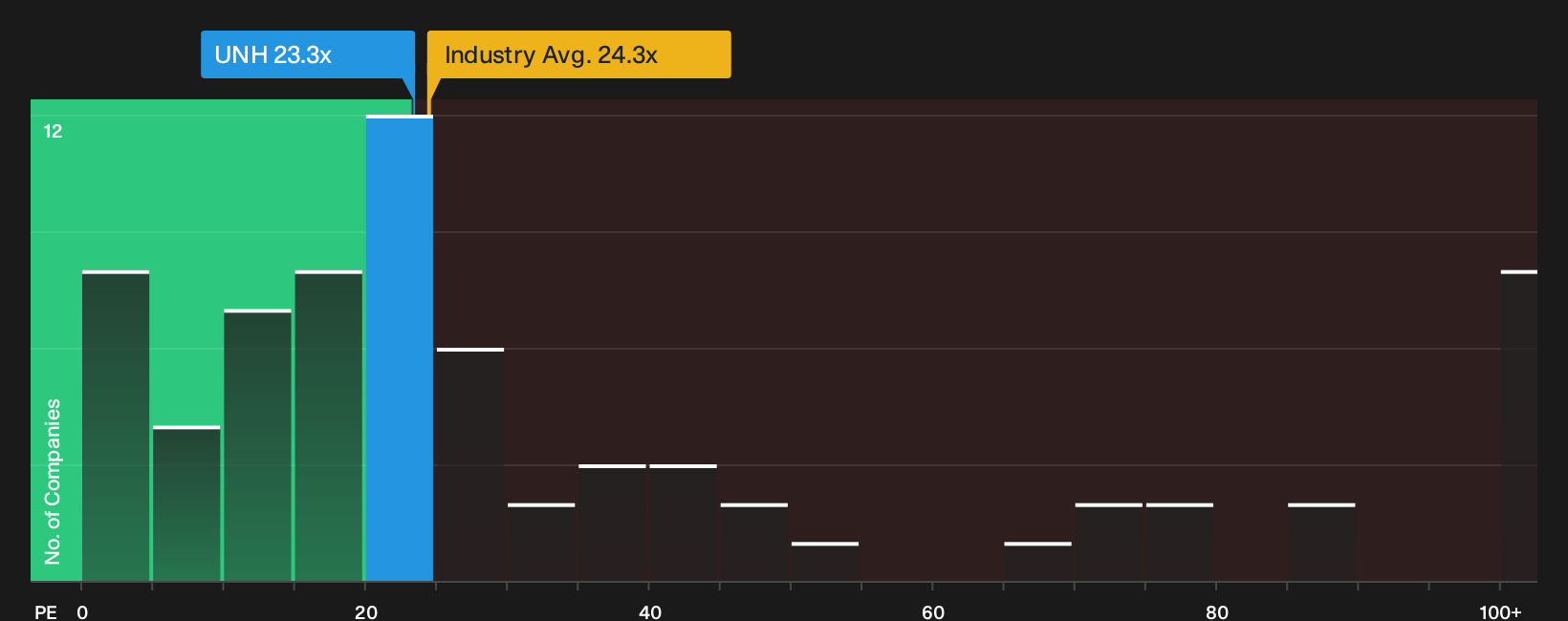
A P/E lens fits UnitedHealth Group because earnings remain the main yardstick investors use for large insurers with stable cash generation. On that basis, the stock trades on about 23.3x earnings, a touch under the broader Healthcare sector average near 24.3x and below the peer group around 26.5x. That places the share price in the lower half of the range investors are currently paying for similar healthcare businesses.
Because the Fair Ratio model, which blends factors such as growth potential, profitability, size and risk, points to a higher P/E than the current 23.3x, the shares screen as undervalued on this yardstick. Despite the leadership reshuffle and ongoing margin recovery effort, the multiple still prices UnitedHealth Group at a discount to what this framework suggests for its earnings profile. That gap is what investors need to weigh against the practical execution risks around new Medicare plan designs and modernization. Explore the numbers behind UnitedHealth Group's P/E valuation.
The UnitedHealth Group Narrative: What Would Justify Today's Price?
Simply Wall St Narratives for UnitedHealth Group pick up where this valuation puzzle leaves off by spelling out which future assumptions on growth, margins and earnings would need to hold for the shares to be worth materially more or meaningfully less than today. Each one treats UnitedHealth Group's estimated worth as a thesis that can be revisited over time, so you can track how the story and the underlying business data line up as conditions change.
Community views on UnitedHealth Group split between those who see execution upside in the current setup and those who worry the integrated model is already fully reflected.
Bull case: 24% undervalued
"The company continues to invest in technology that improves physician workflows and digital engagement, and the current AI program that targets billions of dollars of G&A savings through automation of claims, call handling, clinical documentation and back-office functions is aimed at lifting net margins and operating earnings over time..."
Discover why this Narrative puts UnitedHealth Group at 24% undervalued.
Bear case: 19% overvalued
"The company’s valuation typically reflects this balance, investors pay a premium for predictability, scale, and integration, the risk is not collapse, but compression..."
Explore why this Narrative puts UnitedHealth Group at 19% overvalued.
Before acting on UnitedHealth Group’s valuation, one more factor deserves your attention
The figures only tell part of the story for UnitedHealth Group, because the people steering the business and the way their rewards are structured can heavily influence how those numbers evolve over time. See who runs UnitedHealth Group and how they are paid.
This article by Simply Wall St is general in nature. We provide commentary based on historical data and analyst forecasts only using an unbiased methodology and our articles are not intended to be financial advice. It does not constitute a recommendation to buy or sell any stock, and does not take account of your objectives, or your financial situation. We aim to bring you long-term focused analysis driven by fundamental data. Note that our analysis may not factor in the latest price-sensitive company announcements or qualitative material. Simply Wall St has no position in any stocks mentioned.
Have feedback on this article? Concerned about the content? Get in touch with us directly. Alternatively, email editorial-team@simplywallst.com