
UGI (UGI) Pulls Back As Its Valuation Debate Gets Harder To Ignore
UGI (UGI) continues to attract attention as a long-established energy distributor with a market value near US$7.7b and a recent share price of US$36.36, supported by diversified propane, gas, and power operations.
Short-term trading has been choppy for UGI, with a 1-day share price return of 1.93% and a 30-day share price return that declined 5.41%. Longer-term performance has been much stronger, with a 1-year total shareholder return of 16.78% and a 3-year total shareholder return near 99.26%, suggesting earlier momentum that investors are now reassessing around the current US$36.36 level.
Scan beyond UGI and look at other utility and energy players with resilient fundamentals by checking our handpicked list of solid balance sheet and fundamentals (25 results).
UGI looks like a durable utility-style business. However, the recent pullback has taken some heat out of a share price that previously ran hard. Is this still a quality story at a fair tag, or has the valuation run ahead of itself?
Price-to-Earnings of 11.6x: Is it justified?
UGI trades on a P/E of 11.6x against a last close of $36.36, and that level currently looks low compared with both peers and the broader gas utilities space.
The P/E ratio compares what investors pay per share to the earnings that UGI generates per share. For an established energy distributor with a long operating history, this measure gives a quick read on how the market is valuing its profit engine relative to other utility and gas players.
UGI is flagged as trading at good value versus both its immediate peer group and the global gas utilities industry, where average P/Es are 14.3x and 13.9x respectively. The implied fair P/E of 19.3x from the fair ratio framework is also far above the current 11.6x level. This indicates that the market is pricing UGI at a clear discount to where that model suggests sentiment could trend over time if conditions stay similar.
Explore the SWS fair ratio for UGI.
Result: Preferred multiple of Price-to-Earnings of 11.6x (UNDERVALUED)
Still, the UGI story can be knocked off course if propane volumes weaken across its 801 million gallons footprint or if regulatory shifts pressure its Utilities returns.
Find out about the key risks to this UGI narrative.
Another view on UGI’s valuation
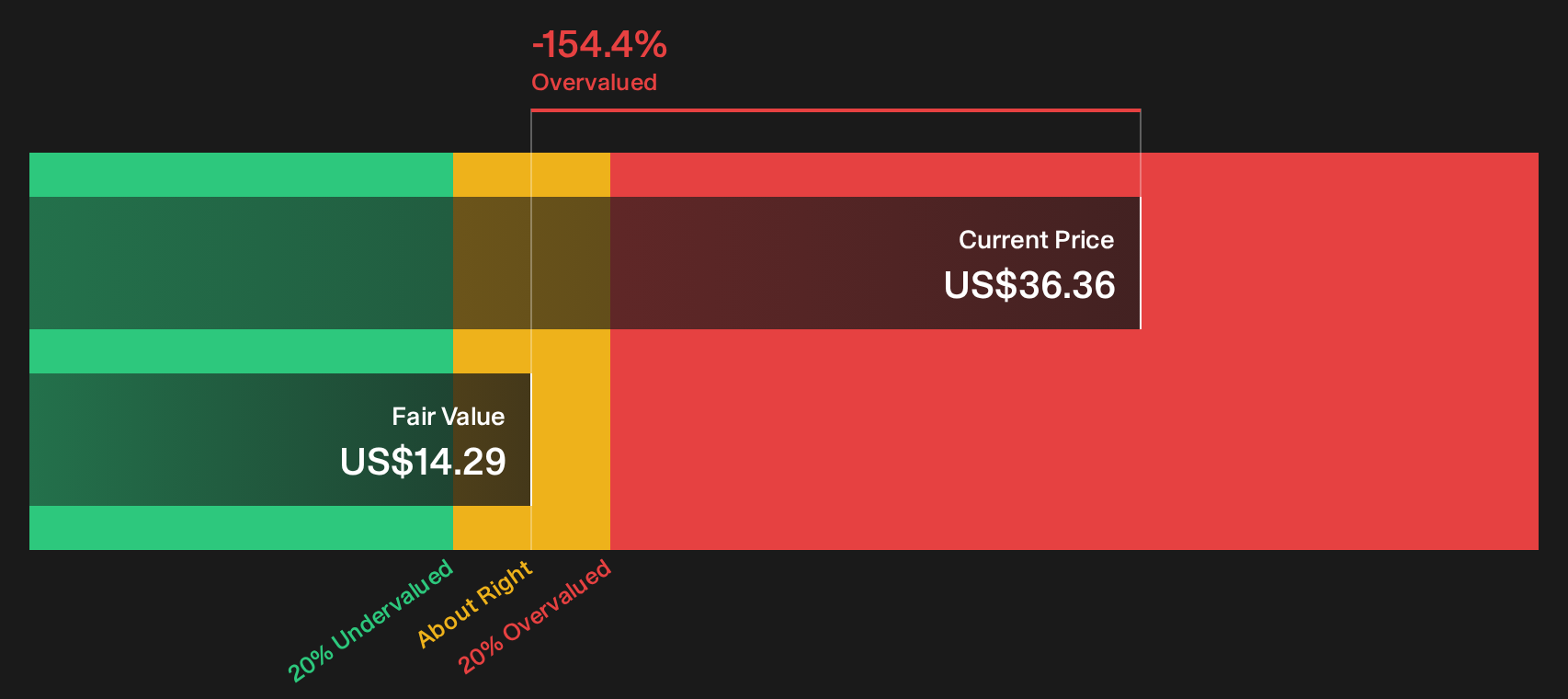
Price-based metrics cast UGI as inexpensive, yet the SWS DCF model tells a different story. On that framework, the estimated future cash flow value is $14.29 per share versus the current $36.36 price, which points to the stock trading well above that intrinsic estimate. Which lens do you trust more when cash flows and sentiment diverge this far?
Look into how the SWS DCF model arrives at its fair value.
Simply Wall St performs a discounted cash flow (DCF) on every stock in the world every day (check out UGI for example). We show the entire calculation in full. You can track the result in your watchlist or portfolio and be alerted when this changes, or use our stock screener to discover 28 high quality undervalued stocks. If you save a screener we even alert you when new companies match - so you never miss a potential opportunity.
Next Steps
Mixed messages in the valuation story for UGI, or a clear signal hiding in plain sight. Act while the data is fresh and pressure test both sides of the argument for yourself by reviewing the 4 key rewards and 2 important warning signs
Looking for more UGI-sized investment ideas?
If you stop at UGI, you miss a wider set of opportunities that might fit your risk profile, income needs, or appetite for under-the-radar ideas.
- Target reliable income streams by reviewing stocks in the 7 dividend fortresses that focus on higher-yield payouts backed by substantial underlying businesses.
- Hunt for potential mispricings by scanning the 28 high quality undervalued stocks where quality fundamentals and discounted valuations line up in the same place.
- Prioritize capital preservation and steadier compounding by focusing on the 31 resilient stocks with low risk scores which filters for resilient balance sheets and lower risk profiles.
This article by Simply Wall St is general in nature. We provide commentary based on historical data and analyst forecasts only using an unbiased methodology and our articles are not intended to be financial advice. It does not constitute a recommendation to buy or sell any stock, and does not take account of your objectives, or your financial situation. We aim to bring you long-term focused analysis driven by fundamental data. Note that our analysis may not factor in the latest price-sensitive company announcements or qualitative material. Simply Wall St has no position in any stocks mentioned.
Have feedback on this article? Concerned about the content? Get in touch with us directly. Alternatively, email editorial-team@simplywallst.com