
As Muse and Astra start the “digital workforce” era, Musk is focusing on “AI computing power supply”! SpaceX (SPCX.US) turns AI rivals into big customers
The Zhitong Finance App learned that the “AI ambition” of SpaceX (SPCX.US), the “AI+ Space Exploration” leader founded by Musk and with a market value close to 2 trillion US dollars, seems to be fully expanding from competing for the leading position in AI models to selling or leasing its huge AI computing power resources to the global AI industry. The latest report released by The Information on October 1 revealed that, according to information revealed by a series of people familiar with the matter, the self-use AI supercomputing power cluster originally serving Grok has evolved into a “Neocloud” (Neocloud) type AI computing power leasing or sale business that undertakes the needs of large AI model developers/large AI cloud computing customers such as Anthropic and Google.
According to information, SpaceX plans to launch about 420,000 Nvidia GPUs in November, expand the Memphis Minihard campus, and prepare capacity for a new agreement of about 1.1 billion US dollars per month to start in December; they also discussed computing power leases with Microsoft in the summer, but the results of the negotiations are not clear. Model contests continue to create demand, and SpaceX is trying to transform the efficient construction speed of AI computing power infrastructure, powerful power resources built around AI systems, and AI cluster operation capabilities into a strong revenue curve. This is why the market is paying more attention to SpaceX's “AI computing power valuation attributes”, driving the company's stock price to rise sharply by nearly 40% since the low in early August, and the market value is approaching 2 trillion US dollars.
The participation of Google, a subsidiary of Alphabet, is particularly significant in the AI computing power industry chain: according to the disclosed agreement, it obtained huge computing power resources such as about 110,000 Nvidia GPUs and supporting CPUs, DRAM memory/NAND data center storage systems, and agreed to pay 920 million US dollars per month from October 2026 to June 2029. Tech giants with self-developed TPU and huge cloud infrastructure also need to outsource computing capacity, which means that competition for computing power is also a competition for usable capacity and launch time.
The strong performance and future outlook recently announced by US memory chip supergiant Micron, one of the world's top three memory chip manufacturers, implemented this unprecedented investment expansion around AI infrastructure into the computing power supplier's profit statement — Micron's revenue for the fourth quarter of fiscal year 2026 was US$54.229 billion, up about 379% year over year, with adjusted earnings of US$33.42 per share; revenue guidance for the next quarter was US$61.5 billion ± 1.5 billion US dollars. The quarterly revenue of data center SSDs is close to $10 billion, more than 10 times that of the same period last year. The vast majority of HBM supplies have already been signed in 2027, and prices have increased significantly over the same period last year. Management expects storage supply and demand from 2027 to 2028 to be further tighter than the already tight record supply and demand for memory chips, which is enough to indicate that AI computing power demand is expanding the overall commercial value of the entire AI computing power supply system, including the storage layer.
The key to SpaceX's transformation is to transform previously underutilized resources into marketable services. According to a recent report from The Information, Colossus's utilization rate was once below 40% last year, and is still low this spring; Musk initially opposed leasing capacity and later accepted Anthropic's demand, including full revitalization of H100 resources, which are relatively inefficient for his own Grok training. According to The Information, the big tech company has also solved the problem of secure multi-tenant isolation of the original system. Between chip ownership and cloud service revenue, there are engineering thresholds for scheduling, software, security isolation, and customer access; beyond these thresholds, partial idleness can only be transformed into the effective supply that the industry urgently needs.
In order to speed up delivery, the company reserved gas turbines worth hundreds of millions of dollars in advance, introduced ABB robots to arrange wiring, used modular facilities for parallel construction — so-called “locking electricity in advance, compressing the construction period, and improving reliability”, and accelerated the 500MW data center with Saudi Humain. Meanwhile, Colossus II's drainage and structural problems may cause delays of at least two to three weeks, prompting SpaceX to rotate engineers and strengthen project management and reliability.
These details together strongly explain — what determines the scale of commercialization of AI computing power resources is the complete delivery capability from power supply and construction to stable operation, and this is SpaceX's advantage of efficiently integrating AI computing power resources. Customers buy computing services that can operate continuously, and the delivery capacity must cover the complete chain from power supply to cluster stability. Anthropic and Google have long been rivals of XAI (XAI has been acquired by SpaceX), founded by Musk, and are now SpaceX's largest computing power resource customers, enabling SpaceX to continue to seize the growing trend in demand for strong AI computing power brought about by multiple model ecology/intelligent systems in the AI reasoning era dominated by AI agents, increasing the utilization rate of AI computing power clusters and broadening revenue sources.
Behind the beginning of AI agents participating in enterprise business processes: a single instruction to leverage the entire AI data center
The financial disclosure shown in the latest IPO prospectus of Anthropic, a global AI model/ AI application leader, explains why SpaceX is undergoing this transformation from the AI computing power demand side. What has the most industrial significance is undoubtedly the expansion of actual computing power spending. According to Anthropic's confidential IPO prospectus previously disclosed by some media, Anthropic's revenue in 2025 is close to 4.6 billion US dollars, operating losses of 8.06 billion US dollars, and computing power and infrastructure expenses of 7.33 billion US dollars, which is about three times that of the previous year, accounting for about 58% of the total operating expenses of 12.65 billion US dollars. The data in this latest IPO prospectus shows that commercialization of cutting-edge models is simultaneously increasing revenue and consumption of computational resources, and investment in AI agent/AI big model training, inference, and infrastructure is still significantly ahead of profit delivery.
The longer-term signal comes from Anthropic's infrastructure commitments of at least $518 billion over the next ten years, of which about 80% are non-cancellable or require payment regardless of use; most Anthropic's arrangements for SpaceX/XAI up to $84.5 billion by 2029 allow cancellation with 90 days' notice. It is worth noting that these are future contractual obligations and should be understood separately from current expenses and confirmed revenue. However, these latest signs all point to the fact that the world's most advanced AI model lab is exchanging long-term promises for future capacity, and SpaceX is trying to transform the speed of construction into an increasingly strengthened supply position.
Some media quoted information revealed by people familiar with the matter as reporting that Anthropic has signed an agreement to pay up to 84.5 billion US dollars to use the AI computing power resources of SpaceX, the “AI+ Space Exploration” leader founded and led by Musk until 2029. This also means that Anthropic agreed to pay for computing power to SpaceX is close to double the previous estimate. This move also highlights that the faster the commercialization process of AI large models/AI agents focusing on proxy workflows, the more strategically valuable the computing power clusters that can be delivered in a timely manner and operate stably.
Recent advances in cutting-edge AI agent/AI model technology represented by Muse, Astra, and Anthropic Claude can be described as providing an important technical foundation for large-scale commercial expansion of AI applications into various industries and the continued surge in AI computing power requirements — in particular, the expansion of the scope of intelligent applications is expected to simultaneously increase AI superaccelerators such as AI GPUs/TPUs and AI core infrastructure requirements such as high-performance CPUs, high-performance HBM/DRAM/NAND memory chips in data centers, and high-speed optical interconnect devices.
Judging from the AI inference system architecture, GPUs and dedicated accelerators are responsible for model calculation, the CPU is responsible for converting inference results into actual operation, and memory and storage are responsible for storing and retrieving task states. Long contexts and multiple rounds of calls increase pre-populated computation and KV cache requirements; browsers, code sandboxes, retrieval, and task orchestration increase server CPU load; file, database, persistent memory, and cache layers extend requirements to server DRAM, enterprise SSDs, and high-speed networks. Nvidia's technical materials have described AI agent reasoning as an extremely large system project spanning GPU HBM, CPU DRAM, local NVMe and remote storage, as well as internal high-speed optical interconnections that are critical for data transmission.
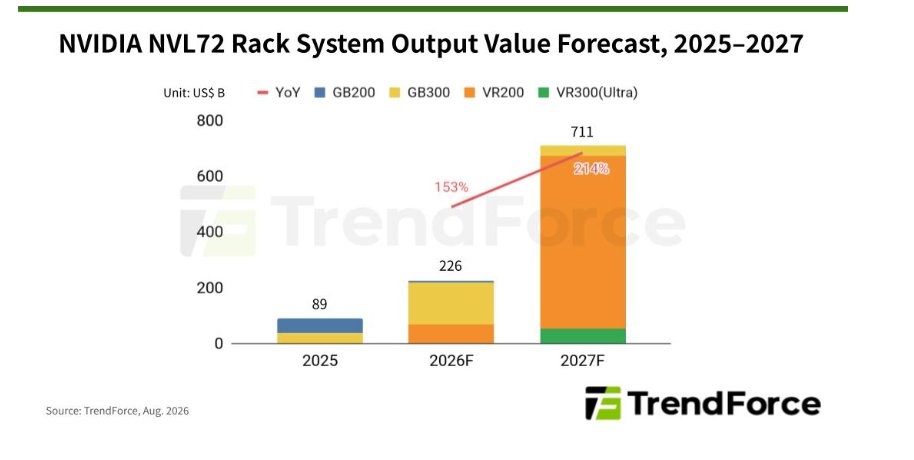
According to Anthropic management, the memory chip components of AI data center server clusters and AI GPUs are still the clearest supply bottlenecks at the AI computing power industry chain level. Market research agency TrendForce predicts that in 2026, server DRAM contract prices will increase by about 270% and enterprise-grade SSD prices will increase cumulatively by about 235%; HBM contract prices may still rise 70% to 140% in 2027, that is, they will continue to double. These data reflect the combined effects of the continued expansion of AI computing power demand and the increase in memory chip prices. TrendForce estimates also show that shipments of NVL72 racks covering Blackwell and Vera Rubin platforms are expected to increase by more than 50% year on year in 2027; the accompanying market research shows that the output value of related systems is expected to rise from about US$226 billion in 2026 to US$711 billion in 2027, a sharp increase of 214% year over year.
The core change promoted by Muse and Astra is to make the “digital labor force” a new consumer of computing power. Meta's Muse is driven by Muse Spark and has a dedicated cloud virtual machine that can continue to execute tasks after users leave the application, and an independent Sentinel agent reviews external operations; OpenAI's GPT-6 Astra provides the ability for DOTS. Each agent has a cloud computer, browser, and tools, which can handle continuous work and delegate sub-agents. A user instruction, which unfolds into a continuous process of planning, retrieval, execution, inspection, and re-reasoning.
The overall AI computing power requirement mechanism behind it can be summarized as: total inference workload = number of active users × frequency of tasks per person × number of model calls per task × calculation amount per call. Increased penetration affects the first item, while workflow automation and multi-agent collaboration expand the middle two. Anthropic's previous research report revealed that the agents in the study sample consumed about 4 times more tokens than normal chat, and the multi-agent system was about 15 times; this empirical data could not be directly applied to Muse or Astra, but it clearly showed changes in resources from “answering questions” to “completing complex human tasks with high efficiency.”
A deeper driving force for growth is the reduction in the cost of each successful task and the expansion of the scope of work that AI can undertake economically. Astra is simultaneously improving capabilities and token efficiency in some public evaluations, so the increase in demand does not require each task to consume more and more resources — that is, as long as the scale of new tasks exceeds the resource savings per task, the total computing demand will continue to expand. Furthermore, the open source and closed source AI model competition trend is jointly expanding the space required for AI computing power resources by improving quality, lowering usage thresholds, and expanding scenarios.
The “delivery kill line” of the AI frenzy: How SpaceX opened up space for imagination in a $3 trillion valuation
The accelerated popularity and penetration of AI agents around Muse and Astra is changing the resource structure of data centers. GPUs are responsible for main model computation, while CPUs run browsers, code sandboxes, tool calls, data processing and task orchestration; long contexts and high concurrency expand active KV cache requirements to drive HBM capacity and bandwidth upgrades; DDR supports virtual machines, tool processes, and partial cache offloading; and enterprise-grade SSDs carry files, long-term memory, and contextual hierarchical storage. When using cross-node pre-filling/decoding separation, the KV cache also needs to be transported through a high-speed network to expand network equipment and corresponding optical interconnection requirements. Effective computing power depends on whether the entire system can be expanded collaboratively.
This also explains why the main line of investment is spreading to CPUs, storage, and high-speed optical interconnections within data centers. On September 21, demand expectations driven by the Muse download frenzy drove AMD up about 10%, Intel about 12%, and Arm about 17%; South Korea's September data released on October 1 provided further verification of the memory chip manufacturing side (South Korea has two of the world's largest memory chip manufacturers — SK Hynix and Samsung Electronics): semiconductor exports were about US$60.3 billion, a crazy increase of 262.8% year on year; computer exports were US$7 billion, up 435.3% year on year; semiconductor equipment imports were US$3.44 billion, up 50.8% year on year. The export value is driven by both volume and price, while the increase in equipment imports shows that demand for computing power is being fully transmitted to the expansion of semiconductor production capacity.
Some Wall Street analysts have made judgments throughout the industry chain based on this trend: the unprecedented frenzy of AI in global enterprise layout is forming an “AI computing power delivery cutoff line” — the upper limit of commercial scale is increasingly dependent on how much cost, delay, and reliability an enterprise can continue to deliver how many successful tasks. SpaceX is competing for supply positions on this border by locking up electricity ahead of schedule, expanding clusters, acquiring customers, and strengthening stability. For capital markets, indicators that underlie revaluation are also materialized—namely, available electricity, on-time capacity, paid utilization, effective task throughput per megawatt, and ultimately formed cash flow.
According to information, TD Cowen, the top financial institution on Wall Street, covered SpaceX for the first time at the end of September, giving it a “buy” rating and a target price of $200, which implied a 35.1% increase from the closing price of $148.07 on October 1. The core logic is that terrestrial AI computing power leasing will be the main engine of recent growth. It is expected that related revenue will reach 66 billion US dollars in 2027, accounting for about 58% of total revenue, and contribute more than half of the revenue since the first quarter of that year. In terms of price target coverage for other Wall Street financial giants, Goldman Sachs gave a “buy” rating and a target price of 220 US dollars within 12 months, Morgan Stanley gave a “gain” and a target price of up to 300 US dollars, UBS gave a “buy” and a target price of 210 US dollars, and Bank of America gave a “buy” rating of 235 dollars.
In the sample of 37 Wall Street analysts compiled by S&P Global as of September 30, the overall rating is “buy”. The average target price for the next 12 months is $226.04, representing a potential increase of about 52.7% compared to $148.07; based on static estimates that the current total share capital of about 13.57 billion shares remains unchanged, the implied market value is about US$3.07 trillion, up from the current figure of about US$2.01 trillion. Analysts gave a core expectation corresponding to this optimistic valuation scenario. SpaceX, under Musk's leadership, is increasingly focusing on turning electricity, construction speed, and cluster operation capacity into continuous revenue to serve many AI customers.